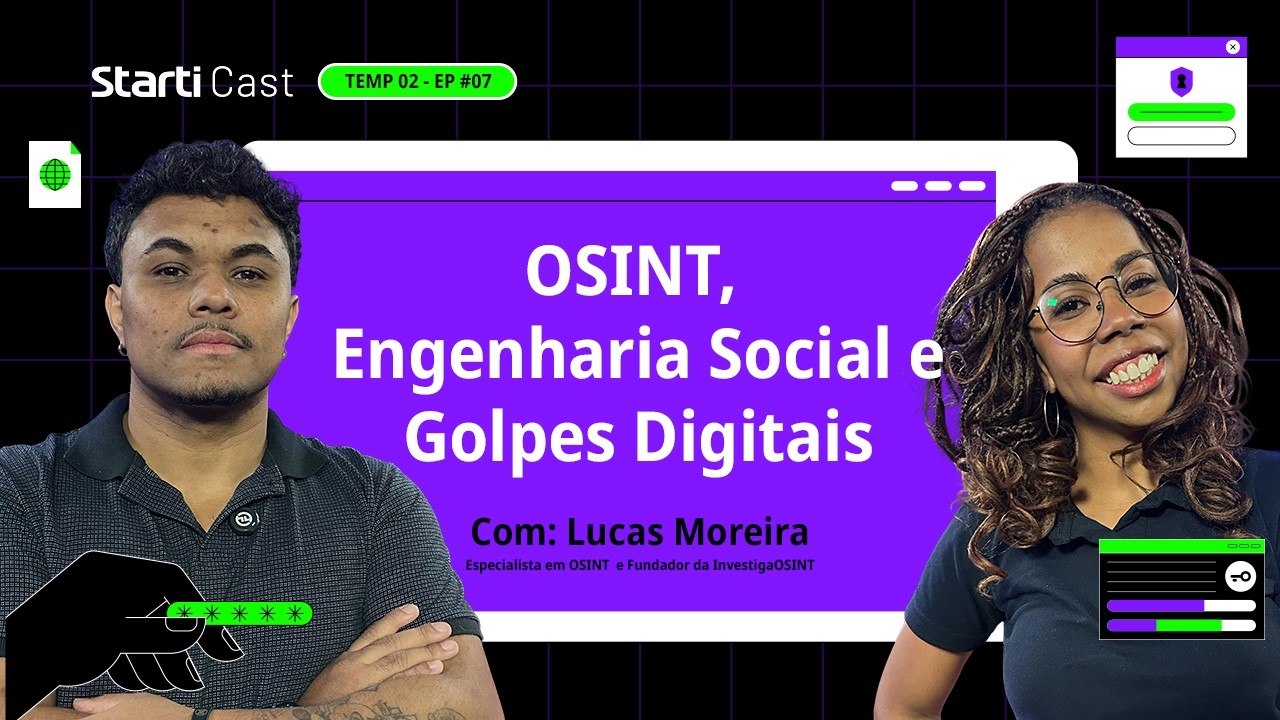
OSINT: você está sendo observado e não sabe | Starti Cast #07
Keywords
Summary
170 words
Critical Evaluation
Value of the Information & Strength of the Argument
The value of the information lies in its practical, real-world perspective on OSINT and social engineering. Lucas Moreira provides concrete examples of how attackers leverage publicly available data to target individuals and organizations, making the content highly relevant for both personal and corporate security. The argumentation is solid, as it is based on the speaker’s extensive experience and is presented in a logical, step-by-step manner. However, the discussion is largely anecdotal and lacks empirical evidence or references to specific studies or reports, which slightly weakens the overall argumentation.
Scientific Rigor, Source Quality, Title Accuracy
The scientific rigor is moderate. The content is based on expert opinion rather than peer-reviewed research, and no formal sources are cited within the video. The description provides links to various OSINT tools and resources, which are useful for practical application but do not serve as academic references. The title accurately reflects the content, focusing on OSINT and its implications for personal and corporate security. The adequacy between title and content is good, as the video delivers on its promise to explain OSINT and its risks.
189 words
Title / Content Match
The title accurately reflects the content, which focuses on OSINT and how individuals and companies are exposed online.
Quality & Reliability
7/10
The content is based on the expert testimony of Lucas Moreira, a seasoned OSINT practitioner. The discussion is practical and grounded in real-world examples, but lacks formal citations or references to academic or industry sources. The claims are plausible and align with common knowledge in cybersecurity, but the absence of verifiable sources and the conversational format limit the overall reliability.
Key Moments
Markers derived by PSI from the transcript: the creator did not define chapters.
- Introduction of Lucas Moreira and his background in OSINT and social engineering.
- Explanation of OSINT with the example of finding someone at a bar via social media.
- Discussion on how social media trends like 'who am I' can expose personal data.
- Examples of how employees' posts about their workplace can facilitate attacks.
- Explanation of the role of OSINT in penetration testing and reconnaissance.
- Discussion on how Facebook and LinkedIn are used for information gathering.
- Insights into how Twitter, Telegram, and Discord are used as sources of information.
- Advice for companies on limiting access and implementing security policies.
- Recommendation to use tools like Have I Been Pwned and password managers.
- Final thoughts on the importance of employee training and awareness.
Cited Sources
- Have I Been Pwned — Recommended for checking if emails have been leaked in data breaches.
- Firefox Monitor — Recommended for monitoring email breaches.
- Avast Hack Check — Recommended for checking email breaches.
- Have I Been Pwned - Pwned Passwords — Recommended for checking if passwords have been leaked.
- Google Password Checkup — Recommended for checking password security.
- Bitwarden — Recommended as a password manager.
- 1Password — Recommended as a password manager.
- NordPass — Recommended as a password manager.
- WhatsMyName — Recommended for finding usernames across platforms.
- Namechk — Recommended for checking username availability.
- Sherlock — Recommended for finding usernames across social networks.
- Epieos — Recommended for OSINT investigations.
Concurring Sources
- Open-source intelligence - Wikipedia — Supports the definition and scope of OSINT as described in the video.
- Social engineering (security) - Wikipedia — Corroborates the techniques and risks of social engineering discussed.
External References
Contribution & Novelties
The video provides a practical, accessible introduction to OSINT and social engineering, emphasizing the importance of understanding one’s digital footprint. It offers actionable advice for individuals and companies to reduce their exposure. The discussion is enriched by real-world examples and the speaker’s experience, making it valuable for those new to cybersecurity.
Pour aller plus loin :
- Open-source intelligence - Wikipedia — Provides a comprehensive overview of OSINT methodologies and applications.
- Social engineering (security) - Wikipedia — Explains the psychological manipulation techniques used in social engineering attacks.
- Have I Been Pwned — A practical tool to check if your email or passwords have been compromised in data breaches.
107 words
Radar Profile
The radar profile shows a balanced distribution across the four dimensions, with slightly higher scores in information quantity and quality, reflecting the video's practical content. The technical level is moderate, indicating that the content is accessible to a general audience while still providing valuable insights. The overall reliability is adequate, supported by the speaker's expertise and the practical tools recommended.
💬 Sur les 0 commentaires analysés, aucune tendance n'a pu être dégagée.