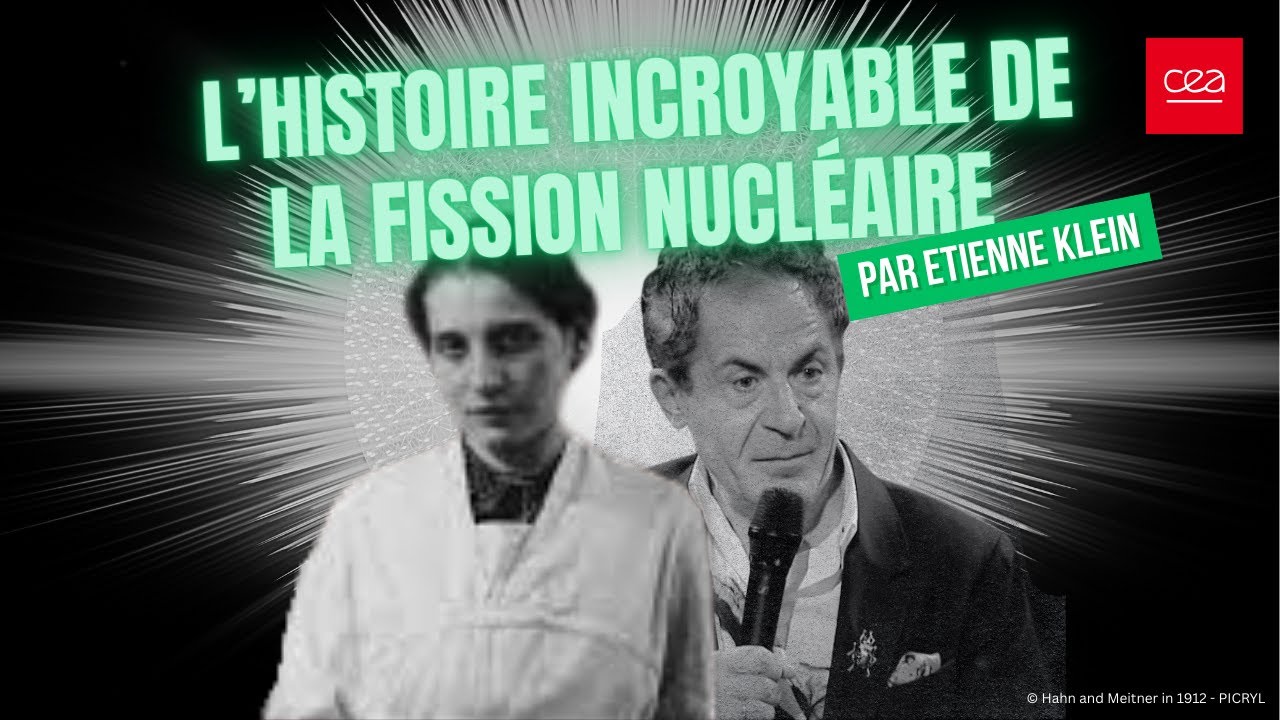
L’histoire incroyable de la fission nucléaire par Etienne Klein
Keywords
Summary
174 words
Critical Evaluation
The lecture is an excellent example of science communication, blending historical narrative with clear explanations of complex physics concepts. Klein’s expertise is evident, and he presents the material in an accessible yet rigorous manner. The argumentation is solid, as he carefully distinguishes between established facts and interpretations, and he acknowledges the contributions of various scientists, particularly highlighting the often-overlooked role of Lise Meitner. The sources cited, though not explicitly listed, are implied through the historical references and are consistent with well-known scientific literature. The title accurately reflects the content, and the lecture’s structure is logical, progressing from the ancient concept of the atom to the modern understanding of fission. One minor critique is that the lecture could have benefited from visual aids to illustrate the nuclear processes, but the verbal explanations are sufficiently clear. Overall, this is a high-quality educational resource that provides valuable insights into the history of nuclear physics.
151 words
Title / Content Match
The title accurately reflects the content, which is a detailed historical account of the discovery of nuclear fission.
Quality & Reliability
9/10
The speaker is a renowned physicist and philosopher of science, and the content is historically accurate and well-documented, with references to key scientific discoveries and figures.
Key Moments
Markers derived by PSI from the transcript: the creator did not define chapters.
- Introduction to the concept of the atom in ancient Greece and other cultures.
- Jean Perrin's 1906 experiment confirming the existence of atoms.
- Discovery that the atom is not indivisible; introduction of the nucleus and electrons.
- Explanation of the 'toothpaste argument' and the mistaken idea of protons and electrons in the nucleus.
- Discovery of the neutron by Chadwick in 1932, correcting previous misconceptions.
- Fermi's experiments bombarding elements with neutrons, leading to the idea of transuranic elements.
- Fermi's experiment with uranium and the initial claim of producing element 93.
- The naming controversy of element 93 and the political context in fascist Italy.
- Ida Noddack's hypothesis of nuclear fission, which was ignored at the time.
- Hahn and Strassmann's experiments and Meitner's theoretical explanation of fission.
Cited Sources
- CEA YouTube Channel — The video is published on the official CEA channel, which is a reliable source for nuclear science information.
Concurring Sources
- Nuclear Fission - Britannica — Encyclopedic entry confirming the historical facts presented in the lecture.
Contribution & Novelties
The lecture provides a unique narrative that emphasizes the role of Lise Meitner and the often-overlooked contributions of women in science. It also clarifies common misconceptions about the discovery process.
Pour aller plus loin :
- Lise Meitner - Wikipedia — Biographical details and her role in the discovery of nuclear fission.
- Nuclear fission - Wikipedia — Overview of the physics and history of nuclear fission.
- Enrico Fermi - Wikipedia — Information on Fermi’s experiments and contributions.
76 words
Radar Profile
The radar profile shows high scores across all dimensions, indicating a well-rounded and reliable presentation. The lecture excels in information quantity and quality, with a strong technical level and high reliability.
💬 Sur les 0 commentaires analysés, aucune tendance n'est disponible.