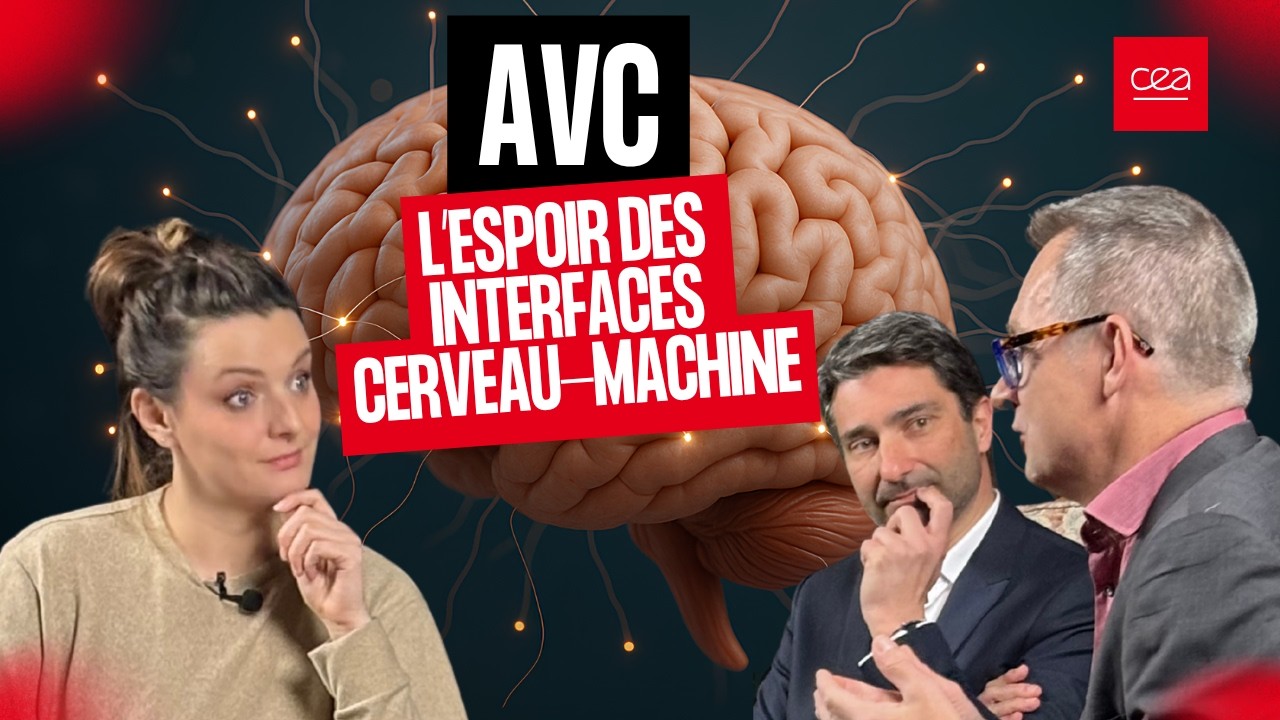
🧠AVC : l'espoir des interfaces cerveau-machine
Keywords
Summary
209 words
Critical Evaluation
The video provides a comprehensive overview of brain-machine interfaces (BMIs) for stroke rehabilitation, featuring two leading experts from the CEA. The information is presented with scientific rigor, referencing peer-reviewed publications and explaining technical concepts clearly. The discussion is well-structured, starting with the basics of BMI and progressing to specific clinical applications and future directions. The experts demonstrate a deep understanding of the field, and their explanations are accessible without oversimplifying. The use of real patient cases (Thibault and Gert-Jan) adds credibility and illustrates the practical impact of these technologies. The video also highlights the importance of interdisciplinary collaboration, as seen in the brain-spine interface project with Swiss teams. However, the video is primarily an expert opinion and does not provide a systematic review of the literature. Some aspects, such as the challenges and limitations of these technologies (e.g., long-term stability, ethical considerations), are not deeply explored. The title accurately reflects the content, focusing on hope for stroke patients. Overall, the video is a valuable resource for understanding the current state and potential of BMIs in neurorehabilitation, with a high level of scientific accuracy and clarity.
185 words
Title / Content Match
The title accurately reflects the content, focusing on hope for stroke patients through brain-machine interfaces.
Quality & Reliability
8/10
The video features two senior CEA researchers (Guillaume Charvet and Philippe Ciuciu) discussing brain-machine interfaces for stroke rehabilitation. They reference peer-reviewed publications (The Lancet Neurology 2019, Nature 2023) and explain technical aspects clearly. The content is based on established research and expert knowledge, with no obvious misinformation. However, it is primarily a discussion and not a systematic review, so a score of 8 reflects high reliability with minor limitations.
Key Moments
Markers derived by PSI from the transcript: the creator did not define chapters.
- Introduction to the topic and guests.
- Explanation of brain-machine interface components.
- Presentation of Thibault's exoskeleton control (2019).
- Discussion of Gert-Jan's brain-spine interface (2023).
- Comparison of measurement methods: intracortical, ECoG, EEG.
- Details on CEA's Wimagine implant and its advantages.
- Explanation of fMRI principles and its role.
- Discussion on decoding algorithms and AI.
- Future directions for rehabilitation after stroke.
- Conclusion and key takeaways.
Cited Sources
- The Lancet Neurology publication on exoskeleton control (2019) — Mentioned as the publication of Thibault's results.
- Nature publication on brain-spine interface (2023) — Mentioned as the publication of Gert-Jan's results.
Concurring Sources
- The Lancet Neurology publication on exoskeleton control (2019) — Supports the claim of the first tetraplegic patient controlling an exoskeleton.
- Nature publication on brain-spine interface (2023) — Supports the claim of the brain-spine interface enabling walking.
Contribution & Novelties
The video provides an expert perspective on the evolution of brain-machine interfaces from compensatory to rehabilitative applications, specifically for stroke. It highlights the CEA’s unique approach using ECoG implants (Wimagine) that balance invasiveness and signal quality, and emphasizes the importance of low-latency decoding for natural control. The discussion also integrates fMRI insights from NeuroSpin, showcasing a multidisciplinary approach.
Pour aller plus loin :
- Brain–computer interface (Wikipedia) — Provides a general overview of BMI technologies and applications.
- Electrocorticography (Wikipedia) — Details the ECoG method used by the CEA.
- Functional magnetic resonance imaging (Wikipedia) — Explains the fMRI technique discussed by Philippe Ciuciu.
- Neuroplasticity (Wikipedia) — Relevant to the rehabilitative potential of BMIs.
111 words
Radar Profile
The radar profile shows high scores in information quantity, quality, and reliability, with a slightly lower technical level, indicating a well-balanced and accessible expert discussion.