5.1 Examples for System Properties: Linearity, Time Invariance, Causality, Stability, Memory
Keywords
Summary
133 words
Critical Evaluation
Value of the Information & Strength of the Argument
The video provides clear, step-by-step explanations of system properties using concrete examples. The instructor defines each property precisely and demonstrates the verification process, which is valuable for students learning signals and systems. The argumentation is logically sound, using mathematical inequalities (e.g., triangle inequality) and definitions to justify conclusions. The interactive format allows for clarification of common misunderstandings, such as the distinction between causality and stability. The examples are well-chosen to illustrate different aspects of the properties, including systems that are not memoryless, not causal, or not time-invariant. The instructor also highlights the relationship between memorylessness and causality, and notes that for LTI systems, properties can be inferred from the impulse response, though this is not explored in detail.
Scientific Rigor, Source Quality, Title Accuracy
The video is a tutorial based on standard definitions from signals and systems theory. The instructor does not cite external sources, but the content aligns with established textbooks such as Oppenheim and Willsky’s ‘Signals and Systems’. The title accurately reflects the content, which is a set of examples for system properties. The video is a classroom recording, so the rigor is appropriate for an educational setting. The instructor corrects mistakes made during the session, demonstrating a commitment to accuracy. The description notes that the video does not cover how to determine these properties from the impulse response for LTI systems, which is a limitation but not a flaw.
241 words
Title / Content Match
The title accurately describes the content: the video provides examples to illustrate system properties including linearity, time invariance, causality, stability, and memory.
Quality & Reliability
7/10
The video is a tutorial that explains system properties through worked examples. The explanations are mathematically sound and follow standard definitions. However, the video is a classroom recording with interactive Q&A, which may introduce minor inaccuracies (e.g., initial confusion about causality). The content is consistent with standard signal processing textbooks.
Key Moments
Markers derived by PSI from the transcript: the creator did not define chapters.
- Introduction to the video and the plan to examine system properties.
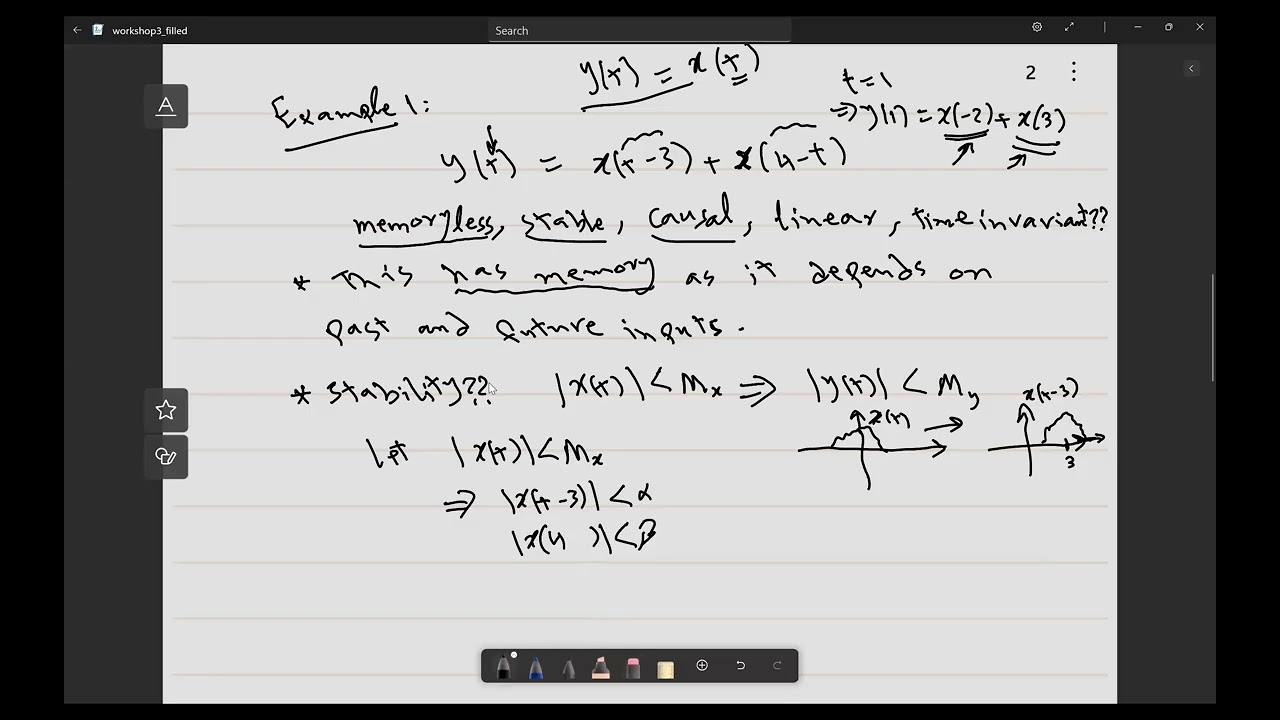
- Example 1: y(t)=x(t-3)+x(4-t). Discussion of memoryless property.
- Explanation of memoryless systems and why the system is not memoryless.
- Checking stability of Example 1 using bounded input and triangle inequality.
- Checking causality of Example 1, noting dependence on future input.
- Review of linearity and time invariance definitions; assignment to check for Example 1.
- Example 2: y(t)=cos(5t)x(t). Checking memoryless and stability.
- Checking causality and linearity of Example 2.
- Checking time invariance of Example 2, showing it is time-variant.
- Example 3: y[n]=sum_{k=-∞}^{2n} x[k]. Discussion of memoryless and stability.
- Checking causality, linearity, and time invariance of Example 3.
- Conclusion and note on LTI systems and impulse response.
Contribution & Novelties
The video provides a clear, example-driven approach to understanding system properties, which is valuable for students. It clarifies common misconceptions, such as the difference between causality and stability, and emphasizes the importance of definitions. The interactive format allows for real-time clarification of doubts.
Pour aller plus loin :
- Signals and Systems (Oppenheim & Willsky) — A standard textbook covering system properties in depth.
- Linear time-invariant system — Wikipedia article on LTI systems, including properties.
- Causal system — Wikipedia article on causality in systems.
- BIBO stability — Wikipedia article on bounded-input bounded-output stability.
92 words
Radar Profile
The radar profile shows balanced scores across information quantity, quality, technical level, and reliability, indicating a well-rounded educational resource. The high quality and technical level suggest the video is suitable for students with some background in signals and systems.