7.4 Example on applying CTFS properties to find a signal
Keywords
Summary
191 words
Critical Evaluation
Value of the Information & Strength of the Argument
The video provides a valuable educational walkthrough of CTFS properties, demonstrating their application in a detective-style problem. The argumentation is solid: each step logically follows from the previous, and the reasoning is clearly explained. The use of multiple properties (periodicity, conjugate symmetry, odd symmetry, Parseval’s relation) showcases their interconnectedness. The presentation is methodical and easy to follow, making it a useful resource for students learning Fourier series.
Scientific Rigor, Source Quality, Title Accuracy
The video is scientifically rigorous in its mathematical derivations, with no apparent errors. However, it does not cite any external sources or references; it relies solely on the instructor’s explanation. The title accurately reflects the content, which is an example of applying CTFS properties. The video is a tutorial, so the lack of citations is acceptable, but it limits the ability to verify claims independently.
147 words
Title / Content Match
The title accurately describes the content: an example applying CTFS properties to find a signal.
Quality & Reliability
8/10
The video is a clear, step-by-step tutorial on applying Continuous-Time Fourier Series properties to solve a problem. The reasoning is logical and mathematically sound, with no apparent errors. The presentation is thorough and educational, though it lacks external references or citations.
Key Moments
Markers derived by PSI from the transcript: the creator did not define chapters.
- Introduction to the example and the five clues.
- Clue 1: Signal is periodic with fundamental period 4, leading to fundamental frequency.
- Clue 2: Fourier coefficients are zero for |k|>1, reducing to three terms.
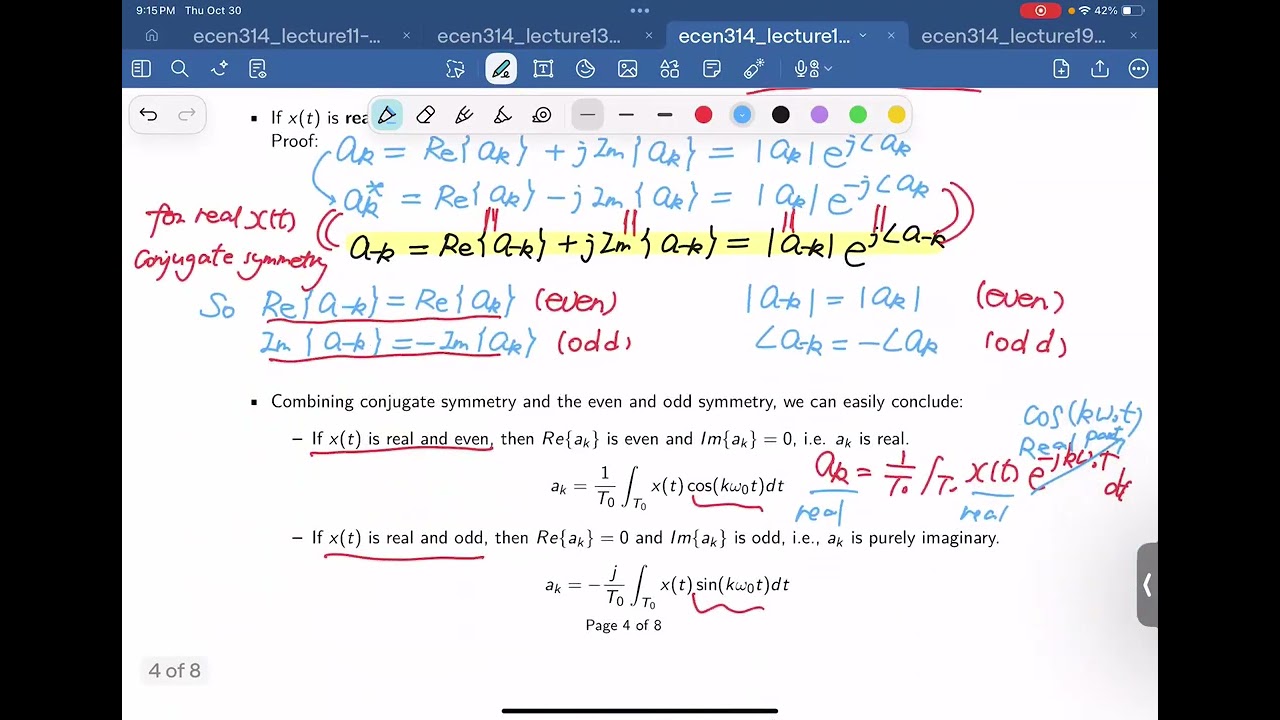
- Clue 3: Signal is real, implying conjugate symmetry.
- Clue 4: Introduction of y(t) with coefficients b_k, and its oddness.
- Derivation that a_0 = 0 and a_1 = a_{-1}.
- Clue 5: Power of the signal given as 12, leading to Parseval's relation.
- Solving for a_1 using Parseval's relation.
- Final synthesis: x(t) = ±√6 cos(π t / 2).
- Conclusion and summary of the solution process.
Contribution & Novelties
The video offers a unique pedagogical approach by presenting a problem where the signal must be deduced from clues, effectively reinforcing the properties of CTFS. It demonstrates how multiple properties can be combined to solve a problem, which is valuable for students. The step-by-step reasoning is clear and methodical.
Pour aller plus loin :
- Fourier series — Provides a comprehensive overview of Fourier series, including properties and applications.
- Parseval’s theorem — Explains the energy conservation relation used in the video.
- Continuous-time Fourier series — Details the mathematical formulation and properties.
90 words
Radar Profile
The radar profile shows high scores in quality of information and reliability, with moderate scores in quantity and technical level. This indicates a focused, well-explained tutorial that may not cover extensive breadth but provides depth in the specific example.