3.2 Example for Fast DT Convolution Sum
Keywords
Summary
140 words
Critical Evaluation
Value of the Information & Strength of the Argument
The video provides a clear and concise demonstration of a fast method for computing discrete-time convolution. The argumentation is logically structured, starting with the problem statement and then systematically applying algebraic properties of convolution. The use of the distributive and commutative properties, along with the sifting property, is well-explained and justified. The presenter also clarifies the commutative nature of convolution, which is a key point for the derivation. The explanation is rigorous and accurate, making it a valuable resource for understanding efficient convolution computation.
Scientific Rigor, Source Quality, Title Accuracy
The video is scientifically rigorous, with a correct mathematical derivation. However, it does not cite any external sources or references, which is typical for tutorial content. The title accurately reflects the content, as it focuses on a fast method for computing a discrete-time convolution sum. The video is self-contained and does not rely on external sources, which is acceptable for a tutorial. The absence of citations does not detract from the correctness of the content, but it limits the ability to verify the information independently.
184 words
Title / Content Match
The title accurately reflects the content: it demonstrates a fast method for computing a discrete-time convolution sum.
Quality & Reliability
8/10
The video presents a clear, step-by-step derivation of a discrete-time convolution using algebraic properties. The mathematical reasoning is sound and consistent with standard signal processing theory. The explanation is accurate, though it lacks formal citations or references to external sources.
Key Moments
Markers derived by PSI from the transcript: the creator did not define chapters.
- Introduction and problem statement: x[n] and h[n] are defined.
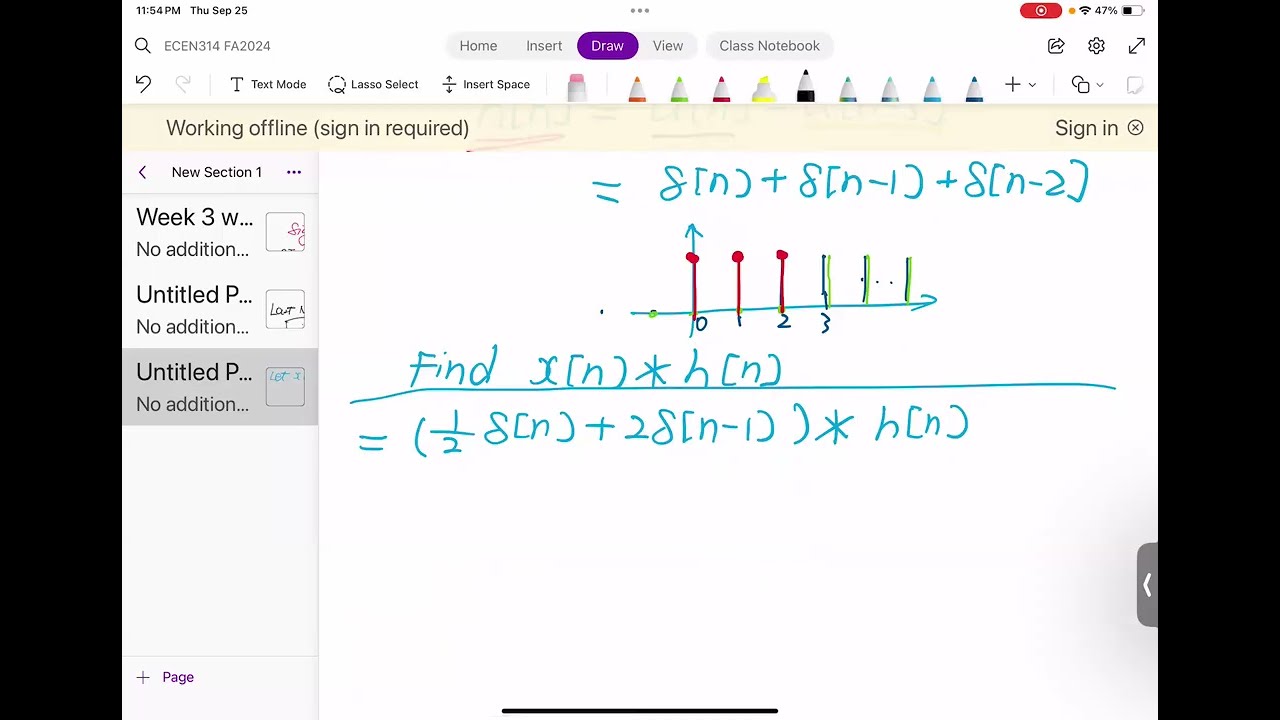
- Explanation of h[n] as a difference of step functions, resulting in three impulses.
- Rewriting x[n] as a sum of scaled and shifted impulses.
- Applying distributive property to expand the convolution.
- Introduction of the sifting property and its application.
- Using commutative property to reorder convolution terms.
- Final simplification and combining like terms to obtain the output signal.
- Conclusion and summary of the fast method.
Contribution & Novelties
The video provides a clear and efficient method for computing discrete-time convolution, which is a fundamental operation in signal processing. It emphasizes the use of algebraic properties to simplify calculations, which is a valuable technique for students and practitioners. The approach is not novel in the field, but the presentation is pedagogically effective.
Pour aller plus loin :
- Convolution — Wikipedia article on convolution, providing background and properties.
- Discrete-time Fourier transform — Related concept for frequency-domain analysis.
- Linear time-invariant system — Wikipedia article on LTI systems, which are the context for convolution.
92 words
Radar Profile
The radar profile shows high scores in quality of information and reliability, with moderate scores in quantity and technical level. This indicates a focused, accurate tutorial that provides essential information without excessive depth or breadth.