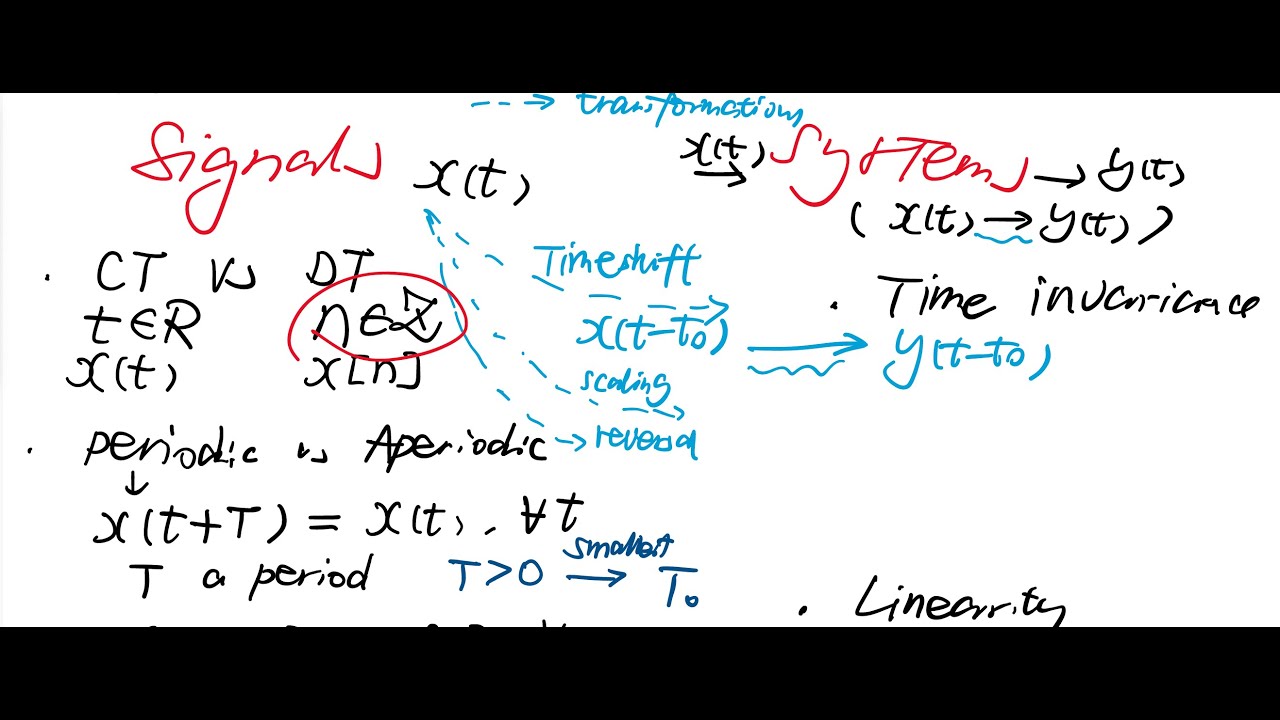
1. Examples for Basic Signals
Keywords
Summary
166 words
Critical Evaluation
Value of the Information & Strength of the Argument
The video provides valuable educational content, clearly explaining core concepts in signals and systems. The instructor uses a step-by-step approach, building from definitions to worked examples, which aids understanding. The argumentation is logically sound, with mathematical derivations presented for key results, such as the periodicity condition for discrete-time signals. The examples are well-chosen to illustrate common pitfalls, such as the order of time transformations and the non-periodicity of certain discrete-time signals. The explanation of the third example, using trigonometric identities to find the period of a product of signals, is particularly insightful. Overall, the video effectively conveys the material and reinforces learning through practical application.
Scientific Rigor, Source Quality, Title Accuracy
The video is scientifically rigorous, with accurate mathematical explanations and correct conclusions. The instructor demonstrates a strong grasp of the subject matter. However, the video does not cite any external sources, which is typical for a tutorial based on standard textbook material. The title accurately reflects the content, as the video indeed focuses on examples of basic signals. The presentation is clear and well-organized, with a logical flow from review to examples. The lack of formal citations is not a significant drawback given the educational nature of the content, but it does limit the ability to verify specific claims independently.
220 words
Title / Content Match
The title accurately reflects the content, which focuses on examples of basic signals and their properties.
Quality & Reliability
8/10
The video is a clear, well-structured tutorial on basic signals and systems concepts, with correct mathematical derivations and practical examples. The instructor demonstrates a solid understanding of the material, and the explanations are accurate. Minor limitations include a lack of formal citations and a somewhat informal presentation style.
Key Moments
Markers derived by PSI from the transcript: the creator did not define chapters.
- Introduction and review of signal types (continuous-time vs discrete-time, periodic vs aperiodic).
- Discussion of analog vs digital signals and system properties (time invariance, linearity).
- Example 1: Elementary time transformations (time shift, reversal, scaling) on a rectangular pulse.
- Explanation of the correct order of operations for time transformations, emphasizing common mistakes.
- Example 2: Periodicity of continuous-time and discrete-time sinusoidal signals.
- Derivation of the condition for discrete-time periodicity (rational multiple of pi).
- Example 3: Periodicity of a product of two discrete-time sinusoids, using trigonometric identities.
- Finding the fundamental period of the sum of two periodic signals via least common multiple.
- Conclusion and summary of key points.
Contribution & Novelties
The video provides a clear and accessible tutorial on basic signals and systems, with a focus on worked examples. It effectively demonstrates the application of theoretical concepts to practical problems, which is valuable for students. The explanation of the order of time transformations and the periodicity of discrete-time signals is particularly helpful. The video does not present new research but serves as a pedagogical resource.
Pour aller plus loin :
- Signals and Systems — Provides an overview of the field.
- Discrete-time signal — Explains discrete-time signals and their properties.
- Euler’s formula — Used in the video to derive trigonometric identities.
100 words
Radar Profile
The radar profile shows high scores in quantity and quality of information, with a slightly lower score in technical level, indicating that the content is comprehensive and accurate but may not be extremely advanced. The overall reliability is high, reflecting the correctness of the material.