6.2 CTFS Simple Example Using the Inverse Euler's Formula
Keywords
Summary
156 words
Critical Evaluation
Value of the Information & Strength of the Argument
The video provides a clear and correct demonstration of computing CTFS coefficients using Euler’s formula. The argumentation is logical: it first establishes the fundamental period, then applies Euler’s formula, and finally identifies the coefficients. The method is efficient and well-suited for signals composed of sinusoids. The explanation is accessible and reinforces the theoretical concept with a concrete example. However, the video does not discuss alternative methods or potential pitfalls, and the presentation is somewhat informal with occasional verbal hesitations.
88 words
Title / Content Match
The title accurately describes the content: a simple example of continuous-time Fourier series solved using Euler's formula.
Quality & Reliability
7/10
The video provides a clear, step-by-step derivation of CTFS coefficients for a simple periodic signal using Euler's formula. The mathematical reasoning is sound and aligns with standard signal processing theory. However, the presentation is informal and lacks rigorous formalization, and no external sources are cited.
Key Moments
Markers derived by PSI from the transcript: the creator did not define chapters.
- Introduction and problem statement: find CTFS coefficients for x(t) = cos(10πt) + cos(20πt).
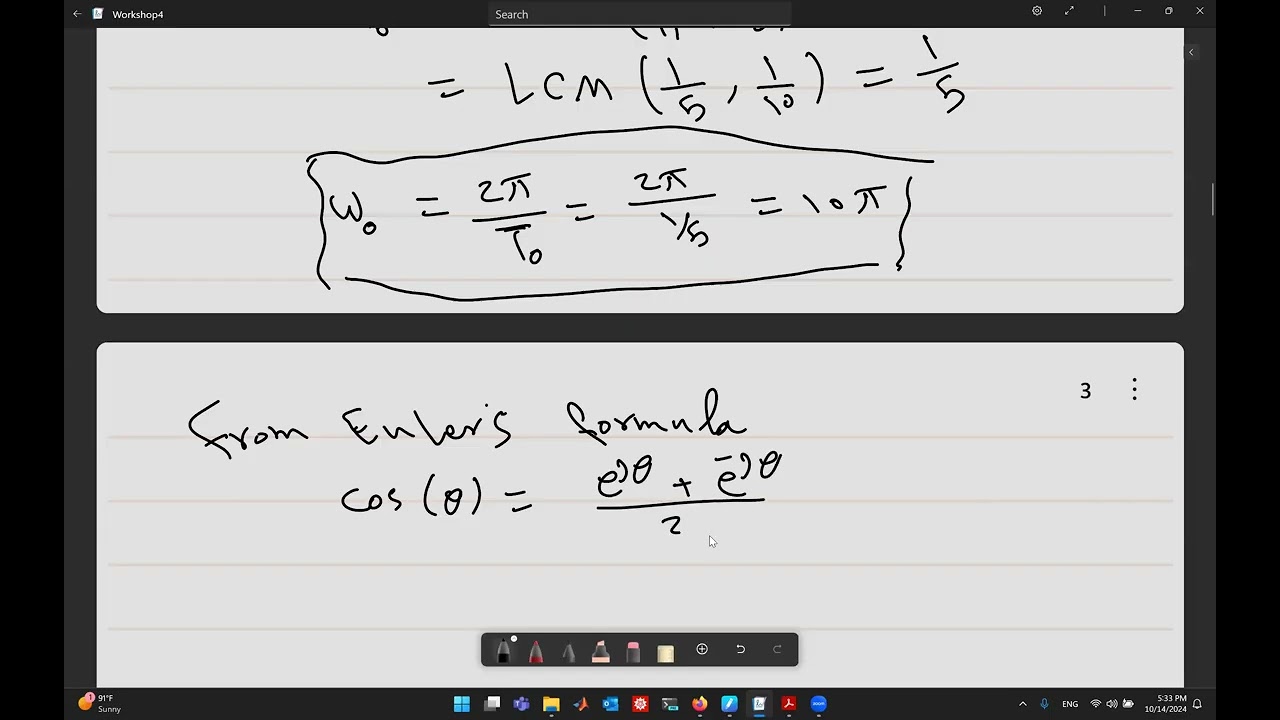
- Finding the fundamental period: T1 = 1/5, T2 = 1/10, LCM = 1/5, so ω0 = 10π.
- Applying Euler's formula to expand cosines into complex exponentials.
- Rearranging terms and identifying coefficients: a_k = 1/2 for k = ±1, ±2.
- Plotting the magnitude spectrum with impulses at ±10π and ±20π.
- Concluding that coefficients are purely real, phase zero.
Contribution & Novelties
The video offers a clear, step-by-step tutorial on computing CTFS coefficients using Euler’s formula, which is a standard technique. It is particularly useful for beginners in signal processing. The example is simple but effectively illustrates the method. The video does not introduce new concepts but reinforces foundational knowledge.
Pour aller plus loin :
- Fourier series — Provides comprehensive background on Fourier series, including Dirichlet conditions and coefficient computation.
- Euler’s formula — Explains the mathematical identity used in the video.
- Continuous-time Fourier series — Detailed treatment of CTFS, including properties and examples.
91 words
Radar Profile
The radar profile shows balanced scores across information quantity, quality, technical level, and reliability, indicating a solid tutorial with moderate depth. The video is technically accurate but not exhaustive, making it suitable for introductory learning.