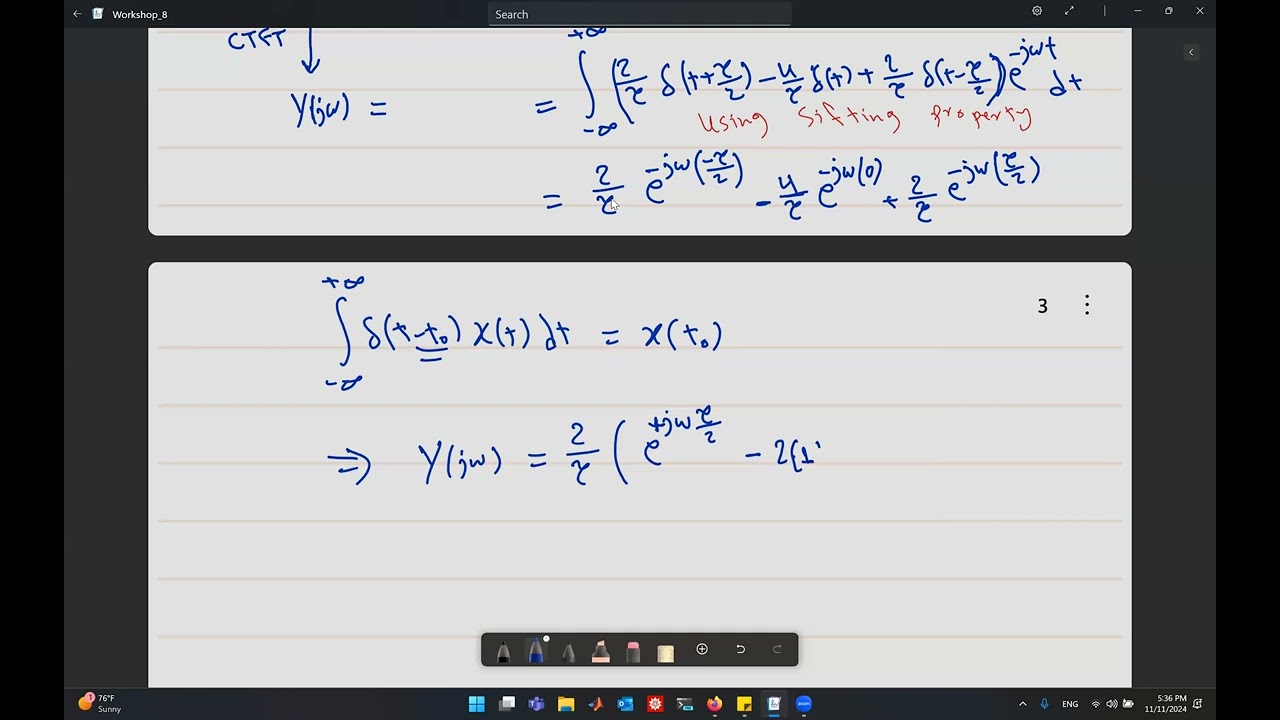
9.6 Example 5 for CTFT Using Properties: Triangle Signal
Keywords
Summary
168 words
Critical Evaluation
Value of the Information & Strength of the Argument
The video provides a valuable demonstration of using Fourier transform properties to simplify the computation of CTFTs, which is a fundamental skill in signal processing and related fields. The argumentation is logically sound: the instructor carefully applies the derivative property and the sifting property, and the final result is correctly expressed as a sinc-squared function. The step-by-step approach helps viewers understand the reasoning behind each manipulation. However, the presentation could be more rigorous, as some steps are glossed over and the notation is occasionally inconsistent (e.g., using ’to’ for the parameter). The video does not discuss alternative methods or potential pitfalls, but it effectively illustrates the power of property-based approaches.
Scientific Rigor, Source Quality, Title Accuracy
The video is a tutorial and does not cite any external sources. The mathematical content is standard and appears accurate, but the lack of references means viewers cannot verify the derivations against authoritative texts. The title accurately reflects the content, which is a specific example of CTFT computation using properties. The video is part of a broader course, but this particular segment is self-contained. The presentation is informal, with spoken explanations and handwritten notes, which may reduce perceived rigor but does not undermine the correctness of the mathematics.
213 words
Title / Content Match
The title accurately describes the content: an example of computing the CTFT of a triangle signal using properties.
Quality & Reliability
7/10
The video provides a clear, step-by-step derivation of the CTFT of a triangle signal using Fourier transform properties. The mathematical reasoning is sound and follows standard techniques. However, the presentation is informal and lacks rigorous formalization, and there are no references to external sources.
Key Moments
Markers derived by PSI from the transcript: the creator did not define chapters.
- Introduction of the triangle signal and the goal to find its CTFT.
- Mention of using properties instead of direct integration.
- Taking the first derivative of the triangle signal.
- Taking the second derivative, resulting in impulses.
- Writing the second derivative as a sum of impulses.
- Computing the Fourier transform of the impulses using the sifting property.
- Simplifying the expression using Euler's formula.
- Relating the transform of the second derivative to the original signal via the derivative property.
- Solving for X(jω) and expressing it as a sinc-squared function.
- Final result and conclusion.
Contribution & Novelties
The video provides a clear, step-by-step demonstration of using Fourier transform properties to compute the CTFT of a triangle signal, which is a common exercise in signal processing courses. The approach highlights the efficiency of property-based methods over direct integration. The originality lies in the pedagogical presentation, though the mathematical content is standard.
Pour aller plus loin :
- Fourier transform — Provides background on the Fourier transform and its properties.
- Convolution theorem — Explains the convolution property used to relate the triangle signal to rectangle signals.
- Sinc function — Defines the sinc function and its role in Fourier transforms of rectangular signals.
102 words
Radar Profile
The radar profile shows high scores in technical level and information quality, indicating a mathematically rigorous tutorial. The lower score in information quantity reflects the focused scope of the example. Overall, the video is a solid educational resource for those familiar with basic Fourier transform concepts.