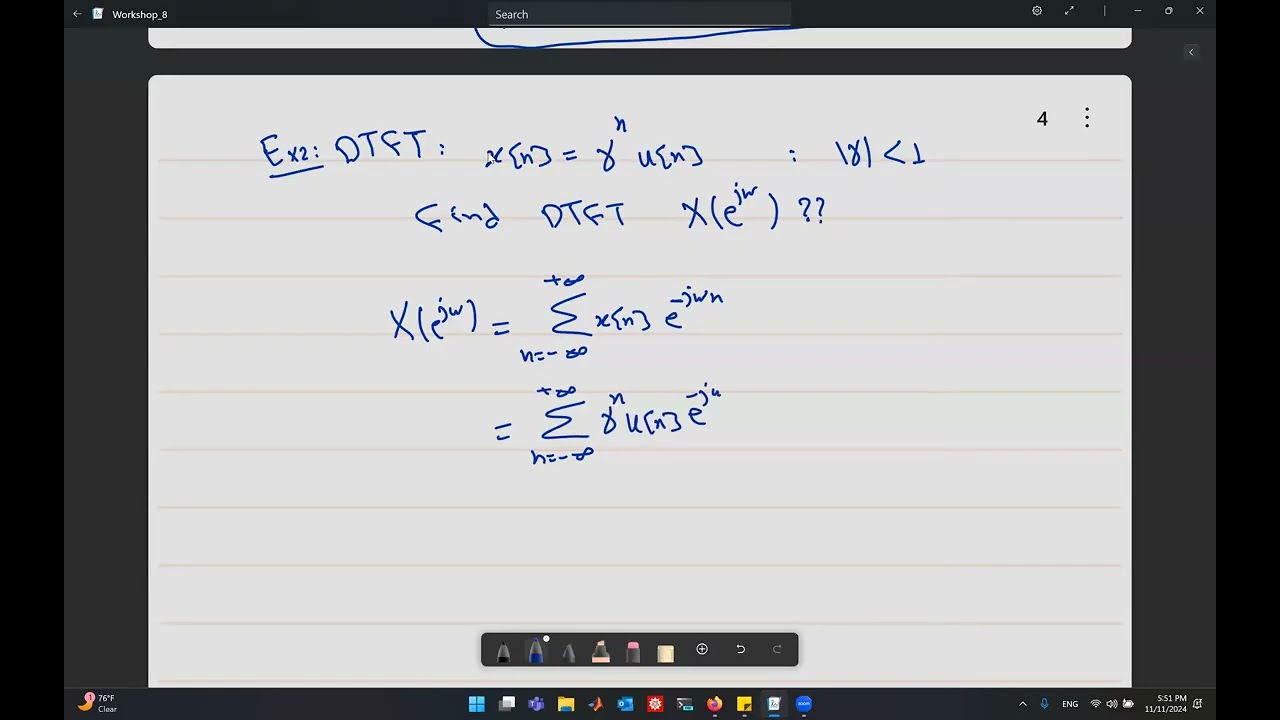
10.2 Example 1 for Discrete-Time Fourier Transform: Causal Exponential
Keywords
Summary
121 words
Critical Evaluation
Value of the Information & Strength of the Argument
The video provides a step-by-step derivation of the DTFT for a causal exponential signal, which is a fundamental result in signal processing. The argumentation is logical and mathematically sound, with careful attention to the convergence condition of the geometric series. The instructor explains the significance of this transform pair for solving inverse DTFT problems, which adds practical value. However, the presentation is informal and lacks rigorous formalization, such as explicit definitions of the DTFT and its properties. The reasoning is accessible to students with a basic background in signals and systems.
100 words
Title / Content Match
The title accurately describes the content: a worked example of the DTFT for a causal exponential signal.
Quality & Reliability
6/10
The video provides a clear derivation of the DTFT of a causal exponential signal, but lacks formal citations, references, or visual aids. The explanation is mathematically sound but presented in a conversational style with some verbal hesitations.
Key Moments
Markers derived by PSI from the transcript: the creator did not define chapters.
- Introduction and recall of continuous-time Fourier transform of exponential signal.
- Definition of the discrete-time causal exponential signal and its importance.
- Application of the analysis equation and simplification using the unit step function.
- Derivation of the geometric series and discussion of convergence condition.
- Final result and comparison with continuous-time case.
Contribution & Novelties
The video offers a clear, step-by-step derivation of the DTFT of a causal exponential signal, which is a foundational result. It emphasizes the practical use of this transform pair in solving inverse DTFT problems, which is valuable for students. However, the content is not novel; it is a standard topic covered in signal processing courses.
Pour aller plus loin :
- Discrete-time Fourier transform — Provides a comprehensive overview of DTFT properties and examples.
- Geometric series — Explains the convergence conditions and formulas used in the derivation.
- Z-transform — A related transform that generalizes the DTFT and is widely used in signal processing.
102 words
Radar Profile
The radar profile shows moderate scores across all dimensions, with slightly higher quality of information and technical level. This indicates a solid but not exceptional tutorial, suitable for students seeking a clear derivation but lacking in depth and references.