10.3 Example 2 for DTFT: Discrete-Time Noncausal Exponential
Keywords
Summary
155 words
Critical Evaluation
Value of the Information & Strength of the Argument
The video provides a clear, step-by-step derivation of the DTFT for a noncausal exponential signal, which is valuable for students learning signal processing. The argumentation is logical, but the instructor makes a mistake regarding the convergence condition, which he corrects mid-video. This correction demonstrates a thoughtful approach, but it may confuse viewers. The explanation of the geometric series and the change of variables is solid, and the final result is correct. However, the video lacks a broader context or applications, limiting its value beyond the specific example.
Scientific Rigor, Source Quality, Title Accuracy
The video is a tutorial with no external sources cited. The mathematical derivation is rigorous, but the presentation includes a minor error that is corrected. The title accurately reflects the content. There are no comments provided, so no analysis of public reception is possible.
146 words
Title / Content Match
The title accurately describes the content: a worked example of DTFT for a noncausal exponential signal.
Quality & Reliability
6/10
The video provides a step-by-step derivation of the DTFT for a noncausal exponential signal, with clear mathematical reasoning. However, the presentation includes a mistake that is corrected mid-video, and the audio quality is suboptimal. The content is accurate but lacks formal rigor and references.
Key Moments
Markers derived by PSI from the transcript: the creator did not define chapters.
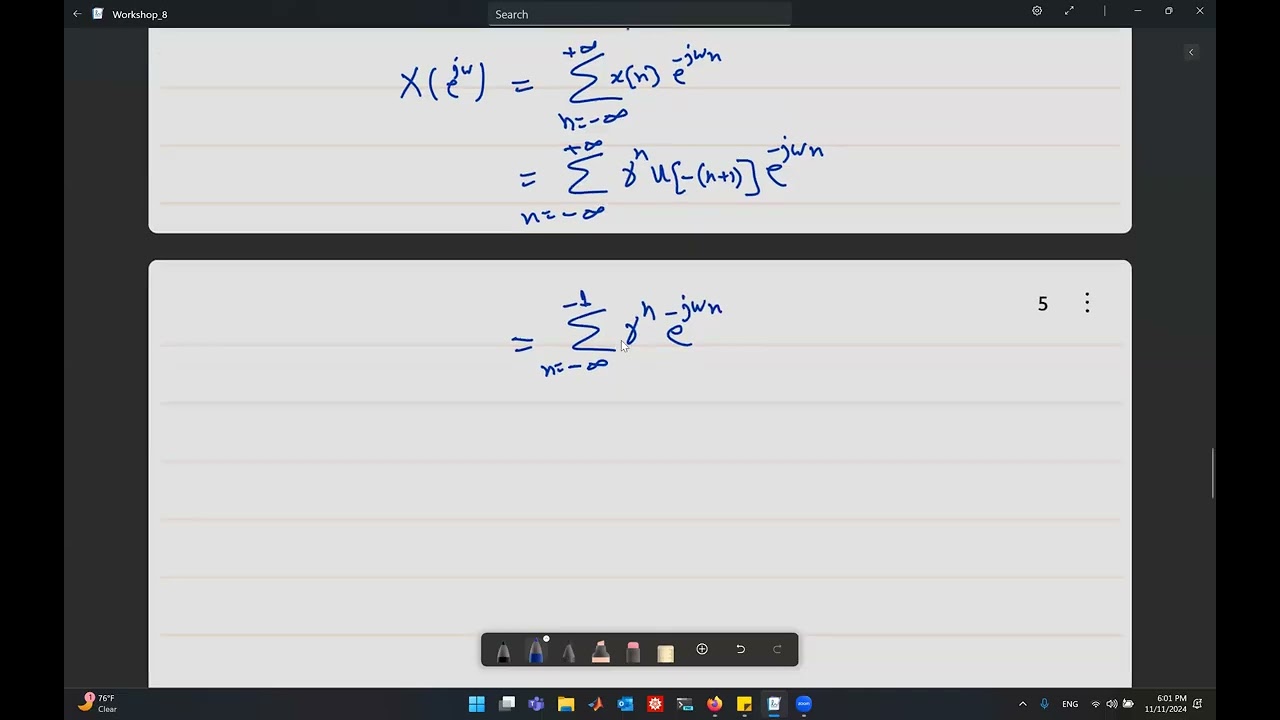
- Definition of the noncausal signal x[n] = gamma^n * u[-n+1] and explanation of its noncausal nature.
- Plotting the signal and determining the range of n where it is nonzero.
- Setting up the DTFT summation and simplifying using the unit step.
- Change of variable to m = -n to transform the sum into a geometric series.
- Correction of the convergence condition: |gamma| > 1 for the noncausal signal.
- Evaluation of the geometric series and simplification to obtain the final DTFT expression.
- Final result and brief conclusion.
Contribution & Novelties
The video provides a clear derivation of the DTFT for a noncausal exponential signal, which is a common example in signal processing courses. It highlights the importance of convergence conditions and the difference between causal and noncausal signals. The step-by-step approach is pedagogical, but the content is not novel.
Pour aller plus loin :
- Discrete-time Fourier transform — Provides background on DTFT and its properties.
- Geometric series — Essential for understanding the summation techniques used.
- Causal system — Explains the concept of causality in signal processing.
86 words
Radar Profile
The radar profile shows moderate scores across all dimensions, with a slightly higher level of technical detail. This indicates a tutorial that is informative but not exceptional in any particular aspect.