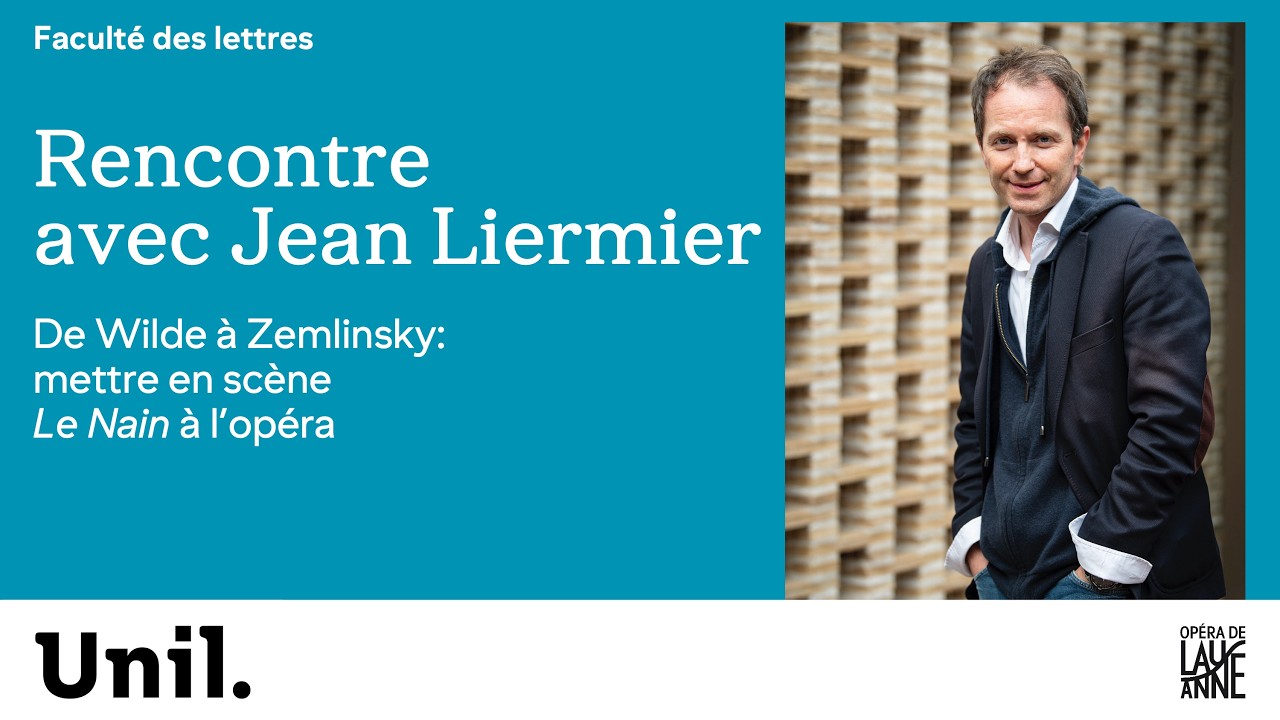
Conférence de Jean Liermier à la Faculté des lettres de l’Université de Lausanne (31 mai 2026)
Keywords
Summary
209 words
Critical Evaluation
Value of the Information & Strength of the Argument
The value of the information lies in the unique perspective of a practitioner, offering insights into the creative decisions behind an opera production. Liermier’s argumentation is coherent and grounded in his extensive experience, though it is subjective and not systematically structured. He effectively uses examples from art history to illustrate his points, making the discussion accessible and engaging. The discussion with students adds a scholarly dimension, but the primary value is in the practical, behind-the-scenes knowledge shared.
Scientific Rigor, Source Quality, Title Accuracy
The conference demonstrates a high level of rigor in its references to the source material: Wilde’s story and Zemlinsky’s opera. Liermier accurately discusses the differences between the original and the adaptation, showing a deep understanding of both. The title accurately reflects the content, and the event is well-organized with clear academic framing. However, as an expert opinion, it lacks the systematic citation of sources typical of academic work. The presence of academic moderators and the seminar context enhance its credibility.
172 words
Title / Content Match
The title accurately reflects the content: a conference by Jean Liermier at the University of Lausanne, focusing on his staging of 'Der Zwerg'.
Quality & Reliability
7/10
The conference is an expert opinion by a renowned stage director, providing insights into his creative process and artistic choices. It is not a peer-reviewed scientific study, but it is grounded in deep professional experience and references to the literary and musical sources. The discussion is moderated by academics, adding a layer of scholarly context. However, the content is subjective and lacks empirical data or systematic analysis.
Chapters
- Mot de bienvenue de Nathalie Dietschy, vice-doyenne Communication et innovation de la Faculté des lettres de l’Unil, qui a mis en place le partenariat entre la Faculté des lettres et l’Opéra de Lausanne.
- Introduction de Constance Frei, professeure en musicologie de la Section d’histoire de l’art, et Juliette Loesch, chargée de cours de la Section d’anglais.
- Conférence de Jean Liermier «De Wilde à Zemlinsky: mettre en scène «Le Nain» à l’opéra»
- Discussion avec Jean Liermier menée par Lirije Ibraimi, Delphine Martinet et Cheyenne Wildt, étudiantes de Master, ainsi que Constance Frei, professeure en musicologie de la Section d’histoire de l’art, et Juliette Loesch, chargée de cours de la Section d’anglais
- Clôture
Cited Sources
- Rencontres de la Faculté des lettres — Mentioned in the description as a source for other events.
- Bilan du séminaire Oscar Wilde on Stage — Mentioned in the description as a link to the seminar's report.
Concurring Sources
- Oscar Wilde - The Birthday of the Infanta — The original story, which the conference discusses in detail.
- Alexander von Zemlinsky - Der Zwerg — The opera, which is the subject of the conference.
Contribution & Novelties
The conference provides a rare insider view of the staging process of an opera, specifically ‘Der Zwerg’, from the perspective of a renowned stage director. It highlights the creative decisions, the adaptation from literature to opera, and the practical challenges of directing singers. The discussion with students and academics enriches the content with academic perspectives.
Pour aller plus loin :
- Oscar Wilde - The Birthday of the Infanta — The original short story that inspired the opera.
- Alexander von Zemlinsky - Der Zwerg — The opera discussed in the conference.
- Mise en scène — The concept of staging in theatre and opera.
102 words
Radar Profile
The radar profile shows a balanced performance across all dimensions, with slightly lower scores in technical level and reliability, reflecting the subjective nature of an expert opinion. The high scores in information quantity and quality indicate a rich and substantive discussion.
💬 Sur les 0 commentaires analysés, aucune tendance n'est disponible.