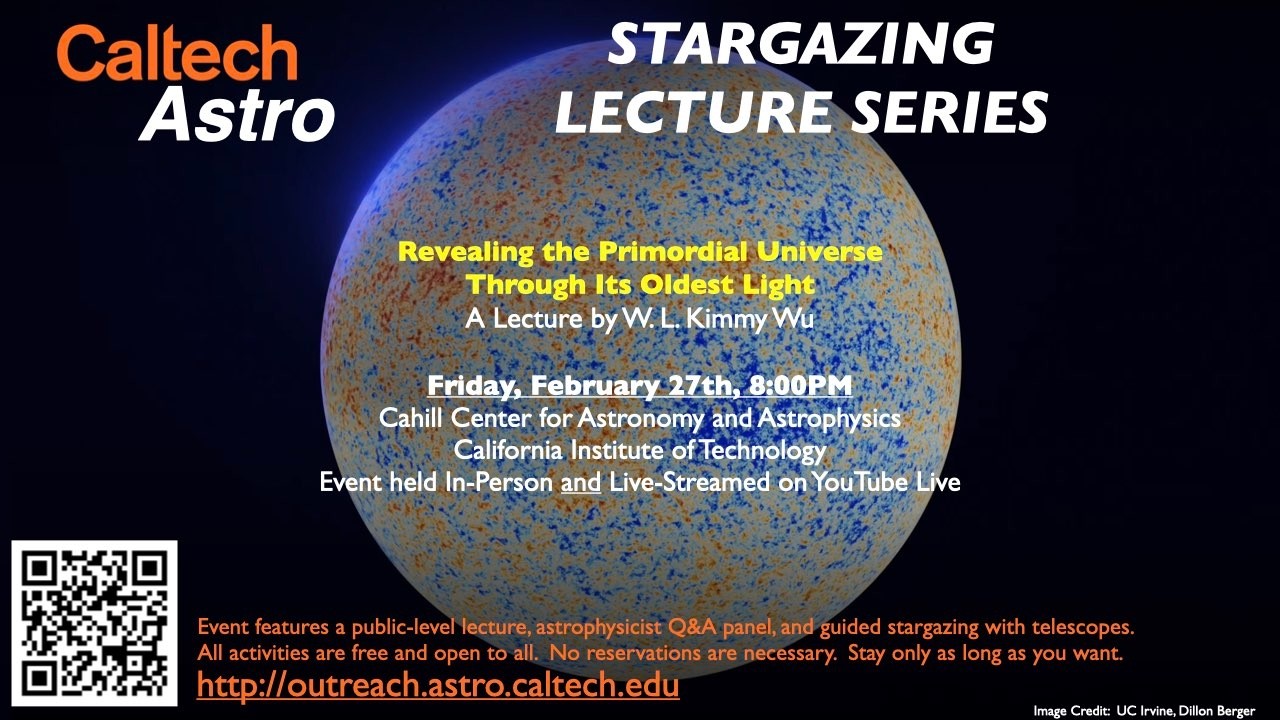
Revealing the Primordial Universe Through Its Oldest Light
Keywords
Summary
130 words
Critical Evaluation
The lecture provides a solid, accurate overview of the cosmic microwave background and its significance in cosmology. Professor Wu, an expert in observational cosmology, presents the material with clarity and appropriate depth for a public audience. The scientific content is up-to-date and aligns with current understanding, including the role of the CMB in determining the universe’s age, composition, and geometry. The Q&A session adds value by addressing common misconceptions and more advanced topics, such as the Hubble tension and the conservation of energy in an expanding universe. The panelists demonstrate expertise and provide nuanced answers. The presentation is well-structured, with clear visuals and analogies (e.g., the inflating balloon) to aid understanding. The main limitation is the brevity of the initial lecture (30 minutes), which necessarily simplifies some complex concepts. However, the extended Q&A compensates by allowing deeper exploration. The title accurately reflects the content, and the presentation is scientifically rigorous. The inclusion of a public Q&A and panel discussion enhances the educational value. Overall, this is a high-quality science communication event that effectively conveys the excitement and importance of studying the CMB.
182 words
Title / Content Match
The title accurately reflects the content, focusing on the cosmic microwave background as the oldest light and its implications for the early universe.
Quality & Reliability
8/10
The presentation is given by an expert observational cosmologist, with accurate and up-to-date information on the cosmic microwave background. The Q&A panel includes multiple astrophysicists, providing a well-rounded discussion. The content is consistent with established scientific knowledge, though some topics (e.g., Hubble tension) are simplified for a general audience.
Chapters
- Announcements
- Introduction of Presenter
- Oldest Light Presentation
- Oldest Light Q&A
- "Why do CMB photons lose energy after they're emitted in the early universe?"
- "Why is the CMB a sphere around us?"
- "What came before the Big Bang?"
- "Do we only see the small fraction of CMB photons coming towards us here on Earth?"
- "Can we not see before the Big Bang because it was too hot?"
- Intermission
- Q&A Panel Introductions
- "How do you differentiate between the CMB and light from intervening matter?"
- "What assumptions go into deriving the age of the universe from the CMB?"
- "Does the loss of energy due to cosmological redshift violate the conservation of energy?"
- "Are there upcoming telescopes that will help with CMB discoveries?"
- "Why is the CMB not totally uniform / homogenous?"
- "Is the universe more likely to end or keep expanding?"
- "Tell us more about microwave radiation."
- "What are your thoughts about the current proposed budget cuts to science?"
- "Are dark matter and dark energy also expanding with the universe?"
- "Is it accurate to think of the expanding universe as an inflating balloon?"
- "Are all momentum, angular momentum, and energy conserved from the initial Big Bang?"
- "What is causing the Hubble Tension?"
- "Why do we have matter and not anti-matter or just energy in the universe?"
- "If the CMB is emitted at 400,000 years, how do we know about the first 3 minutes after the Big Bang?"
- "Is it accurate to calculate distance with redshift?"
- "In the past, did matter behave different because the universe was more compressed?"
- "Would we be able to tell the difference between a galaxy made of anti-matter vs matter?"
- "Do the current cosmological measurements support an open or closed model for the universe?
- "If there is a relationship between SN Ia and the age of its stellar population, how would it affect measurements of the Hubble constant?"
- "How do we measure the energies of quantum fluctuations?"
- Concluding Remarks
Cited Sources
- Caltech Astro YouTube Channel — Related video from the same channel, possibly another lecture.
- Caltech Astro YouTube Channel — Related video from the same channel, possibly another lecture.
Concurring Sources
- Planck Collaboration — ESA's Planck mission provided high-precision measurements of the CMB, consistent with the lecture's content.
Contribution & Novelties
The lecture provides a clear and accessible explanation of the cosmic microwave background and its role in understanding the early universe. It emphasizes the importance of precise measurements and future experiments. The Q&A session offers valuable insights into current research questions, such as the Hubble tension and the nature of dark matter and dark energy.
Pour aller plus loin :
- Cosmic Microwave Background (Wikipedia) — Comprehensive overview of the CMB, its discovery, and scientific significance.
- Hubble’s Law (Wikipedia) — Explanation of the expansion of the universe and redshift.
- BICEP and Keck Array (Wikipedia) — Details on the experiments mentioned for observing the CMB.
- South Pole Telescope (Wikipedia) — Information on the telescope used for CMB observations.
- CMB-S4 (Official site) — Future ground-based CMB experiment discussed in the lecture.
128 words
Radar Profile
The radar profile shows high scores in quantity and quality of information, with a moderate technical level, indicating a well-balanced presentation suitable for a general audience while maintaining scientific depth.