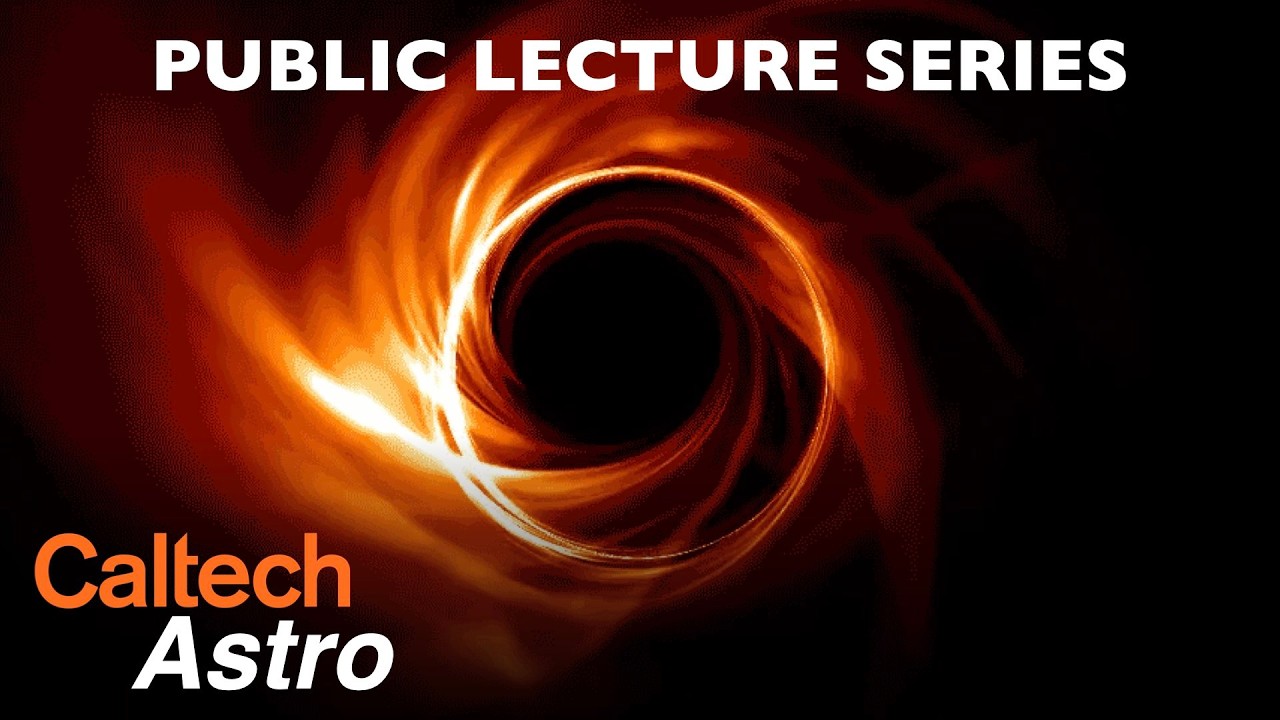
Black Holes, Dark Matter, and AI: Imaging the Hidden Universe - Katie Bouman - 05/29/2026
Keywords
Summary
160 words
Critical Evaluation
The lecture is an excellent example of science communication, providing a clear and engaging overview of cutting-edge astrophysics research. Katie Bouman, a key figure in the EHT collaboration, demonstrates deep expertise and communicates complex concepts effectively. The content is scientifically rigorous, with accurate explanations of general relativity, interferometry, and computational imaging. The discussion of uncertainty in image reconstruction is particularly valuable, as it addresses a common misconception that there is a single ’true’ image. Bouman’s emphasis on the role of AI and machine learning is timely and well-justified, and she appropriately notes the need for validation and caution. The Q&A session adds depth, with panelists providing additional perspectives on topics like dark matter and the fate of the universe. The sources cited are primarily the EHT collaboration’s published results, which are peer-reviewed and highly reliable. The title accurately reflects the content, and the presentation is well-structured. The only minor weakness is that some technical details may be challenging for a general audience, but the speaker does an excellent job of making the material accessible. Overall, this is a high-quality, informative, and inspiring lecture that showcases the power of interdisciplinary science.
190 words
Title / Content Match
The title accurately reflects the content: the lecture covers black hole imaging, dark matter, and AI techniques, as presented by Katie Bouman.
Quality & Reliability
9/10
Lecture by a leading expert (Katie Bouman) with high scientific credibility, based on established research (EHT). The content is well-structured, technically accurate, and includes a Q&A session with multiple experts. The presentation is clear and rigorous, with appropriate caveats about uncertainty and AI methods.
Key Moments
Markers derived by PSI from the transcript: the creator did not define chapters.
- Start of presentation on black holes and imaging challenges
- End of presentation and start of Q&A with audience
- Intermission and transition to panel Q&A
- Panel introductions and start of extended Q&A
- Question about the fate of the universe
- Question about biggest challenges in EHT imaging
- Question about diffusion models and data noise
- Question about validating AI outputs
- Question about imaging black hole jets
- Question about source of light in EHT images
Cited Sources
- Event Horizon Telescope Collaboration — Official website of the EHT collaboration, which produced the first black hole images.
- First M87 Event Horizon Telescope Results — Peer-reviewed paper presenting the first image of the M87 black hole.
- First Sagittarius A* Event Horizon Telescope Results — Peer-reviewed paper presenting the first image of the Milky Way's central black hole.
Concurring Sources
- Event Horizon Telescope Collaboration — The EHT collaboration's official results and publications align with the lecture's content.
- First M87 Event Horizon Telescope Results — Peer-reviewed paper confirming the black hole shadow and supporting the lecture's claims.
Contribution & Novelties
The lecture provides an accessible yet detailed explanation of how computational imaging and AI are used to reconstruct images of black holes from sparse interferometric data. It emphasizes the importance of embracing uncertainty and using multiple algorithms to explore the space of possible images. The discussion of diffusion models and their application to astronomical imaging is particularly novel and highlights the cutting-edge nature of the research.
Pour aller plus loin :
- Event Horizon Telescope — Official site with images, videos, and educational resources.
- Very Long Baseline Interferometry — Technique used by EHT to combine telescopes.
- Diffusion Models in Machine Learning — Overview of diffusion models, which are increasingly used in image generation and reconstruction.
114 words
Radar Profile
The radar profile shows high scores across all dimensions, indicating a well-rounded and reliable presentation. The lecture excels in both information quality and technical depth, with a strong emphasis on rigorous scientific methods. The only slightly lower score is in technical level, which is still high, reflecting the accessibility of the content to a general audience.
💬 No comments were provided for analysis.