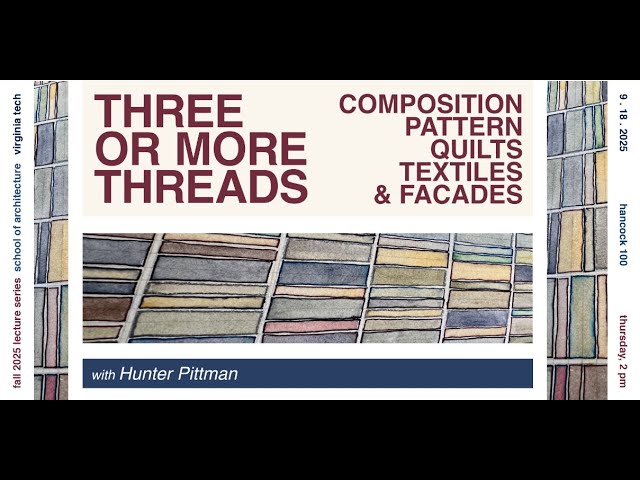
Fall 2025 Lecture Series | Hunter Pittman: Three or More Threads
Keywords
Summary
218 words
Critical Evaluation
Value of the Information & Strength of the Argument
The lecture offers valuable insights into architectural composition and the philosophical underpinnings of the discipline. Pittman’s argument for reconciling instrumentality and representation is well-articulated, drawing on historical sources and personal experience. He effectively uses case studies from previous lectures to illustrate different compositional strategies, highlighting the tension between pure ideas and material constraints. The concept of ‘personal density’ is compelling and provides a practical framework for students to think about their own intellectual development. The argumentation is coherent and persuasive, though it relies heavily on anecdotal evidence and personal reflection rather than systematic analysis.
Scientific Rigor, Source Quality, Title Accuracy
Pittman demonstrates intellectual rigor by referencing classical and contemporary thinkers such as Quintilian, Dalibor Vesely, and Alan Jacobs. He accurately cites Vesely’s 1985 essay and Jacobs’s book, and his interpretations are generally faithful. However, the lecture lacks formal citations and does not provide specific references for all claims. The title ‘Three or More Threads’ is apt, as the lecture weaves together multiple themes, but it is somewhat vague. Overall, the sources are credible and used appropriately, though the presentation is more conversational than academic.
193 words
Title / Content Match
The title 'Three or More Threads' accurately reflects the lecture's structure, which weaves together multiple themes: composition, personal density, and the stochastic nature of architecture.
Quality & Reliability
7/10
The lecture is a personal and reflective discourse by an experienced architect and educator, drawing on historical and philosophical references (e.g., Vesley, Quintilian) and personal practice. It is not a formal academic presentation with rigorous citations, but it demonstrates deep expertise and coherent argumentation. The sources mentioned are credible but not systematically referenced.
Key Moments
Markers derived by PSI from the transcript: the creator did not define chapters.
- Introduction to the lecture and the watercolor paintings, described as an obsession.
- Discussion of the concept of techné and its historical roots, referencing Vesley's essay.
- Introduction of 'stochastic techné' from Quintilian and its relevance to architecture.
- Analysis of previous lectures' projects (Campbell Hall, Marcus's house, Frank's arc) in terms of composition.
- Discussion of Alan Jacobs's book 'Breaking Bread with the Dead' and the concept of 'personal density'.
- Encouragement for students to cultivate their own personal density and intellectual life.
- Conclusion and final reflections on the importance of maintaining one's own creative practice.
Cited Sources
- Architecture in the Conflict of Representation — Essay by Dalibor Vesely, cited in the lecture to discuss the split between instrumentality and representation.
- Breaking Bread with the Dead — Book by Alan Jacobs, discussed in the lecture for its concept of 'personal density'.
- The Hedgehog Review — Journal edited by Alan Jacobs, mentioned as a source of his writings.
Concurring Sources
- Architecture in the Conflict of Representation — Vesely's essay aligns with the lecture's discussion of the art/science split in architecture.
- Breaking Bread with the Dead — Jacobs's book supports the lecture's emphasis on engaging with the past to build personal density.
Contribution & Novelties
The lecture provides a unique perspective on architectural composition by connecting it to the philosophical concept of techné and the practical notion of ‘personal density’. It offers a framework for students to think about their own intellectual development and resilience in the face of professional pressures. The idea of ‘stochastic techné’ is particularly novel, highlighting the inherent uncertainty in architectural practice.
Pour aller plus loin :
- Techné (Wikipedia) — Provides background on the Greek concept of craft and knowledge.
- Dalibor Vesely (Wikipedia) — Information on the architectural theorist cited in the lecture.
- Alan Jacobs (Wikipedia) — Overview of the author and his works, including ‘Breaking Bread with the Dead’.
109 words
Radar Profile
The radar profile shows a balanced lecture with strong scores in information quality and reliability, but slightly lower in technical depth and quantity of information. This reflects a reflective and philosophical approach rather than a data-heavy presentation.
💬 No comments were provided for analysis.