Spring 2026 Lecture Series | IAWA Symposium Keynote
Keywords
Summary
185 words
Critical Evaluation
Value of the Information & Strength of the Argument
The lecture provides valuable insights into the under-documented history of women architects in Soviet Ukraine. It offers a nuanced analysis of the gender dynamics within the profession, showing how initial progress was undermined by later state policies and how women’s work in certain areas (e.g., serial housing, rural planning) was systematically devalued. The argumentation is solid, based on extensive archival research and a critical approach to sources. The speaker acknowledges the limitations of the archive and the difficulty of reconstructing biographies, which strengthens the credibility of the presentation. The use of specific examples and case studies makes the argument concrete and compelling.
Scientific Rigor, Source Quality, Title Accuracy
The lecture demonstrates high scientific rigor. The speaker cites specific archival documents, journals, and publications, and is transparent about the gaps in the historical record. The sources are primarily primary sources from the 1930s and later, and the speaker critically evaluates them. The title accurately reflects the content, as it is a keynote lecture in a symposium series. The lecture does not rely on external sources beyond the speaker’s own research, but the research itself is well-documented and credible.
196 words
Title / Content Match
The title accurately reflects the content: a keynote lecture in a spring lecture series, part of an IAWA symposium.
Quality & Reliability
8/10
The lecture is based on original archival research, presented by a PhD architectural historian. The speaker cites specific archives, journals, and documents, and acknowledges the limitations and silences in the historical record. The presentation is well-structured and critically engages with sources, though some claims rely on secondary sources and the speaker's interpretations.
Key Moments
Markers derived by PSI from the transcript: the creator did not define chapters.
- Introduction and welcome by Paula, introduction of Christine Fallon and the prize.
- Christine Fallon's remarks and introduction of Kate Mallaya.
- Kate Mallaya begins her presentation, posing the central question about the lack of recognition for Soviet Ukrainian women architects.
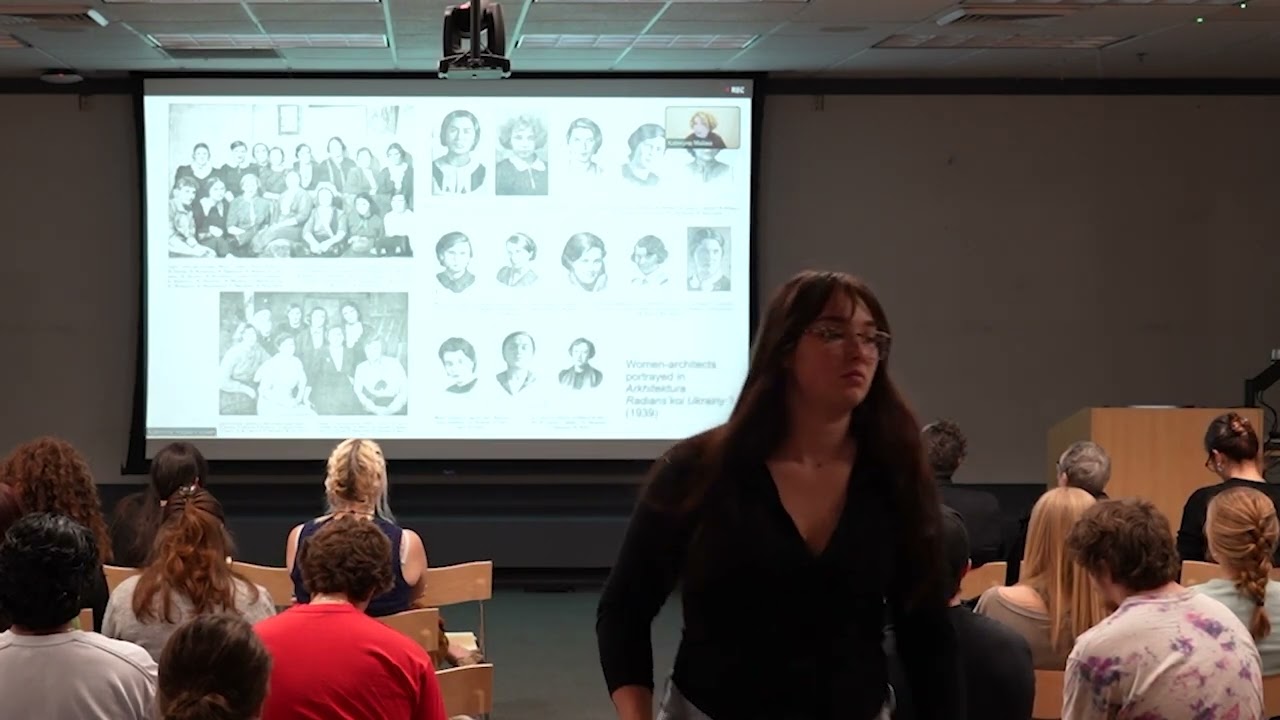
- Discussion of the 1939 special issue of 'Architecture of Soviet Ukraine' and the entry of women into the profession.
- Case study of Isir Bonstein, an Odessa architect, and the challenges of tracing her career.
- Case study of Tamara Kobo, focusing on her childcare designs and the shift in Soviet gender policy.
- Discussion of the school building campaign and the role of women in serial design.
- Impact of World War II on women architects and their postwar careers.
- Case studies of Nina Manuchara and Fania Militka, illustrating different paths in research and practice.
- Discussion of the Academy of Architecture and the turn to research, and the colonial twist in the erasure of women's contributions.
- Conclusion and Q&A session.
Cited Sources
- Venus in Two Acts — Referenced by Saidiya Hartman, discussing the challenge of constructing history from archival silences.
- Architecture of Soviet Ukraine (journal) — 1939 special issue dedicated to International Women's Day, highlighting women architects.
- Taking the Soviet Union Apart Room by Room — Kate Mallaya's book, published by Cornell University Press, 2023.
- Mass Housing in Ukraine — Kate Mallaya's book, published by DOM Publishers, September 2024.
- Protests Beyond the Plaza — Co-edited volume by Kate Mallaya and Nathan Mark Hudson, published by Routledge, February 2026.
Concurring Sources
- International Archive of Women in Architecture — The archive that sponsored the research and houses related materials.
Contribution & Novelties
This lecture contributes original research on a largely overlooked group of women architects in Soviet Ukraine. It not only recovers the names and careers of several individuals but also critically examines the reasons for their erasure, including the nature of their work (serial, collective, rural), the impact of war, and the politics of memory. The concept of ‘archival silences’ is applied to architectural history, offering a methodological framework for future research.
Pour aller plus loin :
- International Archive of Women in Architecture (IAWA) — The archive that sponsored this research, containing resources on women in architecture.
- Women in Architecture (Wikipedia) — Overview of the historical contributions and challenges of women in the field.
- Saidiya Hartman’s ‘Venus in Two Acts’ — The essay referenced in the lecture, discussing archival silences and the writing of history.
134 words
Radar Profile
The radar profile shows high scores in information quantity, quality, and reliability, with a slightly lower score in technical level, indicating that the content is accessible to a general audience while maintaining scholarly depth.