La investigación hoy, aportes y desafíos: Inteligencia artificial en contexto académico
Keywords
Summary
176 words
Critical Evaluation
Value of the Information & Strength of the Argument
The video provides valuable insights into AI from an academic perspective, covering both technical foundations and practical applications. The argumentation is solid, with speakers grounding their explanations in scientific concepts and examples. Cabana’s explanation of language models is particularly clear and accessible, using analogies to illustrate complex ideas. The discussion on ethical and pedagogical implications is well-reasoned, though some points are presented as opinions rather than evidence-based claims. Overall, the content is informative and thought-provoking, encouraging critical reflection on AI’s role in academia.
92 words
Title / Content Match
The title accurately reflects the content, which discusses AI research contributions and challenges in an academic context.
Quality & Reliability
8/10
The video features expert speakers from academic and educational institutions, providing a balanced and critical overview of AI in academia. Claims are supported by examples and references to ongoing research, though some statements are anecdotal and not fully sourced.
Key Moments
Markers derived by PSI from the transcript: the creator did not define chapters.
- Introduction and welcome by Marcela Shen and Nacho Esteban, outlining the cycle of activities.
- Álvaro Cabana begins his presentation on the fundamentals of generative AI and language models.
- Cabana explains how language models predict the next word and the concept of training.
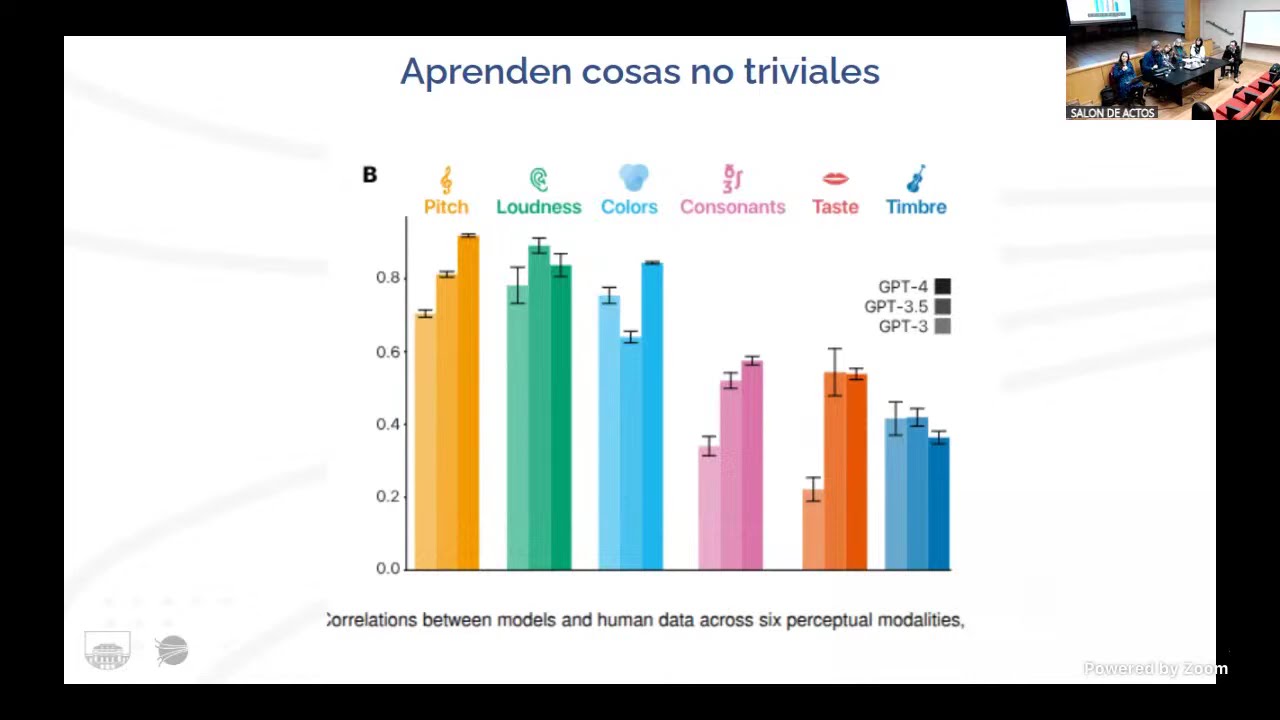
- Discussion on the similarities between AI representations and human cognition, including color perception and brain activity.
- Cabana addresses the limitations and ethical challenges of AI, including potential for fraud and the digital divide.
- Isabel Amigo presents on AI in education, emphasizing ethical use and the AI Manifesto.
- Adriana Miniño and Alicia Díaz Costoff provide practical guidance on AI tools for academic research.
- Q&A session with the audience, addressing questions and concerns about AI in academia.
Cited Sources
- Small World of Words — Mentioned by Álvaro Cabana as his international project on lexical processing.
- AI Manifesto — Referenced by Isabel Amigo in the context of ethical AI use in education.
Concurring Sources
- Small World of Words — Referenced by the speaker as a project related to lexical processing.
Contribution & Novelties
The video offers a multidisciplinary perspective on AI in academia, combining technical explanations with educational and library science insights. It emphasizes the need for critical reflection and ethical considerations. The discussion on the neural correlates of language models is particularly novel, bridging AI and neuroscience.
Pour aller plus loin :
- Large language model — Provides a comprehensive overview of LLMs, their architecture, and applications.
- Transformer (machine learning) — Explains the transformer architecture that underpins modern LLMs.
- AI ethics — Discusses ethical considerations and frameworks for AI development and use.
89 words
Radar Profile
The radar profile shows high scores in information quantity, quality, and technical level, indicating a dense and well-structured presentation. The global reliability is also high, reflecting the expertise of the speakers and the academic setting.