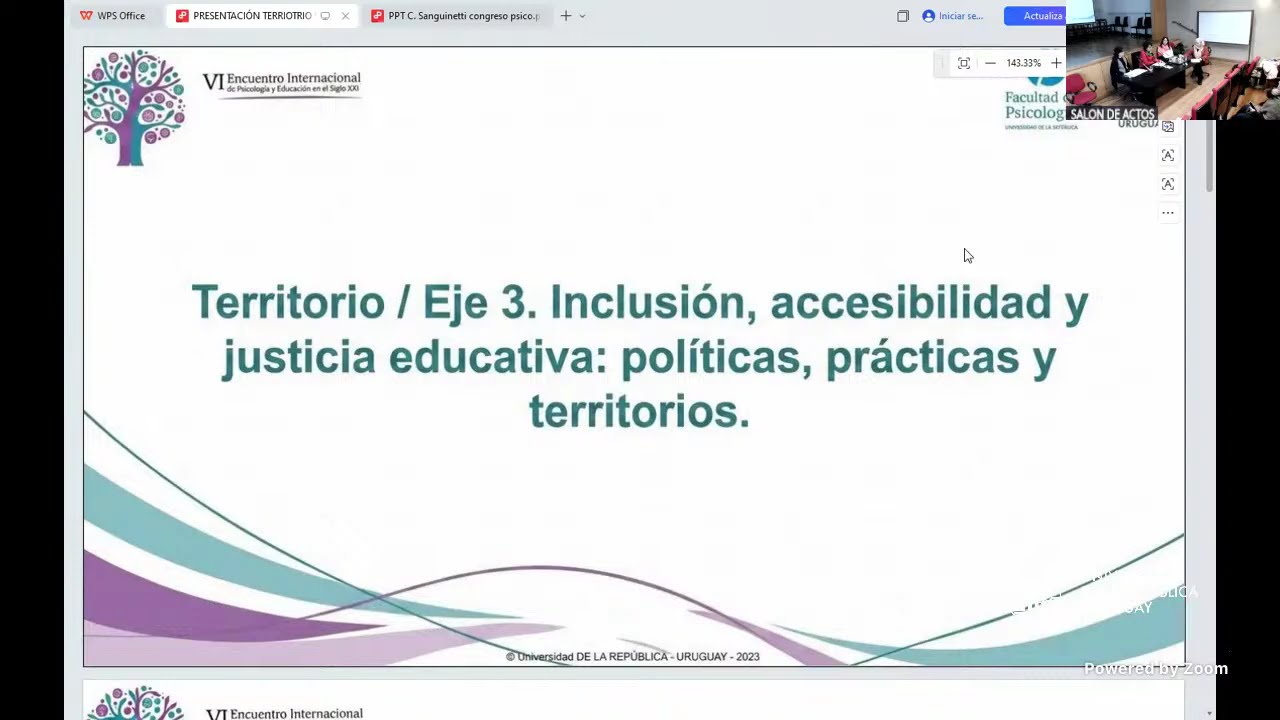
VI Encuentro - "Inclusión, accesibilidad y justicia educativa: políticas, prácticas y territorios"
Keywords
Summary
261 words
Critical Evaluation
Value of the Information & Strength of the Argument
The value of the information lies in the diverse perspectives offered by the three speakers, each bringing insights from their institutional roles: policy-making, ministry coordination, and academia. The argumentation is solid, grounded in theoretical frameworks and practical experience. The speakers critically examine the gap between policy and practice, and propose that inclusion requires a systemic and ethical commitment. They avoid oversimplification and acknowledge the complexity of the issues. The discussion is well-structured, with each speaker addressing the guiding questions from their vantage point. However, the arguments are largely based on qualitative analysis and professional judgment rather than empirical data, which limits the strength of the claims. The panel does not provide concrete solutions but rather opens up avenues for reflection and action.
Scientific Rigor, Source Quality, Title Accuracy
The scientific rigor is moderate: the speakers reference theoretical concepts and institutional frameworks, but they do not cite specific studies or data. The quality of sources is acceptable given the nature of the event (a panel discussion), but it would benefit from more explicit references to research. The title accurately reflects the content, which is a comprehensive discussion of inclusion, accessibility, and educational justice from policy, practice, and territorial perspectives. The video is a recording of a live event, so the production quality is typical of such recordings. No comments were provided for analysis.
231 words
Title / Content Match
The title accurately reflects the content, which focuses on inclusion, accessibility, and educational justice from policy, practice, and territorial perspectives.
Quality & Reliability
7/10
The video is a panel discussion with experts in education policy and psychology, providing a balanced and nuanced perspective on inclusive education. The speakers are credible professionals from relevant institutions, and the content is well-structured. However, it is a debate format with limited empirical data, and the claims are largely based on professional experience and theoretical frameworks rather than original research.
Key Moments
Markers derived by PSI from the transcript: the creator did not define chapters.
- Introduction and welcome by the moderator, Claudia, outlining the structure of the panel and the guiding questions.
- Martina Bailongoday begins her presentation, focusing on the gap between norms and practices, and the need for ethical and epistemological reflection.
- Martina discusses the importance of personal availability and the role of policy in bridging the gap, referencing Luciana Cadahia's 'Republic of Care'.
- Martina concludes her talk, emphasizing the need to embrace conflict and avoid comfortable terms.
- Carolina Pablo begins her presentation on the architecture of an inclusive educational system, focusing on interinstitutional coordination.
- Carolina provides examples of interinstitutional articulation, such as the Commission for Educational and Socio-Professional Continuity for Disability.
- Carolina concludes her talk, highlighting the need for a systemic approach and the transformation of practices, cultures, and policies.
- The third speaker, Andrea, presents her perspective, likely focusing on territorial and community aspects, though the transcription is incomplete.
- The panel opens for questions from the audience, with discussion on the challenges and opportunities for inclusive education.
- The panel continues with audience engagement and final remarks.
Cited Sources
- Luciana Cadahia - República de los Cuidados — Martina references this book to discuss the concept of care and political imagination.
Concurring Sources
- UNESCO - Inclusion in Education — This source aligns with the video's emphasis on inclusive education as a human right and the need for systemic change.
Contribution & Novelties
The video provides a valuable contribution by bringing together perspectives from different institutional levels (policy, ministry, academia) on inclusive education in Uruguay. It highlights the persistent gap between policy and practice and emphasizes the need for interinstitutional coordination and ethical commitment. The discussion offers a nuanced understanding of inclusion beyond disability, incorporating intersectionality and territorial considerations.
Pour aller plus loin :
- Inclusive education - UNESCO — This source provides an international framework for inclusive education, relevant to the discussion.
- Index for Inclusion — A tool for developing inclusive schools, directly related to the transformation of practices and cultures.
- Social model of disability — This concept underpins the shift from a medical to a social understanding of disability, relevant to the discussion on inclusion.
123 words
Radar Profile
The radar profile shows relatively balanced scores across all dimensions, with slightly higher scores in information quality and reliability. This indicates a well-rounded discussion with strong content, though the technical level is moderate, reflecting the panel's focus on policy and practice rather than technical details.