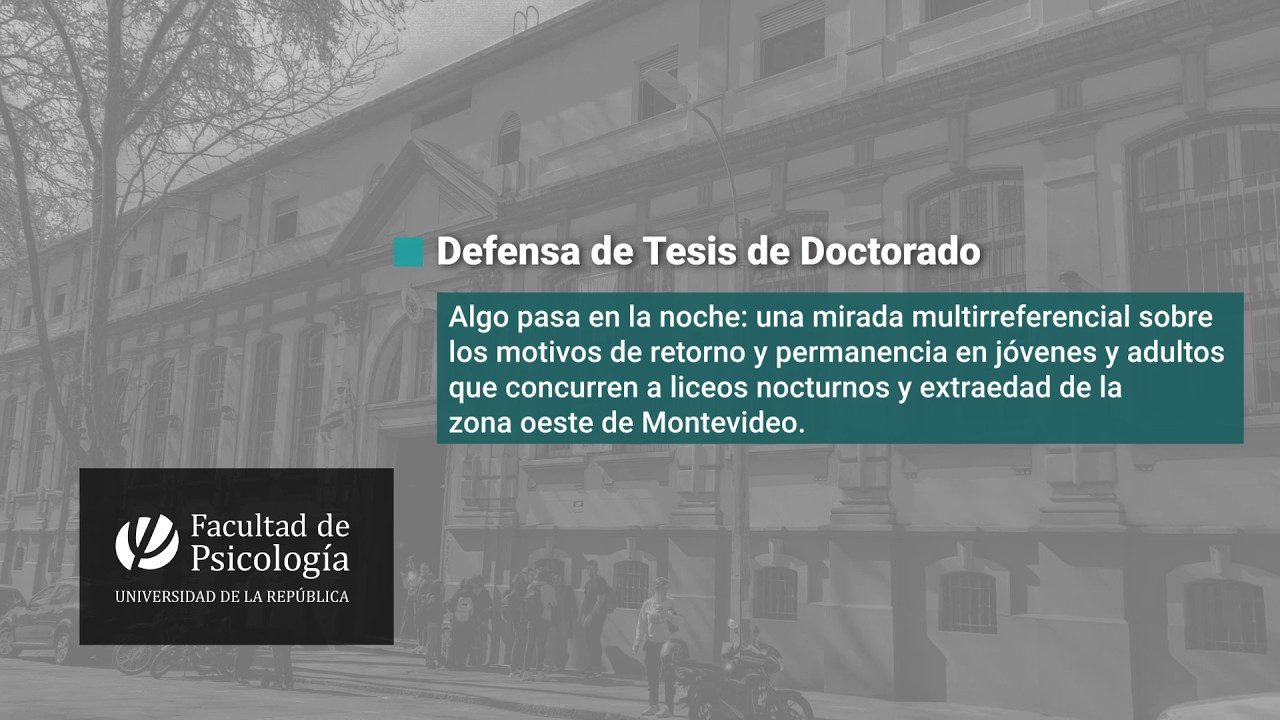
Defensa de Tesis doctoral de Diego Cuevasanta
Keywords
Summary
207 words
Critical Evaluation
Value of the Information & Strength of the Argument
The value of the information is high, as it provides a comprehensive overview of a doctoral research project that addresses a significant social issue: the low completion rates of secondary education in Uruguay, particularly among disadvantaged populations. The argumentation is solid, grounded in a multi-referential theoretical framework that integrates psychological, sociological, and educational perspectives. The candidate clearly justifies the research gap, the methodological choices, and the interpretation of results. The presentation is well-structured, with a logical flow from problem statement to methodology to findings. The candidate demonstrates a deep understanding of the subject and effectively communicates the complexity of the phenomenon.
Scientific Rigor, Source Quality, Title Accuracy
The scientific rigor is evident in the systematic literature review, the use of validated instruments (e.g., the scale of subjective social value of education), and the transparent description of the sampling and data collection procedures. The sources cited are relevant and include both national and international studies, as well as theoretical works from various disciplines. The title accurately reflects the content, emphasizing the multi-referential approach and the specific context of night schools in western Montevideo. The defense is a formal academic evaluation, and the candidate appropriately acknowledges the contributions of the tribunal and advisors. No comments were provided for analysis.
216 words
Title / Content Match
The title accurately reflects the content, focusing on the reasons for return and permanence in night schools in western Montevideo.
Quality & Reliability
8/10
The presentation is a doctoral thesis defense, based on a rigorous mixed-methods study with a clear theoretical framework and transparent methodology. The research is situated within established academic literature and includes a diverse sample. However, as a defense, it is a presentation of the candidate's own work, and the findings are not yet peer-reviewed in a formal publication.
Key Moments
Markers derived by PSI from the transcript: the creator did not define chapters.
- Introduction and welcome by the tribunal president, Cecilia Pereda.
- Diego Cuevasanta begins his presentation, thanking the audience and acknowledging his advisors and tribunal.
- Presentation of the research starting point: his work on motivation and educational trajectories, and the context of night schools in the Cerro area.
- Discussion of the research problem: low completion rates of secondary education in Uruguay, and the lack of information on night school students.
- Presentation of the research questions and objectives.
- Review of antecedents: motivational and relational factors in return and permanence.
- Conceptual framework: multi-referential approach, including theories of motivation, educational trajectories, and institutional analysis.
- Methodology: sequential mixed-methods design, with quantitative questionnaires and qualitative interviews.
- Description of the study context: western zone of Montevideo, six schools, and participant characteristics.
- Presentation of results: motives for return, expectations, institutional factors, and strategies for permanence.
Cited Sources
- Tesis doctoral de Claudia Cabrera — Cited as a source for sociodemographic information in the questionnaire.
- Sancho Álvarez et al. (escala de valor social subjetivo de la educación) — Used as a scale to measure the subjective social value of education.
- González Rey (técnicas generadoras de logicidad y expresión) — Referenced for the dialogic nature of research techniques.
- Ardoino (mirada multirreferencial) — Referenced for the multi-referential approach.
- Folari (lazo social y reproducción) — Referenced in the context of institutions.
- Bourdieu (violencia simbólica) — Referenced in the context of institutions.
- Simos y Maelein (La defensa de la escuela en la cuestión pública) — Referenced for the idea of school as a space of suspension.
- Bárbara Briscioli (trayectorias intermitentes) — Referenced for the concept of intermittent trajectories.
- Arnett (adultez emergente) — Referenced for the concept of emerging adulthood.
- Teoría de metas, teoría de autodeterminación, teoría de expectativa-valor de Eccles — Referenced as motivational theories.
- Carrasco (extensión como faro pedagógico) — Referenced for the role of extension in research.
- Ares Pons (Universidad, anarquía organizada) — Referenced for the ethical and political demands of knowledge.
Concurring Sources
- Estudio de Santiago Cardoso sobre doble inequidad — Cited as evidence of the double inequity in dropout and return rates.
Contribution & Novelties
The thesis contributes to the understanding of why adults return to and persist in night schools, a topic that is under-researched in Uruguay. It offers a multi-referential perspective, integrating psychological, sociological, and educational theories, and uses a mixed-methods approach to capture both quantitative patterns and qualitative narratives. The study provides empirical evidence from a specific socio-economically disadvantaged area, highlighting the role of institutional factors and social networks. It also introduces the concept of ‘adultez emergente’ to this context, offering a new lens for understanding adult learners’ motivations.
Pour aller plus loin :
- Self-Determination Theory — Relevant to the motivational framework used in the thesis.
- Expectancy-Value Theory — Directly linked to the motivational theories cited.
- Emerging Adulthood — Concept by Arnett, applied in the thesis.
- Mixed Methods Research — Methodological approach used in the study.
- Night School — General context of the research setting.
143 words
Radar Profile
The radar profile shows high scores across all dimensions, indicating a well-rounded and rigorous presentation. The strengths are particularly notable in the quantity and quality of information, as well as in the reliability of the sources. The technical level is also high, reflecting the advanced academic nature of the defense.