Curso Introductorio 11:30 a 13 h
Keywords
Summary
156 words
Critical Evaluation
Value of the Information & Strength of the Argument
The video provides valuable, up-to-date institutional data on the socio-demographic profile of psychology students, which is useful for both students and educators. The argumentation is clear and well-structured, using visual aids and interactive elements to engage the audience. The presenters explain the data in a way that is accessible without oversimplifying, and they emphasize the non-deterministic nature of statistics, which is a nuanced and scientifically sound perspective. However, the lecture is primarily descriptive rather than analytical, and the argumentation is more about informing than critically evaluating the data.
Scientific Rigor, Source Quality, Title Accuracy
The video is scientifically rigorous in its use of institutional data collected over 10 years, with a clear methodology. The sources are primarily internal (the faculty’s own survey), and the presenters mention a published report on the faculty’s website. The title accurately reflects the content, which is an introductory course session on academic planning. The presentation is well-organized, but there is a minor error in one graph (colors inverted), which is acknowledged and corrected. Overall, the sources are reliable and the content is consistent with the title.
190 words
Title / Content Match
The title accurately reflects the content: an introductory course session focused on academic planning, using socio-demographic data.
Quality & Reliability
7/10
The video presents data from a formal institutional survey conducted over 10 years, with clear methodology and transparent presentation. However, it is a lecture aimed at incoming students, not a peer-reviewed study, and some data visualizations contain minor errors (e.g., color inversion).
Key Moments
Markers derived by PSI from the transcript: the creator did not define chapters.
- Introduction and presentation of the monitoring team.
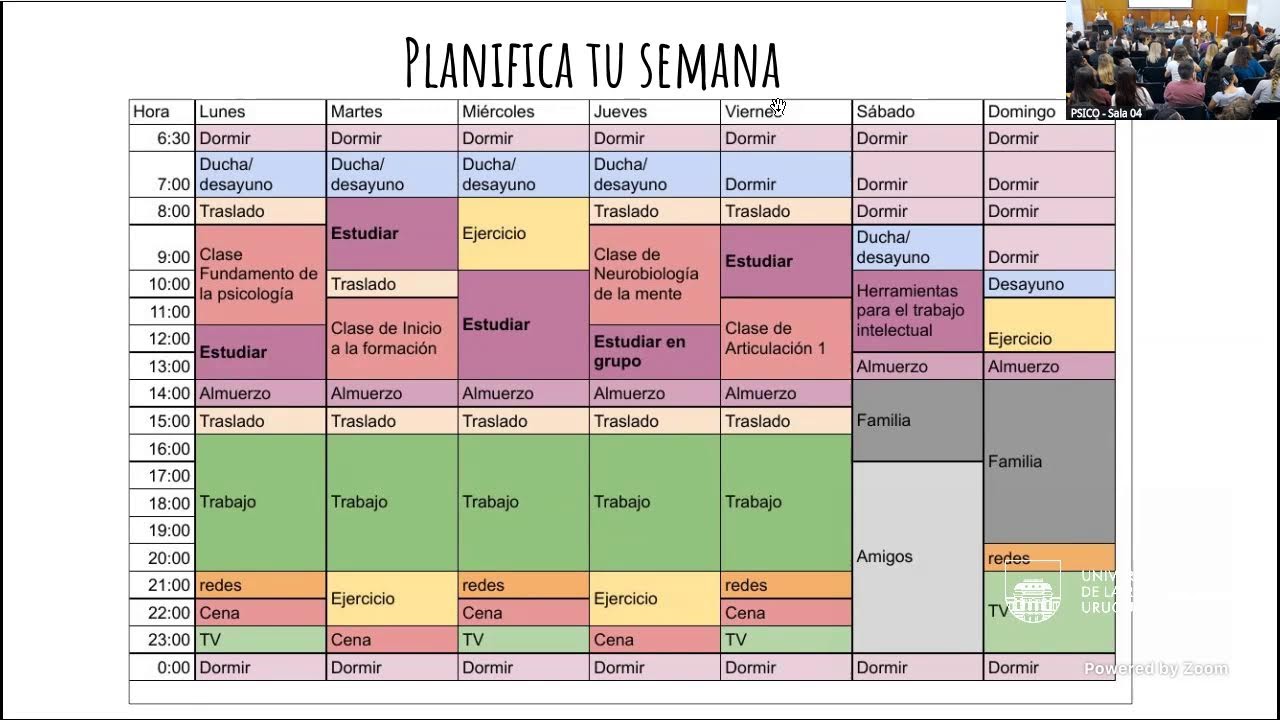
- Explanation of the session's focus on academic planning and socio-demographic profile.
- Interactive poll on students' perceptions of the profile.
- Presentation of real data: 75.5% women, average age 25.7, etc.
- Introduction of age profiles (17-18, 19-29, 30+) and their characteristics.
- Analysis of work and family composition by profile.
- Discussion on educational climate of origin and its impact.
- Motivations for studying psychology and their distribution.
- Introduction to 'intention to enroll' and its variation by profile and semester.
- Interpretation of graphs showing enrollment intentions and adjustments.
Cited Sources
- Informe de la generación de ingreso (Facultad de Psicología) — Mentioned as a published report on the faculty's website with more detailed data.
Concurring Sources
- Udelar - Facultad de Psicología — Institutional source providing official data and reports.
Contribution & Novelties
The video provides a unique, data-driven overview of the socio-demographic profile of psychology students at a specific institution, which is valuable for academic planning. It offers a practical application of statistics in an educational context, emphasizing the non-deterministic nature of data. The interactive approach and focus on student heterogeneity are innovative for an introductory course.
Pour aller plus loin :
- Socioeconomic status and higher education — Relevant for understanding the impact of educational climate.
- First-generation college students — Directly related to the 47.2% first-generation statistic.
- Academic advising — Relevant to the planning advice given.
94 words
Radar Profile
The radar profile shows high scores in quantity of information and reliability, reflecting the comprehensive data presented. The technical level is moderate, suitable for an introductory audience. The overall balance indicates a solid, informative lecture with a strong empirical base.