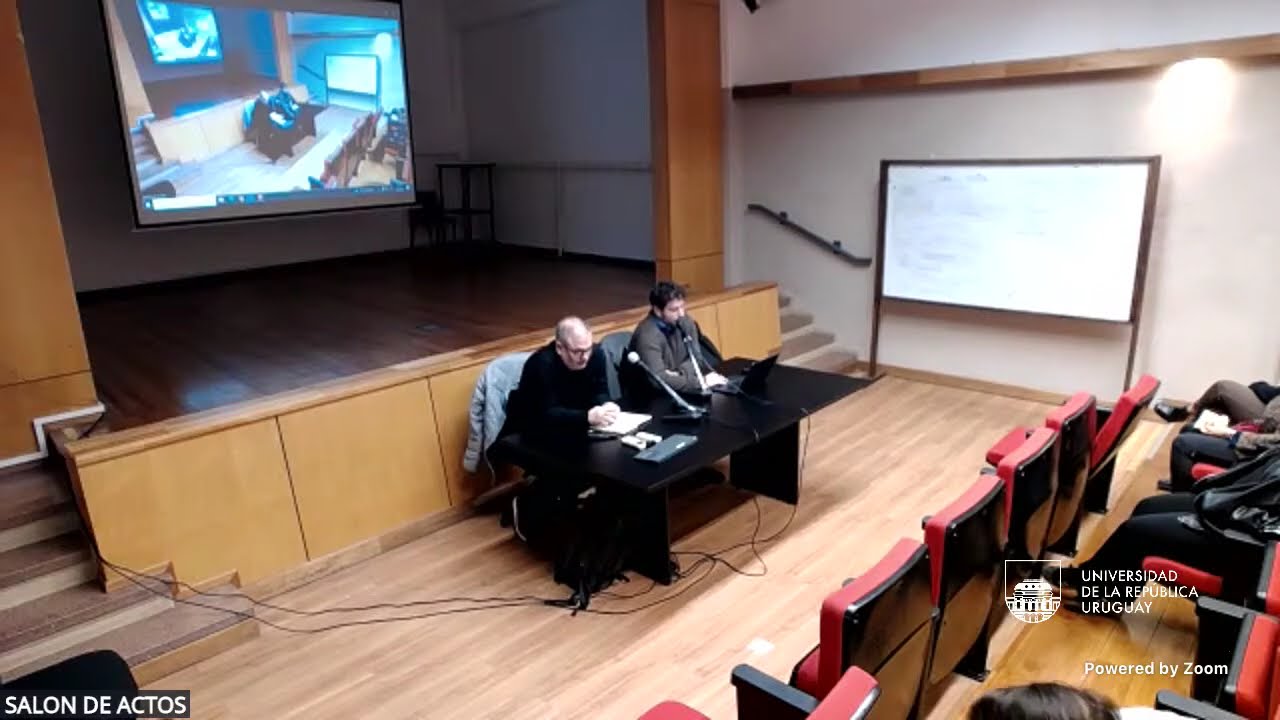
20hr Conferencia Paulo Beer (USP) / 21hr Conferencia Rodrigo de la Fabián (Univ. Diego Portales)
Keywords
Summary
167 words
Critical Evaluation
Value of the Information & Strength of the Argument
The value of the information lies in its interdisciplinary synthesis, connecting psychoanalysis, philosophy of language, and critical technology studies. The argumentation is solid, building from concrete examples (e.g., AI in military decisions, credit scoring) to theoretical frameworks (Austin’s speech acts, Foucault’s power-knowledge). The speaker acknowledges complexity and avoids oversimplification, making a compelling case for the performative nature of AI predictions. However, the argument relies heavily on interpretive analysis rather than empirical evidence, which may limit its generalizability.
Scientific Rigor, Source Quality, Title Accuracy
The lecture demonstrates scientific rigor through careful citation of sources such as Carisa Velis’s book ‘Prophecy’ and Austin’s ‘How to Do Things with Words’. The title accurately reflects the content, as it names the speakers and their institutional affiliations. The discussion is well-structured, with clear progression from examples to theoretical implications. The adequacy between title and content is high, as the conference indeed presents two academic lectures on the announced topics.
163 words
Title / Content Match
The title accurately reflects the content: two consecutive lectures by the named speakers, focusing on psychoanalysis and digital culture.
Quality & Reliability
8/10
The conference presents a well-structured theoretical argument grounded in references to Foucault, Austin, and contemporary philosophy of technology. The speaker demonstrates deep knowledge and provides nuanced analysis, though the content is primarily interpretive and not empirically verified.
Key Moments
Markers derived by PSI from the transcript: the creator did not define chapters.
- Introduction and welcome by the host, presentation of the speakers.
- Paulo Beer begins his lecture 'Entre utopías y encantamientos: el deseo como fricción'.
- Discussion of the concept of friction in digital environments and its relation to power.
- Introduction of Carisa Velis's work on AI as a modern oracle.
- Analysis of AI predictions as performative speech acts using Austin's theory.
- Examples of self-fulfilling prophecies and the seduction of inevitability.
- Discussion of Foucault's interpretation of Oedipus and the relation between power and knowledge.
- Transition to Rodrigo de la Fabián's lecture.
- Rodrigo de la Fabián's lecture begins, focusing on psychoanalytic perspectives.
- Concluding remarks and Q&A session.
Cited Sources
- Prophecy: Prediction, Power, and the Struggle for the Future from Ancient Oracles to AI — Referenced by Paulo Beer as the main theoretical framework for understanding AI as a modern oracle.
- How to Do Things with Words — Austin's work on speech act theory, used to analyze the performative nature of AI predictions.
- La verdad y las formas jurídicas — Foucault's lectures, cited in the discussion of power and knowledge in the Oedipus myth.
Concurring Sources
- Prophecy: Prediction, Power, and the Struggle for the Future from Ancient Oracles to AI — The book by Carisa Velis aligns with the lecture's central thesis about AI as an oracle.
Contribution & Novelties
The lecture offers a novel perspective by linking the concept of ‘friction’ in digital design to broader questions of desire and power. It challenges the common assumption that AI predictions are neutral descriptions, arguing instead that they are performative acts that shape reality. The synthesis of psychoanalysis, philosophy of language, and critical technology studies provides a unique framework for understanding the seduction of inevitability in contemporary society.
Pour aller plus loin :
- Speech act theory — Provides background on Austin’s theory, essential for understanding the argument.
- Self-fulfilling prophecy — Explains the psychological phenomenon referenced in the lecture.
- Foucault’s power-knowledge — Relevant to the discussion of power and knowledge in the context of AI.
113 words
Radar Profile
The radar profile shows high scores in information quantity, quality, and technical level, indicating a dense and well-argued lecture. The reliability score is slightly lower, reflecting the interpretive nature of the content, but overall the lecture is robust and intellectually stimulating.
💬 Sur les 0 commentaires analysés, aucune tendance n'a pu être dégagée.