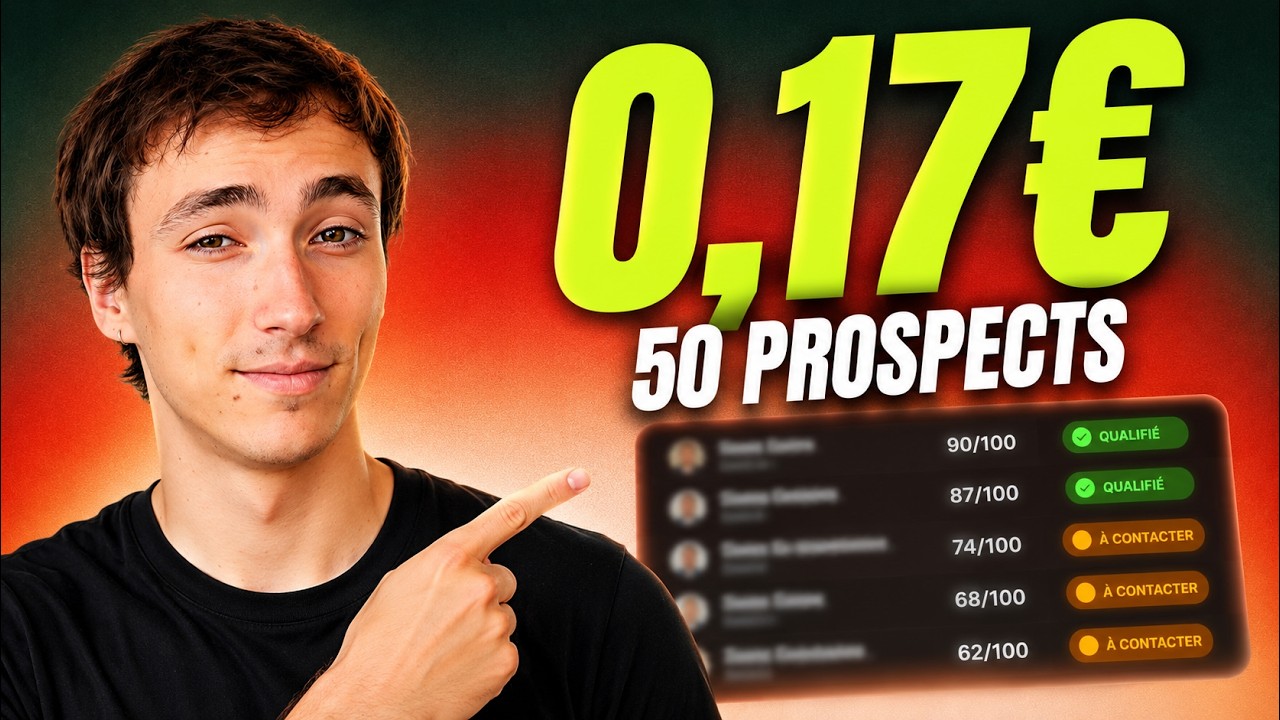
Comment prospecter avec l'IA ? (Masterclass complète)
Keywords
Summary
134 words
Critical Evaluation
Value of the Information & Strength of the Argument
The video provides a clear, actionable framework for AI-driven prospecting. The value lies in the concrete demonstration of a complete workflow, from defining ICP to sending messages. The argumentation is based on the presenter’s experience and a live demo, which adds credibility. However, the claims about cost and effectiveness are not backed by rigorous data or comparisons. The advice on targeting by behavior and using ‘prospect nests’ is sound and aligns with common marketing principles. The emphasis on follow-up is also valuable. Overall, the information is practical and well-structured, but the lack of scientific evidence limits its generalizability.
Scientific Rigor, Source Quality, Title Accuracy
The video does not cite any scientific sources or external references. The only links provided are to the presenter’s own blog and company, which serve as promotional material. The title accurately reflects the content, and the video is well-structured with clear chapters. The lack of external validation and the reliance on anecdotal evidence reduce the scientific rigor. The presenter’s expertise is evident, but the content is more of a tutorial than a research-based presentation. The description includes time codes and practical links, but no references to studies or data.
202 words
Title / Content Match
The title accurately reflects the content: a complete masterclass on AI-driven prospecting, covering strategy, tools, and a live demo.
Quality & Reliability
6/10
The video provides a practical, step-by-step tutorial on AI-powered prospecting, with a live demonstration. The methodology is coherent and based on real tools (Apify, NocoDB, Claude Code), but the scientific rigor is limited: no citations, no external validation, and the claims about cost and effectiveness are anecdotal.
Chapters
Cited Sources
- Eliott Meunier's blog — Personal blog of the presenter, mentioned as a practical link.
- Perspectives.ac — The presenter's company, mentioned as a practical link.
Concurring Sources
- Apify — The scraping platform used in the video.
- NocoDB — The database tool used for lead management.
- Claude Code — The AI orchestration tool used in the workflow.
Contribution & Novelties
The video offers a practical, end-to-end system for AI-powered prospecting, combining scraping, enrichment, scoring, and CRM management. It demonstrates a cost-effective method (17 cents for 50 leads) and provides a reusable process template. The novelty lies in the integration of multiple tools (Apify, NocoDB, Claude Code) into a coherent workflow.
Pour aller plus loin :
- Ideal Customer Profile (ICP) — A foundational concept for B2B marketing.
- Web scraping — The technique used to extract data from websites.
- Customer relationship management (CRM) — The broader context for managing leads.
88 words
Radar Profile
The radar profile shows high scores in information quantity and technical level, reflecting the practical and detailed nature of the tutorial. The lower scores in information quality and global reliability indicate a lack of scientific rigor and external validation. The overall profile suggests a useful but anecdotal resource.
💬 No comments were provided for analysis.