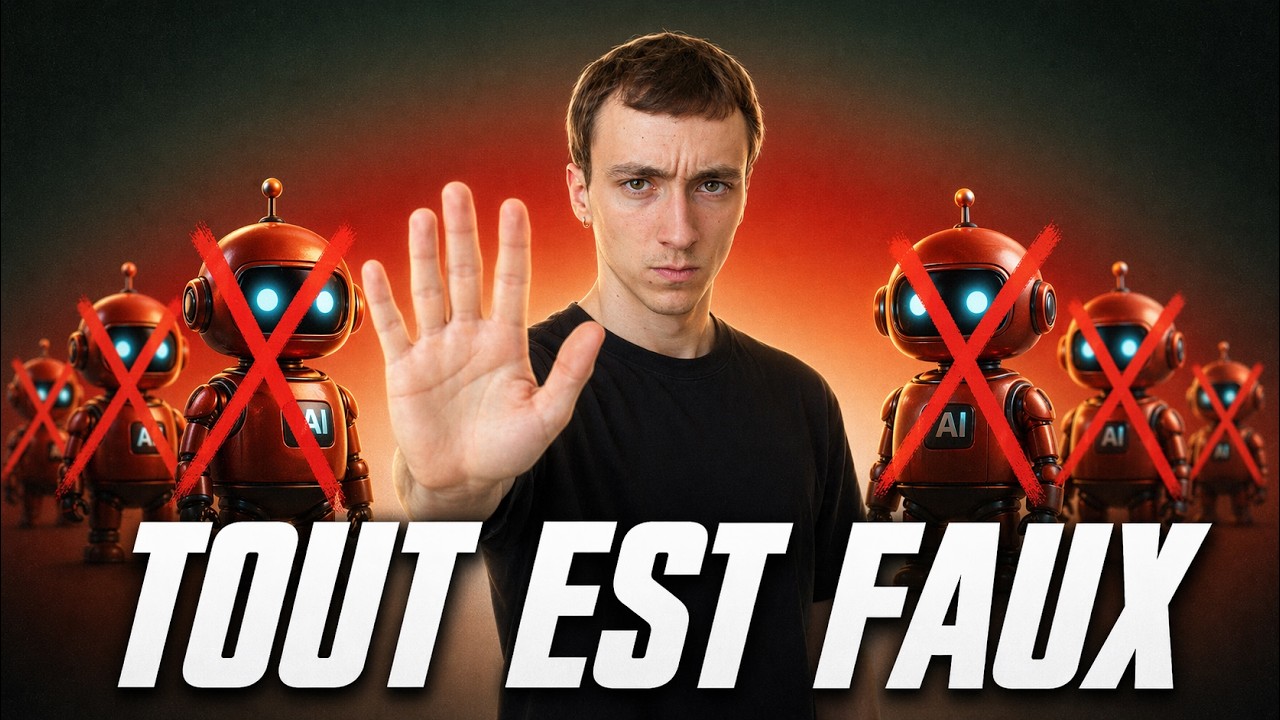
La vérité sur les agents IA que personne n'ose vous dire
Keywords
Summary
125 words
Critical Evaluation
Value of the Information & Strength of the Argument
The video provides valuable, practical insights into what AI agents really are, demystifying the hype and offering a concrete framework (process sheets) that viewers can apply. The argumentation is solid, based on the author’s direct experience and demonstrations. He effectively contrasts his approach with the marketing claims of platforms like Dust, using a relatable McDonald’s analogy to emphasize the importance of processes. The reasoning is coherent and persuasive, though it remains opinion-based rather than evidence-based.
Scientific Rigor, Source Quality, Title Accuracy
The scientific rigor is moderate: the video is an expert opinion with practical demonstrations, but it lacks citations to academic or industry studies. The sources mentioned (Claude Code, Firecrawl) are relevant and credible, but the author does not provide detailed references. The title accurately reflects the content, which is a critical look at AI agent marketing. The video includes a promotional segment for the author’s bootcamp, but this does not detract from the core content.
165 words
Title / Content Match
The title accurately reflects the content, which debunks common marketing myths about AI agents and presents a more grounded, process-oriented view.
Quality & Reliability
6/10
The video offers a clear, practical demystification of AI agents, grounded in the author's direct experience. However, it is largely opinion-based, with limited verifiable sources and some promotional content for the author's bootcamp.
Chapters
- Le bullshit marketing autour des agents IA
- Ce qu'est vraiment un agent IA
- Un agent = une fiche process
- La structure : input, étapes, output, méthode
- Exemple : mon process d'écriture YouTube
- La méthode : là où réside votre valeur ajoutée
- Mapper tous vos process
- Démo : /prepare-coaching
- Démo : /youtube
- Toutes mes commandes slash
- Les process en entreprise
- Les 3 niveaux d'exécution
- Niveau 2 : les crons (tâches automatiques)
- Les triggers (mail, événement)
- Niveau 3 : l'agent persistant (OpenClaw)
- La valeur est dans les process, pas la plateforme
- L'analogie McDonald's
- Humilité épistémique : les limites actuelles
- Les 3 aires d'innovation des modèles
- Pourquoi pas Dust : souveraineté et outils ouverts
Cited Sources
- Claude Code — Mentioned as the primary tool for building custom AI agents and process sheets.
- Firecrawl — Cited as a superior web research tool (MCP) used in the author's process.
- Prisme One Bootcamp — Promoted as a resource for learning to build a 'Second Brain AI' system.
Concurring Sources
- Claude Code — The tool is presented as a viable alternative to SaaS platforms for building custom AI agents.
- Firecrawl — The tool is presented as a superior web research tool for AI agents.
Contribution & Novelties
The video offers a refreshingly demystified view of AI agents, framing them as simple process sheets rather than autonomous robots. It provides a practical methodology for mapping and automating personal and business processes, which is a valuable contribution to the discourse on AI adoption.
Pour aller plus loin :
- AI agent (Wikipedia) — Provides a formal definition of intelligent agents, useful for understanding the theoretical background.
- Model Context Protocol (MCP) — The protocol used by tools like Firecrawl to connect AI models to external data sources.
- Claude Code documentation — Official documentation for the tool used in the video, offering deeper technical details.
103 words
Radar Profile
The radar profile shows a balanced score across all dimensions, with slightly higher scores in information quantity and quality, reflecting the video's practical content. The lower technical level and reliability scores indicate that while the video is informative, it lacks deep technical depth and rigorous sourcing.