CAB-LA chez les travailleuses du sexe au Malawi : adoption et persistance en condition réelle.
Keywords
Summary
141 words
Critical Evaluation
Value of the Information & Strength of the Argument
The video provides valuable real-world data on the use of CAB-LA in a high-risk population, filling a gap in evidence from clinical practice. The argumentation is solid, based on a well-designed observational study with both quantitative and qualitative components. The presentation of results is clear, with visual aids (graphs) and specific numbers. The discussion of barriers and facilitators is nuanced, acknowledging both the benefits and challenges. The study’s limitations, such as the preliminary nature and potential selection bias, are not explicitly discussed, but the overall reasoning is sound.
Scientific Rigor, Source Quality, Title Accuracy
The scientific rigor is high, with a clear methodology and transparent reporting. The sources are not explicitly cited in the video, but the study appears to be based on primary data collection. The title accurately reflects the content. The video is presented by Epicentre, a reputable research organization, which adds credibility. However, the lack of explicit citations and the preliminary nature of the results temper the overall assessment.
171 words
Title / Content Match
The title accurately reflects the content, focusing on the adoption and persistence of CAB-LA among female sex workers in Malawi.
Quality & Reliability
8/10
The video presents preliminary results from an observational study conducted in real-world settings, with a clear methodology (mixed methods, multi-state model) and transparent reporting of limitations. The data is specific and detailed, and the presentation is by a recognized organization (Epicentre, MSF).
Key Moments
Markers derived by PSI from the transcript: the creator did not define chapters.
- Introduction and background on HIV prevalence in Malawi and the need for long-acting PrEP.
- Study objectives and design: observational, mixed methods, 18 months, mobile clinics.
- Baseline characteristics of participants: mostly young women, high mobility, vulnerability.
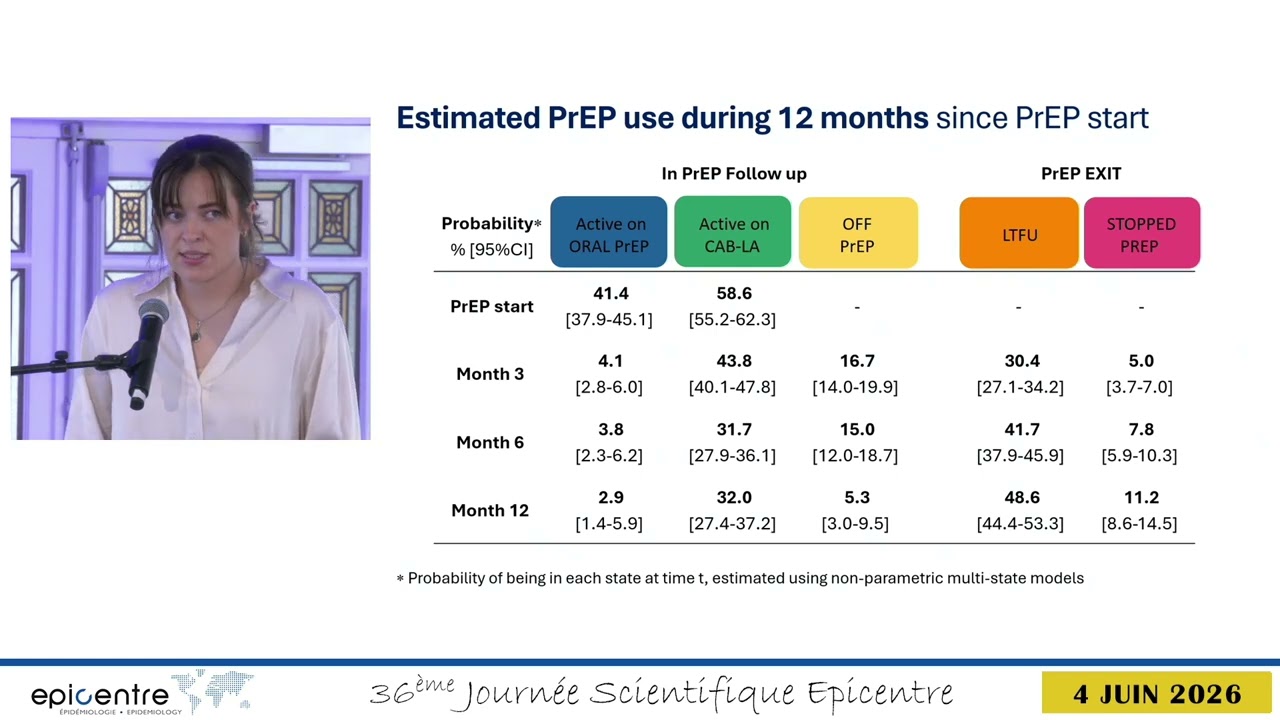
- Adoption rates: 59% chose CAB-LA vs 41% oral PrEP; 70% of those who started preferred CAB-LA.
- Persistence data: discontinuation and loss to follow-up over 12 months, with a multi-state model.
- Qualitative findings: barriers and facilitators, including discretion, side effects, stigma, and mobility.
- Summary and recommendations for improving PrEP adoption and continuation.
Contribution & Novelties
This study provides novel real-world evidence on the use of CAB-LA among female sex workers in sub-Saharan Africa, a population often underrepresented in clinical trials. It highlights the high preference for injectable PrEP and identifies specific barriers and facilitators in this context. The findings can inform implementation strategies for long-acting PrEP in similar settings.
Pour aller plus loin :
- Long-acting injectable PrEP (CAB-LA) - WHO — Overview of HIV prevention and PrEP options.
- Cabotegravir for HIV PrEP - FDA — FDA approval information.
- HIV Prevention - UNAIDS — Global HIV prevention strategies.
- Female sex workers and HIV - The Lancet — Series on HIV and sex workers.
107 words
Radar Profile
The radar profile shows high scores in information quantity, quality, and reliability, with a slightly lower technical level, indicating a well-balanced presentation suitable for a professional audience. The strong scores reflect the study's robust methodology and clear communication.