Cholera dynamics and impact of preventive vaccine in endemic zones of DRC, 2021-2026
Keywords
Summary
198 words
Critical Evaluation
Value of the Information & Strength of the Argument
The video provides valuable data from a large-scale, multi-site study on cholera vaccination in endemic settings, addressing a critical public health question. The argumentation is solid, using appropriate statistical methods (logistic regression, interrupted time series) to quantify risk factors and vaccine impact. The comparison between urban and rural contexts adds depth, and the discussion of challenges (e.g., displacement, seasonality) strengthens the analysis. However, the presentation is dense and may be challenging for non-specialists, and the preliminary nature of some results limits the strength of conclusions.
Scientific Rigor, Source Quality, Title Accuracy
The study appears methodologically rigorous, with clear descriptions of data collection and analysis. The sources are primarily the study’s own data, and no external citations are provided in the video. The title accurately reflects the content, and the presentation is consistent with the described scope. The lack of peer-reviewed references or external validation is a limitation, but the use of established epidemiological methods enhances credibility.
165 words
Title / Content Match
The title accurately reflects the content, which focuses on cholera dynamics and the impact of preventive vaccination in endemic zones of the DRC.
Quality & Reliability
8/10
The presentation is based on a multi-year field study with robust epidemiological methods (logistic regression, interrupted time series) and detailed data. However, the video is a conference presentation with limited peer-reviewed context, and the results are preliminary.
Key Moments
Markers derived by PSI from the transcript: the creator did not define chapters.
- Introduction to the project on cholera dynamics and preventive vaccine impact in DRC.
- Description of the two study sites: Goma (urban) and Bukama (rural).
- Overview of study activities and methods, including vaccine coverage surveys and surveillance.
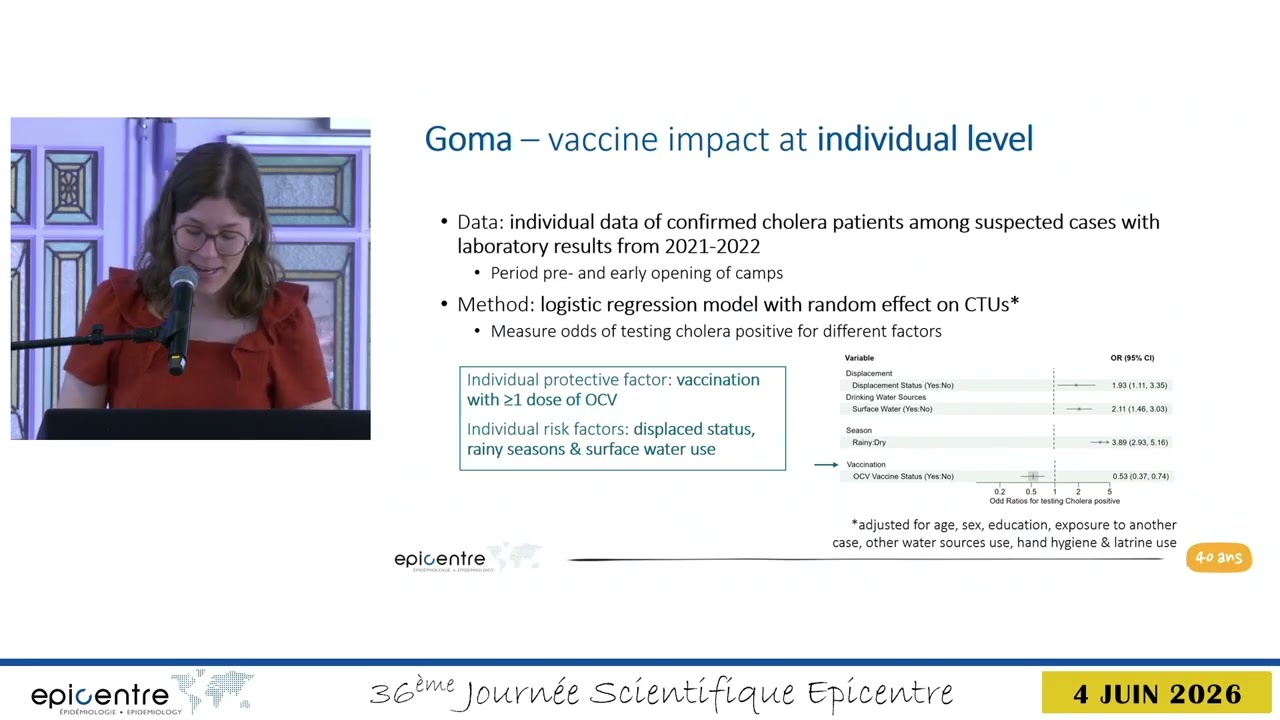
- Results from Goma: 28,630 suspected cases, risk factors, and incidence trends.
- Interrupted time series analysis showing impact of camp openings and vaccination in Goma.
- Comparison of health areas with and without camps in Goma.
- Results from Bukama: 2,600 suspected cases, vaccine coverage, and incidence patterns.
- Impact of vaccination campaigns in Bukama, including differences between two-dose and one-dose campaigns.
- Operational recommendations and conclusion.
Contribution & Novelties
This study provides novel insights into the real-world impact of preventive OCV campaigns in endemic African settings, particularly comparing urban and rural contexts. The use of interrupted time series to disentangle the effects of vaccination from other factors like displacement and seasonality is a methodological strength. The findings highlight the importance of high coverage and two-dose regimens for sustained impact, and the need for targeted strategies in displaced populations and high-risk geographic areas.
Pour aller plus loin :
- Oral cholera vaccine — WHO fact sheet on cholera and OCV.
- Cholera — Overview of cholera disease.
- Interrupted time series analysis — Explanation of the method used.
105 words
Radar Profile
The radar profile shows high scores in information quantity, quality, and reliability, with a slightly lower technical level, indicating a detailed and credible presentation that is accessible to a professional audience.