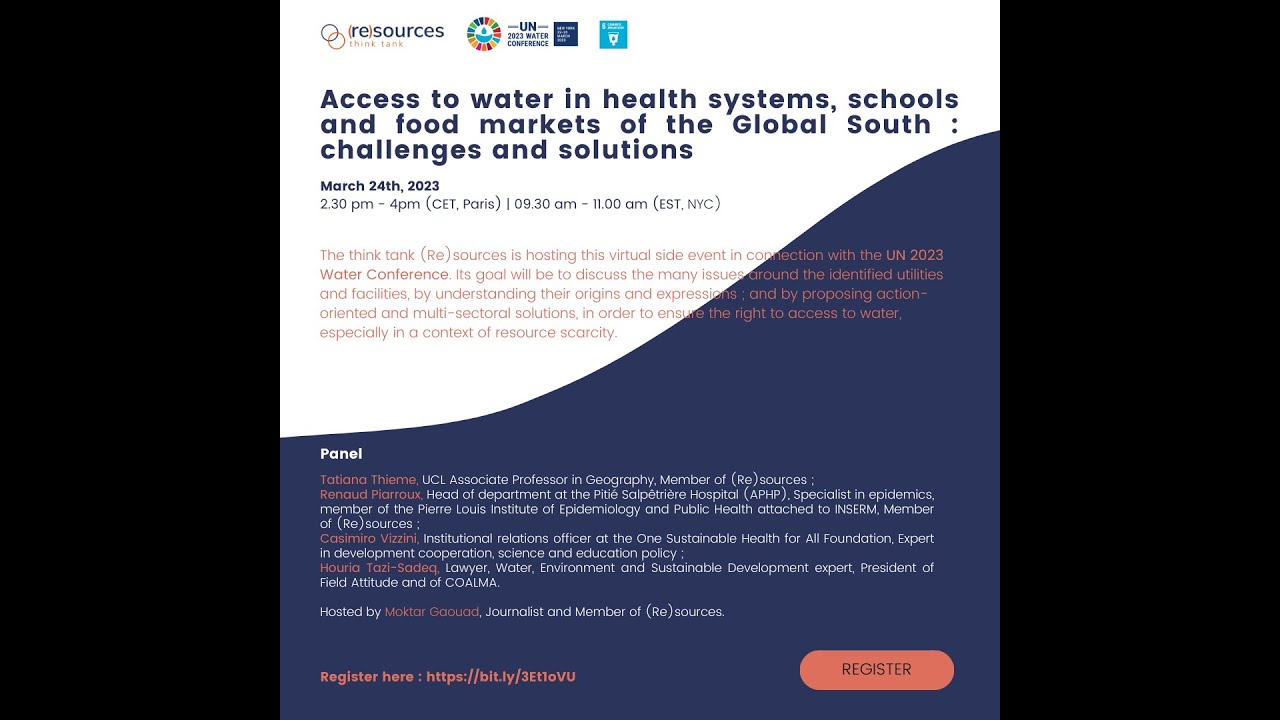
Access to water in health systems, schools and food markets of the Global South
Keywords
Summary
176 words
Critical Evaluation
Value of the Information & Strength of the Argument
The video provides substantial value by bringing together diverse expert perspectives on a critical global issue. The argumentation is generally solid, with panelists supporting their points with data and examples. For instance, Renaud Piarroux cites specific statistics on mortality and disease burden, while Tatiana Thieme offers a nuanced critique of techno-optimistic solutions and highlights the importance of community-based approaches. The discussion is well-structured, with each panelist contributing unique insights. However, the format is a debate, so some claims are not deeply scrutinized, and the argumentation sometimes relies on anecdotal evidence. The value lies in the breadth of perspectives and the emphasis on actionable solutions, though the depth of analysis varies across topics.
Scientific Rigor, Source Quality, Title Accuracy
The scientific rigor is moderate to high. The panelists are credible experts, and they reference reputable sources such as the World Health Organization and academic work. However, specific citations are not always provided in the transcript, and some claims are made without direct references. The title accurately reflects the content, and the video is well-aligned with its stated purpose. The sources cited in the description are not explicitly listed, but the panelists mention relevant organizations and studies. The adequacy between title and content is strong, as the video directly addresses the challenges and solutions for water access in the specified sectors. The overall rigor is acceptable for a panel discussion, though it could be enhanced by more explicit sourcing.
246 words
Title / Content Match
The title accurately reflects the content, which focuses on water access in health systems, schools, and food markets in the Global South.
Quality & Reliability
7/10
The video is a panel discussion with experts from various fields (geography, epidemiology, law, global health) providing a multidisciplinary perspective. The information is generally well-founded and references credible sources, but the format is a debate with limited in-depth verification of specific claims.
Key Moments
Markers derived by PSI from the transcript: the creator did not define chapters.
- Introduction by Patrice Fonlladosa, president of (Re)sources, presenting the think tank and the context of the UN Water Conference.
- Moktar Gaouad introduces the panelists and the structure of the webinar.
- Casimiro Vizzini discusses the concept of global health and the One Health approach, emphasizing the importance of water.
- Tatiana Thieme introduces the concept of 'broken world thinking' and its relevance to water and sanitation infrastructure.
- Renaud Piarroux details the health consequences of inadequate water and sanitation, particularly for children, including diarrheal diseases and neglected tropical diseases.
- Discussion on the impact of water access on education, including school attendance and menstrual hygiene management.
- Tatiana Thieme critiques Western sanitation models and highlights innovative solutions in Nairobi, such as ecological sanitation and community-based initiatives.
- Panelists discuss the role of education and the need for multi-sectoral collaboration in addressing water access.
- Q&A session begins, with panelists answering questions from the audience.
- Concluding remarks and summary of key points by the moderator.
Cited Sources
- UN 2023 Water Conference — The webinar was held as a side event to this conference, and the context of the conference is discussed throughout.
- World Health Organization (WHO) — Referenced for statistics on sanitation access and health impacts.
- Steven Jackson's work on 'broken world thinking' — Tatiana Thieme references this concept in her discussion of repair economies.
- Ellen MacArthur Foundation — Mentioned in relation to circular economy concepts.
Concurring Sources
- WHO/UNICEF Joint Monitoring Programme for Water Supply, Sanitation and Hygiene — Provides data on sanitation access that aligns with the statistics mentioned in the video.
Dissenting Sources
- Techno-optimistic approaches to sanitation — The video critiques techno-optimistic solutions like the 'reinvent the toilet' initiative, which some argue are necessary for scaling up sanitation access.
Contribution & Novelties
The video offers a unique multidisciplinary perspective on water access in the Global South, integrating insights from geography, epidemiology, law, and global health. It challenges conventional approaches and highlights innovative, context-specific solutions. The discussion on ‘broken world thinking’ and the critique of Western sanitation models provides a fresh lens. The emphasis on education and multi-sectoral collaboration is a valuable contribution.
Pour aller plus loin :
- One Health concept — Relevant to the global health framework discussed.
- Ecological sanitation — Directly related to the innovative sanitation solutions mentioned.
- Menstrual hygiene management — Relevant to the discussion on school attendance and gender.
- Water scarcity and climate change — Context for the urgency of water access issues.
114 words
Radar Profile
The radar profile shows high scores in quantity of information and global reliability, reflecting the comprehensive coverage and expert input. The quality of information is also strong, though the technical level is moderate, indicating the content is accessible to a general audience. The overall balance suggests a well-rounded and informative discussion.
💬 No comments were provided for analysis.