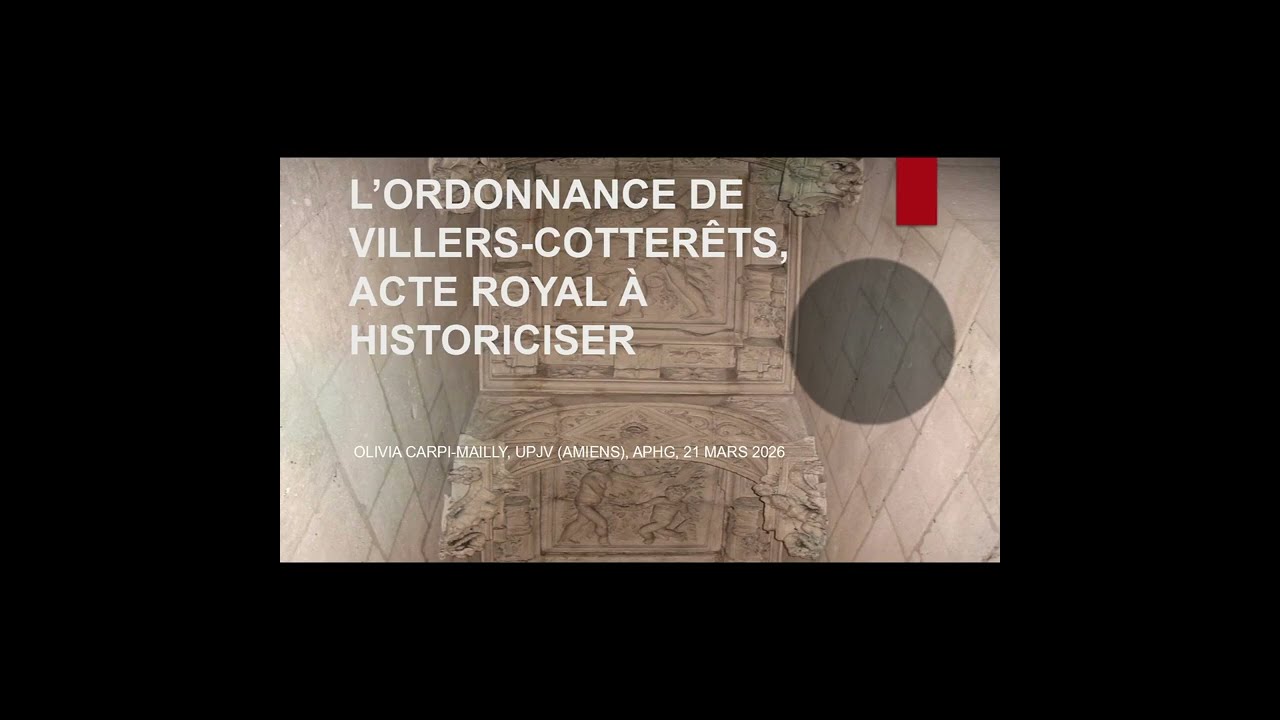
L’ordonnance de Villers-Cotterêts - O.Carpi Mailly
Keywords
Summary
202 words
Critical Evaluation
Value of the Information & Strength of the Argument
The talk provides a valuable historiographical analysis, debunking common misconceptions about the Ordonnance of Villers-Cotterêts. The argumentation is solid, based on historical evidence and scholarly debate. The speaker effectively uses primary sources (the ordonnance text, speeches by Michel de l’Hôpital) and secondary literature (Brunot, Perre) to support her claims. She demonstrates critical thinking by questioning the traditional narrative and offering a nuanced interpretation. The presentation is well-structured, moving from the myth to the historical context and then to the historiographical debate.
Scientific Rigor, Source Quality, Title Accuracy
The speaker demonstrates scientific rigor by grounding her analysis in historical sources and scholarly literature. She cites specific articles of the ordonnance, mentions precedents (ordonnance of 1490), and references key historians (Ferdinand Brunot, Henri Perre). The title accurately reflects the content, as the talk indeed focuses on historicizing the ordonnance. The presentation is well-researched and avoids unsubstantiated claims. The speaker also acknowledges the limitations of the sources and the ambiguity of the text, showing intellectual honesty.
172 words
Title / Content Match
The title accurately reflects the content: the speaker analyzes the Ordonnance of Villers-Cotterêts as a historical act to be contextualized.
Quality & Reliability
8/10
The speaker is a qualified historian (maître de conférences) specializing in early modern French political and institutional history. She presents a well-documented argument, citing specific historical sources and scholarly debates. The presentation is nuanced and critical of common myths, demonstrating scholarly rigor. Minor limitations: the talk is a conference presentation, not a peer-reviewed publication, and some references are mentioned without full citations.
Key Moments
Markers derived by PSI from the transcript: the creator did not define chapters.
- Introduction: speaker introduces herself and the topic, emphasizing the need to historicize the ordonnance.
- Cites recent political speeches (Macron, Stéphane Bern) that perpetuate the myth of the ordonnance making French the official spoken language.
- Discusses the 'jacobin' interpretation of the ordonnance, linking it to revolutionary and republican ideologies.
- Explains the historical context: the ordonnance aimed to replace Latin in legal documents for clarity, not to suppress regional languages.
- Analyzes articles 110 and 111, noting their ambiguity and the debate over the phrase 'en langage maternel françois'.
- Presents the historiographical debate between Brunot's 'limitative' thesis and Perre's 'liberal' thesis.
- Argues that the ordonnance intended a progressive substitution, citing the absence of sanctions and the gradual adoption of French.
- Discusses the broader context of royal sovereignty and administrative unification, emphasizing the role of law and justice.
- Concludes by reiterating the need to historicize the ordonnance and separate it from later ideologies.
Cited Sources
- Ordonnance de Villers-Cotterêts (1539) — The primary source analyzed in the talk.
- Ferdinand Brunot, Histoire de la langue française des origines à 1900 — Cited as proponent of the 'limitative' thesis.
- Henri Perre, La Royauté et les langues provinciales (1933) — Cited as proponent of the 'liberal' thesis.
- Michel de l'Hôpital, Discours d'ouverture des États généraux (1560) — Quoted to illustrate the contemporary view on language and unity.
Concurring Sources
- Ordonnance de Villers-Cotterêts (Wikipedia) — Provides historical context and scholarly interpretations that align with the speaker's arguments.
Dissenting Sources
- Common popular belief that the ordonnance made French the official spoken language — The speaker explicitly challenges this belief, arguing that the ordonnance only affected legal and judicial documents, not spoken language.
Contribution & Novelties
The talk offers a critical historiographical perspective on the Ordonnance of Villers-Cotterêts, challenging the popular myth that it made French the official spoken language. It provides a nuanced analysis of the ordonnance’s articles and situates it within the broader context of royal sovereignty and administrative unification. The speaker’s expertise adds depth to the discussion, making it a valuable resource for understanding the historical reality behind this iconic text.
Pour aller plus loin :
- Ordonnance de Villers-Cotterêts (Wikipedia) — Provides the full text and historical context.
- Ferdinand Brunot (Wikipedia) — Background on the historian and his work on the French language.
- Henri Perre (Wikipedia) — Background on the historian and his thesis on royal language policy.
- Michel de l’Hôpital (Wikipedia) — Background on the statesman and his views on language and unity.
131 words
Radar Profile
The radar profile shows high scores in quality of information and global reliability, reflecting the speaker's expertise and rigorous argumentation. The quantity of information is also substantial, though the technical level is moderate, making the talk accessible to a general audience. The overall profile indicates a well-balanced and trustworthy presentation.
💬 No comments were provided for analysis.