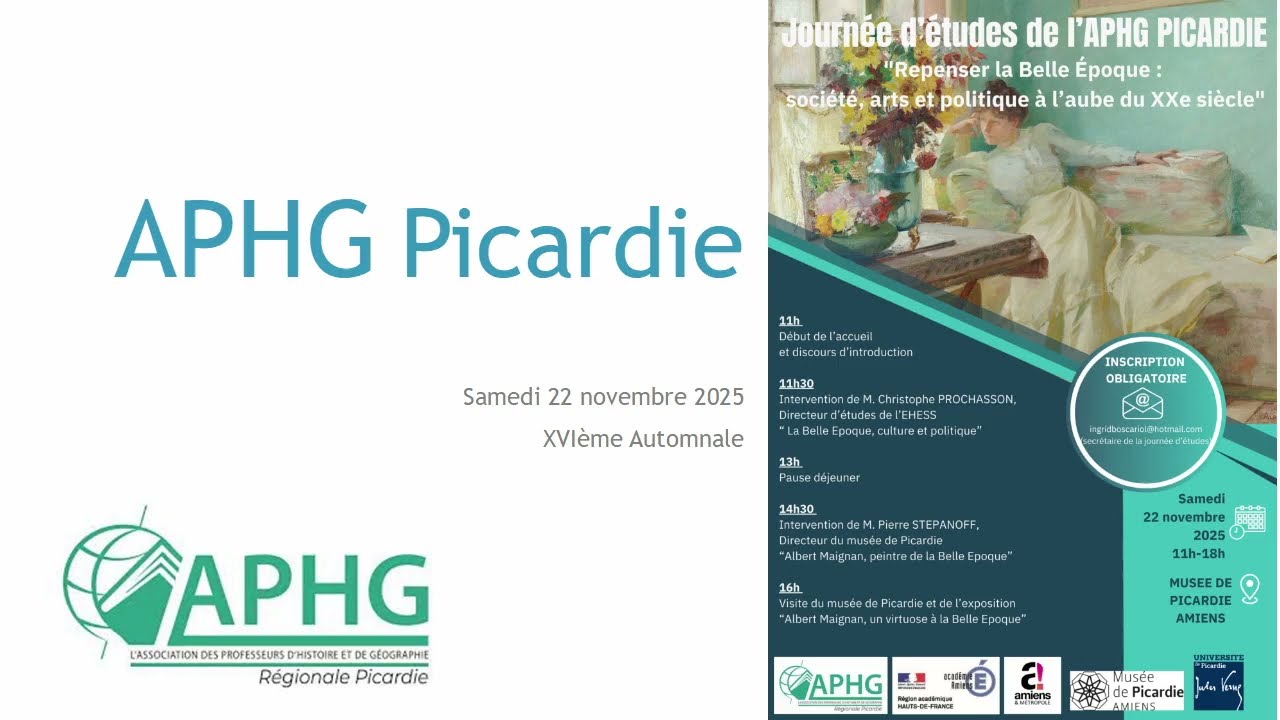
La Belle Époque, culture et politique
Keywords
Summary
175 words
Critical Evaluation
Value of the Information & Strength of the Argument
The lecture provides a valuable synthesis of recent historiography on the Belle Époque, offering a nuanced perspective that goes beyond common stereotypes. Prochasson’s argumentation is solid, as he supports his claims with references to key historians and works, such as Dominique Kalifa’s ‘La véritable histoire de la Belle Époque’ and Madeleine Rebérioux’s contributions. He effectively demonstrates how the Belle Époque was constructed as a nostalgic imaginary in the 1930s and how this imaginary has shaped subsequent historical research. The discussion of the relationship between culture and politics is particularly insightful, highlighting the role of the Third Republic in promoting education and mass culture. However, the lecture is primarily an overview and does not delve deeply into specific debates or controversies, which may limit its value for specialists.
Scientific Rigor, Source Quality, Title Accuracy
The lecture demonstrates a high level of scientific rigor, as the speaker is a distinguished historian and the content is based on established scholarship. Prochasson cites several key works and authors, including Dominique Kalifa, Madeleine Rebérioux, and Antoine Prost, providing a solid foundation for his arguments. The title accurately reflects the content, which explores the cultural and political aspects of the Belle Époque. The lecture is well-structured and coherent, with a clear introduction, development, and conclusion. However, as an oral presentation, it lacks formal citations and references, which may be a limitation for those seeking to verify specific claims. Overall, the sources are reliable and the title is appropriate.
251 words
Title / Content Match
The title accurately reflects the content, which explores the cultural and political dimensions of the Belle Époque.
Quality & Reliability
8/10
The speaker is a recognized historian (director of studies at EHESS) and the content is based on established historiography. The lecture is well-structured and references key scholars and works, though it is an oral presentation without formal citations.
Key Moments
Markers derived by PSI from the transcript: the creator did not define chapters.
- Introduction: The speaker acknowledges the challenge of covering the Belle Époque in 40-45 minutes and outlines his two-part plan.
- Discussion of the term 'Belle Époque' and its origins in the 1930s, with reference to André Aléo's radio program.
- Exploration of the cultural imaginary of the Belle Époque, including the role of art, literature, and the Musée d'Orsay.
- Analysis of the historiographical renewal of the 1980s, influenced by political and cultural factors.
- Discussion of mass culture, including the rise of the press, expositions universelles, and the beginnings of cinema.
- Examination of avant-garde movements in art and the changing relationship with reality, with reference to Henri Poincaré.
- Discussion of the formation of modern social sciences during the Belle Époque, including history, sociology, and geography.
- Conclusion: The speaker summarizes the key points and emphasizes the enduring significance of the Belle Époque.
Cited Sources
- La véritable histoire de la Belle Époque — Referenced as a key synthesis by Dominique Kalifa.
- Les Français de la Belle Époque — Mentioned as a recent book by Antoine Prost.
- Revue 1900 — The speaker mentions he directs this journal, which focuses on cultural and intellectual history of the Belle Époque.
Concurring Sources
- La véritable histoire de la Belle Époque — Dominique Kalifa's work aligns with the speaker's interpretation of the Belle Époque as a constructed imaginary.
Contribution & Novelties
The lecture offers a comprehensive overview of the Belle Époque, synthesizing recent historiography and highlighting the interplay between culture and politics. It provides a nuanced understanding of how the period was constructed as a nostalgic imaginary and how this has influenced historical research. The speaker’s emphasis on the role of the Third Republic in shaping cultural and political life is particularly insightful.
Pour aller plus loin :
- Belle Époque - Wikipedia — Provides a general overview of the period.
- Third French Republic - Wikipedia — Contextualizes the political regime of the era.
- Musée d’Orsay - Official Website — The museum dedicated to the art of the period.
107 words
Radar Profile
The radar profile shows high scores in quantity and quality of information, reflecting the speaker's expertise and the comprehensive coverage of the topic. The technical level is moderate, indicating that the content is accessible to a general audience while still offering depth. The overall reliability is high, supported by the speaker's credentials and the use of established historiography.
💬 No comments were provided for analysis.