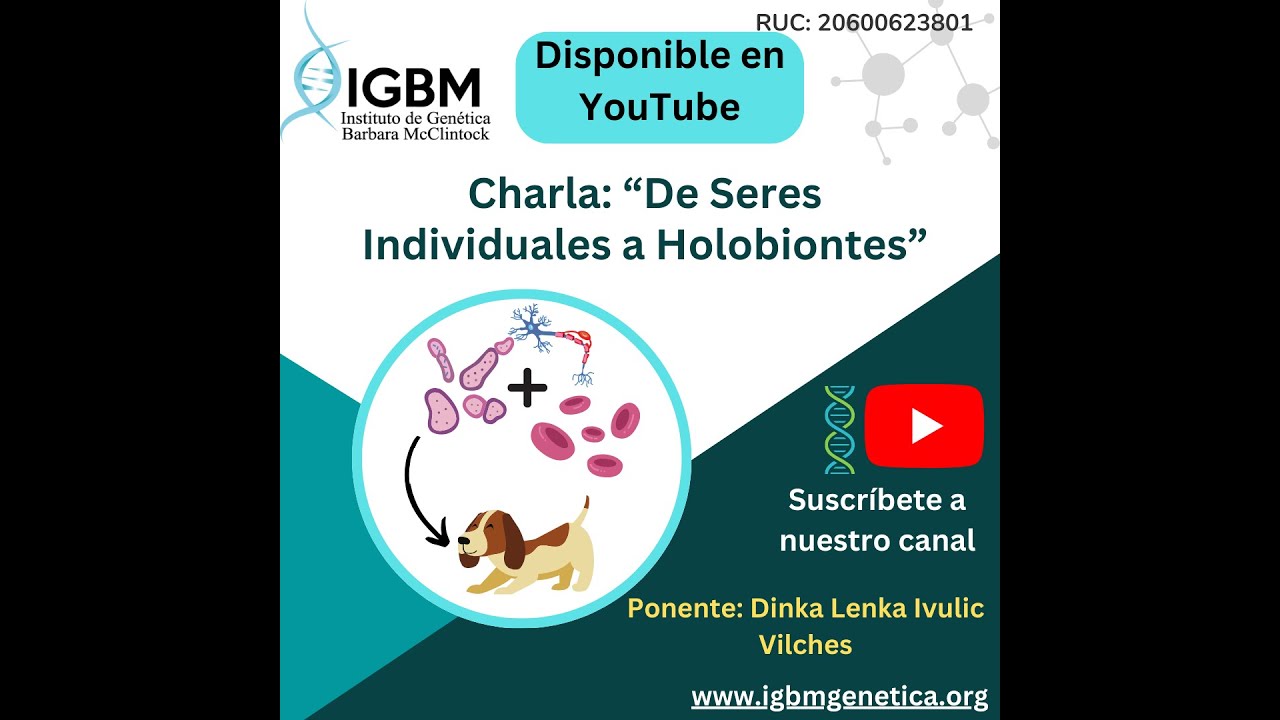
De seres individuales a holobiontes
Keywords
Summary
189 words
Critical Evaluation
Value of the Information & Strength of the Argument
The talk provides a comprehensive overview of the holobiont concept, supported by a wide range of examples from different biological systems. The argumentation is coherent and builds logically from the historical background to modern applications. The speaker effectively demonstrates how the holobiont perspective reshapes our understanding of evolution and biodiversity. However, the presentation is largely descriptive and lacks critical evaluation of the concept’s limitations or alternative viewpoints. The examples are well-chosen and illustrate the diversity of symbiotic relationships, but the depth of explanation varies, with some examples treated superficially.
Scientific Rigor, Source Quality, Title Accuracy
The scientific rigor is generally high, as the content aligns with established research on microbiomes and symbiosis. However, the talk does not cite specific sources or studies, which limits the ability to verify claims. The title accurately reflects the content, which transitions from the traditional view of individual organisms to the holobiont concept. The presentation is well-structured and accessible, but it could benefit from explicit references to the scientific literature. No comments were provided for analysis.
180 words
Title / Content Match
The title accurately reflects the content, which transitions from the traditional view of individual organisms to the holobiont concept.
Quality & Reliability
8/10
The talk is based on well-established scientific concepts (holobiont, hologenome) and presents multiple concrete examples from published research. The speaker is a PhD holder and the content aligns with current microbiome literature. However, no specific citations or references are provided during the talk, and the presentation is largely descriptive rather than critical.
Key Moments
Markers derived by PSI from the transcript: the creator did not define chapters.
- Introduction to the concept of individuality and its limitations.
- Definition of symbiosis and its historical context.
- Lynn Margulis and the endosymbiotic theory.
- Introduction of the holobiont concept and hologenome theory.
- Examples of human microbiome: metabolism, vitamins, bile acids.
- Examples in plants: nitrogen fixation and mycorrhizae.
- Marine examples: bioluminescent squid and fish, coral-algae symbiosis.
- Arthropod examples: Wolbachia and nematode-bacteria coevolution.
- Discussion on the implications of holobionts for evolution and biodiversity.
Cited Sources
- WhatsApp Channel — Channel for sharing links to free talks.
Concurring Sources
- Holobiont - Wikipedia — Supports the definition and examples of holobionts.
- Hologenome theory - Wikipedia — Supports the hologenome concept as a unit of selection.
Contribution & Novelties
The talk provides a clear and accessible introduction to the holobiont concept, synthesizing a wide range of examples from different biological systems. It emphasizes the importance of symbiosis in evolution and challenges the traditional individualistic view. The presentation is valuable for those new to the concept, but it does not offer novel insights for experts.
Pour aller plus loin :
- Holobiont - Wikipedia — Overview of the holobiont concept and its history.
- Hologenome theory - Wikipedia — Explanation of the hologenome theory and its implications.
- Lynn Margulis - Wikipedia — Biography of Lynn Margulis and her contributions to symbiosis.
- Endosymbiotic theory - Wikipedia — Detailed explanation of the endosymbiotic theory.
- Microbiome - Wikipedia — General information on microbiomes and their roles.
121 words
Radar Profile
The radar profile shows high scores in quantity and quality of information, and moderate technical level, indicating a well-structured and informative presentation. The global reliability is also high, reflecting the scientific basis of the content. The talk is suitable for a general audience with some scientific background.