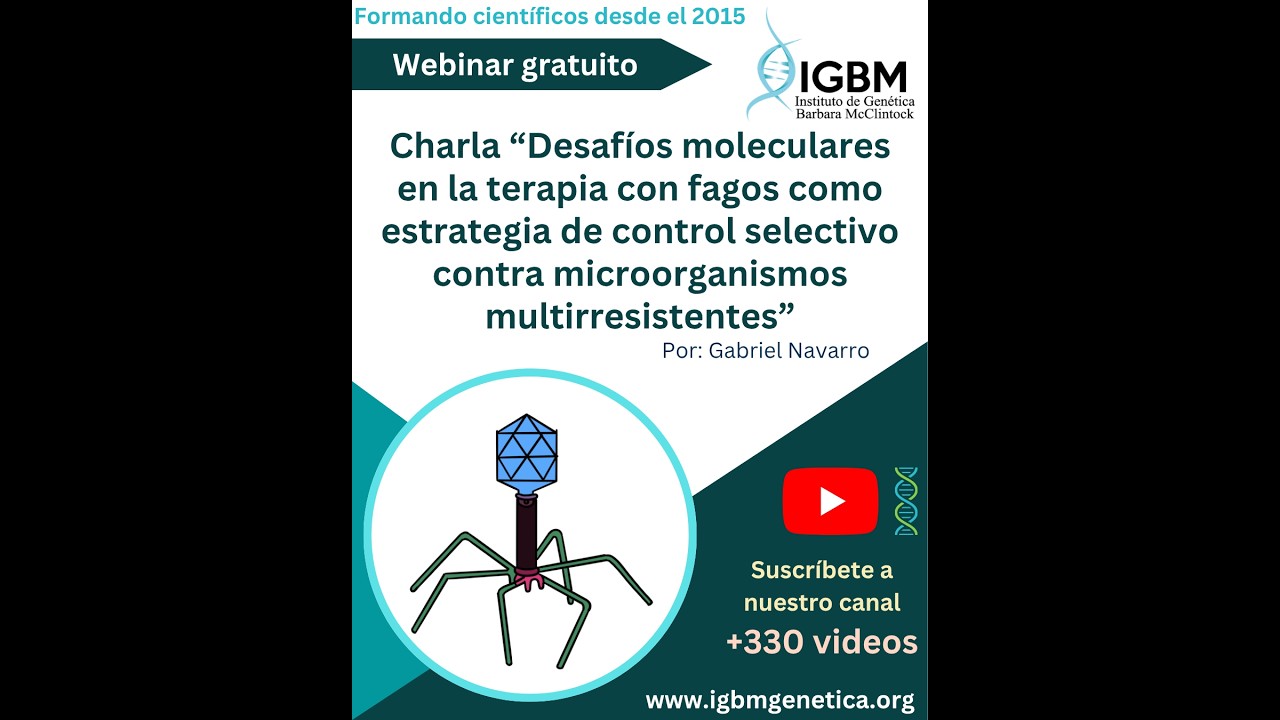
Desafíos moleculares en la fagoterapia como estrategia de control contra microorganismos resistentes
Keywords
Summary
151 words
Critical Evaluation
Value of the Information & Strength of the Argument
The lecture provides valuable information on the current state and challenges of phage therapy, synthesizing historical context, clinical evidence, and molecular mechanisms. The argumentation is coherent and well-supported by cited clinical cases and studies, such as the 2006 Texas study and the 2017 Georgia trial. The speaker effectively explains complex concepts like transduction and endolysins, making the case for phage therapy’s potential while acknowledging its limitations. However, the presentation is largely descriptive and does not critically evaluate the strength of the evidence or discuss alternative viewpoints in depth. The argumentation would benefit from more explicit comparisons with conventional antibiotics and a more nuanced discussion of the risks and benefits.
Scientific Rigor, Source Quality, Title Accuracy
The speaker demonstrates scientific rigor by referencing historical figures and clinical studies, but specific citations are often missing. The title accurately reflects the content, which focuses on molecular challenges. The presentation is technically accurate, but the lack of detailed source citations and the reliance on anecdotal case reports limit its scientific robustness. The speaker does not provide a systematic review of the literature, and some claims, such as the 96.2% of phages having head-tail structure, are stated without reference. Overall, the talk is informative but would benefit from more rigorous sourcing.
215 words
Title / Content Match
The title accurately reflects the content, which focuses on molecular challenges in phage therapy against resistant microorganisms.
Quality & Reliability
7/10
The speaker demonstrates solid knowledge of phage therapy, citing historical and recent clinical cases, and explains molecular mechanisms accurately. However, the presentation is largely a review of existing literature without original data, and some claims lack specific citations. The talk is technically sound but not groundbreaking.
Key Moments
Markers derived by PSI from the transcript: the creator did not define chapters.
- Introduction to antimicrobial resistance and its history.
- Definition of phage therapy and historical cases.
- Clinical cases of phage therapy, including compassionate use.
- Limitations of phage therapy: immune response and transduction.
- Introduction to recombinant endolysins and their advantages.
- Molecular techniques for endolysin production and applications.
Cited Sources
- WHO Global Action Plan on Antimicrobial Resistance — Mentioned in the context of global strategies against antimicrobial resistance.
- Phage therapy clinical trial in Georgia (2017) — Referenced as a randomized double-blind phase 2/3 study using a commercial phage cocktail.
- Case report of phage therapy for Pseudomonas aeruginosa infection in Belgium (2017) — Cited as a compassionate use case.
- Genetically modified phages for Mycobacterium abscessus infection (2019) — Mentioned as the first case of genetically engineered phages.
Concurring Sources
- Phage therapy: past, present and future — Supports the historical and clinical aspects of phage therapy.
- Endolysins as novel antimicrobials — Aligns with the discussion on recombinant endolysins.
Dissenting Sources
- Potential risks of phage therapy — Some studies highlight the risk of phage-mediated transduction of resistance genes, which the speaker acknowledges but does not fully explore.
Contribution & Novelties
The lecture provides a comprehensive overview of phage therapy, emphasizing molecular challenges and the potential of recombinant endolysins. It synthesizes historical and recent clinical evidence, highlighting both the promise and limitations of phage therapy. The discussion of transduction risks and the shift towards endolysins offers a nuanced perspective on the field’s future directions.
Pour aller plus loin :
- Bacteriophage therapy: a review of the literature — Relevant for a broader understanding of phage therapy’s clinical applications.
- Endolysins: a new class of antimicrobials — Discusses the potential of endolysins as alternatives to antibiotics.
- Antimicrobial resistance: global report on surveillance — Provides context on the global burden of AMR.
107 words
Radar Profile
The radar profile shows high scores in information quantity and technical level, indicating a content-rich and technically detailed presentation. The quality and reliability scores are moderate, reflecting the reliance on anecdotal evidence and lack of original research. Overall, the lecture is informative but not groundbreaking.
💬 No comments were provided for analysis.