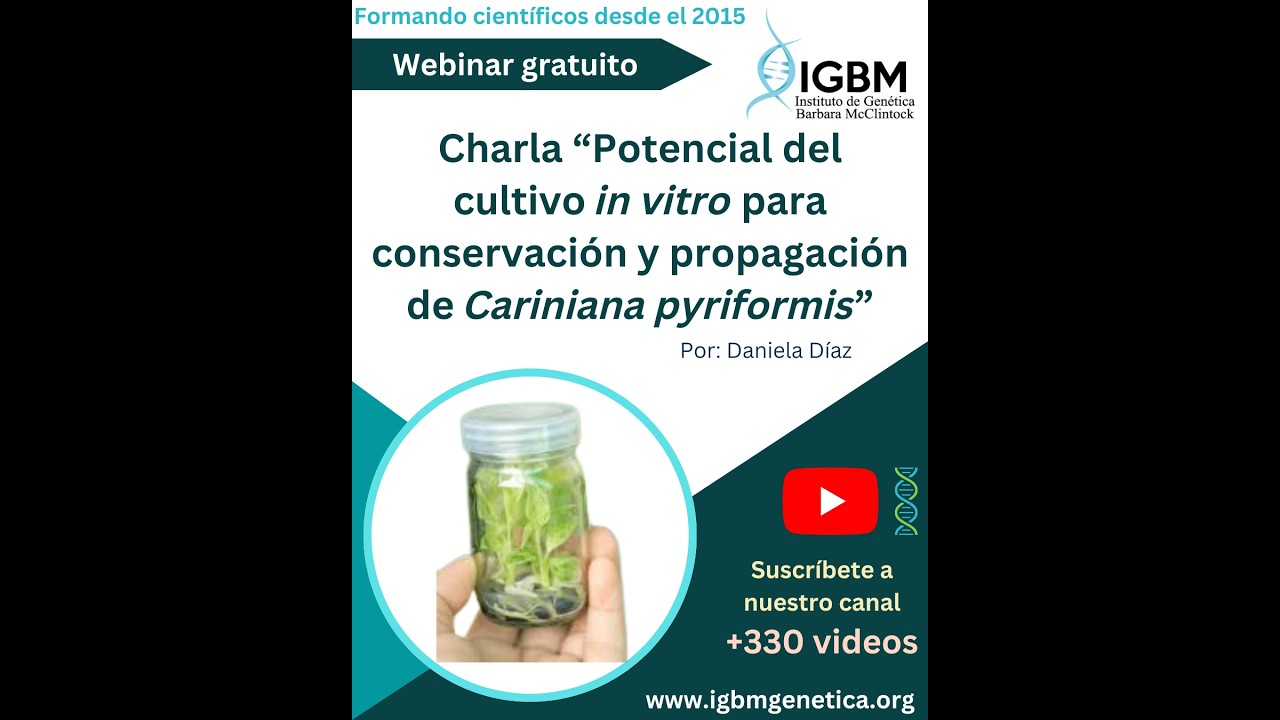
Potencial del cultivo in vitro para conservación y propagación de Cariniana pyriformis
Keywords
Summary
198 words
Critical Evaluation
Value of the Information & Strength of the Argument
The presentation provides valuable information on the conservation of an endangered species using biotechnological tools. The argumentation is solid, based on the species’ critical status, the lack of in vitro studies, and the potential benefits for the region’s economy. The speaker clearly explains the methodology and justifies the choice of techniques. However, the presentation is more of a project proposal than a completed study, and the argumentation relies heavily on the potential outcomes rather than empirical data.
Scientific Rigor, Source Quality, Title Accuracy
The scientific rigor is moderate. The speaker references databases like GBIF and SIB, and mentions regulations such as CITES and the Convention on Biological Diversity, which adds credibility. However, no specific scientific papers are cited, and the project is in early stages, so results are not yet available. The title accurately reflects the content, and the presentation is well-structured. The Q&A session shows engagement with the audience, but no comments were provided for analysis.
166 words
Title / Content Match
The title accurately reflects the content, which focuses on the potential of in vitro culture for conservation and propagation of Cariniana pyriformis.
Quality & Reliability
7/10
The presentation is based on a research project in progress, with clear methodology and references to databases (GBIF, SIB) and regulations (CITES, CBD). However, it lacks detailed experimental data and peer-reviewed sources, and the speaker acknowledges the project is in early stages.
Key Moments
Markers derived by PSI from the transcript: the creator did not define chapters.
- Introduction of the speaker and the topic.
- General characteristics of Cariniana pyriformis.
- Conservation status and reasons for choosing the species.
- Explanation of in vitro techniques: micropropagation and germination.
- Methodology overview and project phases.
- Discussion of regulations and legal framework.
- Q&A session: ecological role and complex phases.
- Q&A session: contaminants and culture media.
Cited Sources
- GBIF — Used to show distribution records of Cariniana pyriformis.
- SIB (Sistema de Información sobre Biodiversidad de Colombia) — Referenced for national biodiversity data.
- CITES — Mentioned as a regulation for protecting endangered species.
- Convention on Biological Diversity — Referenced as a framework for conservation.
Concurring Sources
- IUCN Red List — The speaker mentions the IUCN status of the species, which is consistent with global conservation assessments.
Contribution & Novelties
The presentation highlights a pioneering approach to conserving Cariniana pyriformis using in vitro culture, which has not been previously explored for this species. The project aims to fill a research gap and potentially provide a model for other endangered species in the region. The novelty lies in the application of established biotechnological techniques to a critically endangered timber species, with the dual goal of conservation and commercial reactivation.
Pour aller plus loin :
- Micropropagation — Overview of the technique used for mass propagation.
- Somatic embryogenesis — Related technique for plant regeneration.
- Conservation biology — Broader context for conservation efforts.
99 words
Radar Profile
The radar profile shows balanced scores across information quantity, quality, technical level, and reliability, with a slight emphasis on information quality and technical level. This indicates a well-structured presentation with solid content, though the reliability is slightly lower due to the project's early stage.