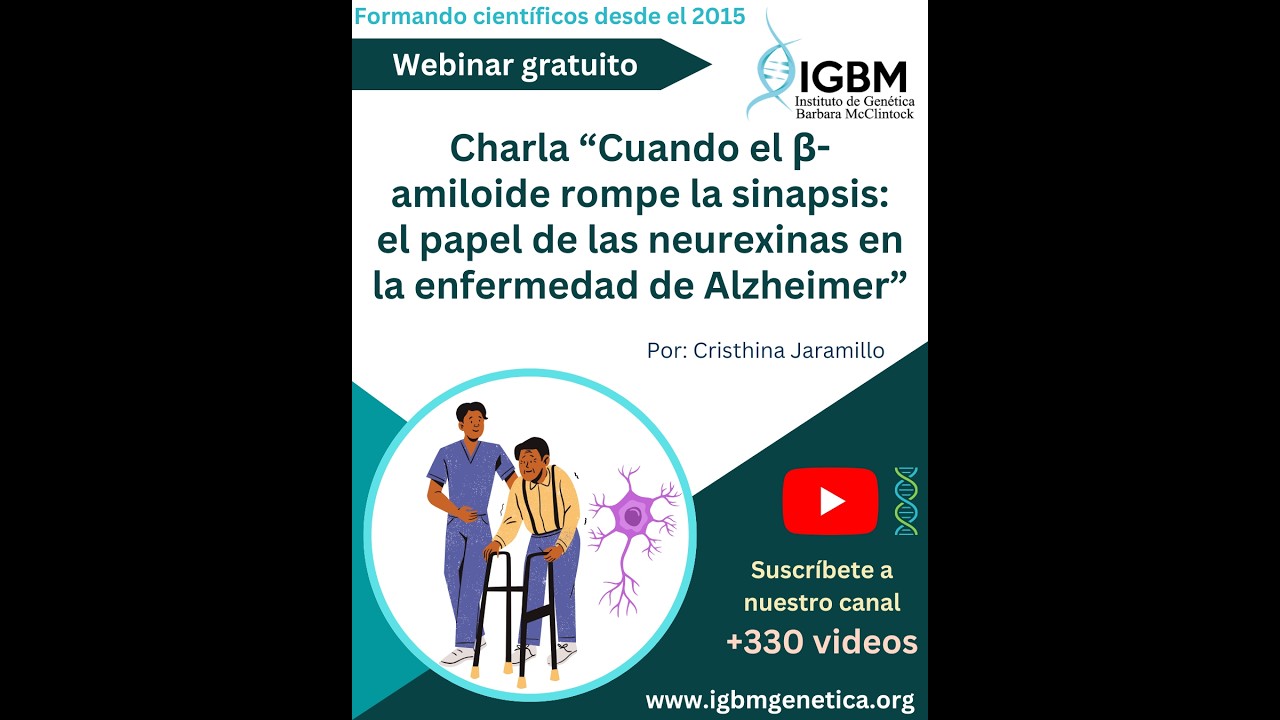
Cuando el β-amiloide rompe la sinapsis: el papel de las neurexinas en la enfermedad de Alzheimer
Keywords
Summary
168 words
Critical Evaluation
Value of the Information & Strength of the Argument
The talk provides a comprehensive overview of the molecular basis of Alzheimer’s disease, with a clear focus on the role of beta-amyloid in synaptic dysfunction. The speaker effectively argues that oligomeric Aβ42 is the primary culprit in synaptic damage, and she supports this with evidence from the literature and her own research. The argumentation is logical and well-structured, moving from the clinical presentation to the molecular mechanisms. The value of the information is high for an audience with some background in neuroscience, as it synthesizes current knowledge and highlights the importance of neurexins in this context.
Scientific Rigor, Source Quality, Title Accuracy
The speaker demonstrates scientific rigor by referencing established concepts and her own laboratory’s work. However, specific citations are not provided in the talk, and the description only includes a WhatsApp channel link, which is not a scientific source. The title accurately reflects the content, and the talk is well-organized. The lack of explicit references is a minor weakness, but the content is consistent with current scientific understanding.
178 words
Title / Content Match
The title accurately reflects the content, which focuses on the role of neurexins in synaptic disruption by beta-amyloid in Alzheimer's disease.
Quality & Reliability
8/10
The speaker is a PhD student in cell biology with a focus on neurodegenerative diseases, and the talk is based on established scientific knowledge and her own research. The content is consistent with current understanding of Alzheimer's disease, though it is presented as an expert opinion rather than a peer-reviewed study.
Key Moments
Markers derived by PSI from the transcript: the creator did not define chapters.
- Introduction of the speaker and topic.
- Clinical case presentation of Alzheimer's disease.
- Histopathological features: amyloid plaques and neurofibrillary tangles.
- Amyloidogenic pathway and generation of Aβ40 and Aβ42.
- Tau hyperphosphorylation and its role in neurodegeneration.
- Effects of Aβ species and concentrations on synaptic function.
- Introduction to neurexins and their role in synaptic adhesion.
- Mechanisms by which beta-amyloid disrupts neurexin function.
- Discussion of therapeutic implications and future directions.
Cited Sources
- Instituto de Genética Barbara McClintock WhatsApp Channel — Channel for joining future talks.
Concurring Sources
- Amyloid beta — General information on amyloid beta, consistent with the talk.
- Neurexin — Information on neurexins, supporting the talk's focus.
Contribution & Novelties
The talk provides a clear synthesis of current knowledge on the role of beta-amyloid in synaptic dysfunction, with a specific focus on neurexins, which is a relatively novel angle. It emphasizes the importance of oligomeric Aβ42 and its interaction with synaptic adhesion molecules. The speaker also highlights the need for early intervention before clinical symptoms appear.
Pour aller plus loin :
- Amyloid beta — Overview of the peptide and its role in Alzheimer’s.
- Neurexin — Information on neurexins and their function in synapses.
- Alzheimer’s disease — General background on the disease.
91 words
Radar Profile
The radar profile shows high scores in information quantity, quality, and reliability, with a slightly lower technical level, indicating a talk that is informative and credible but accessible to a broader audience.
💬 No comments were provided for analysis.