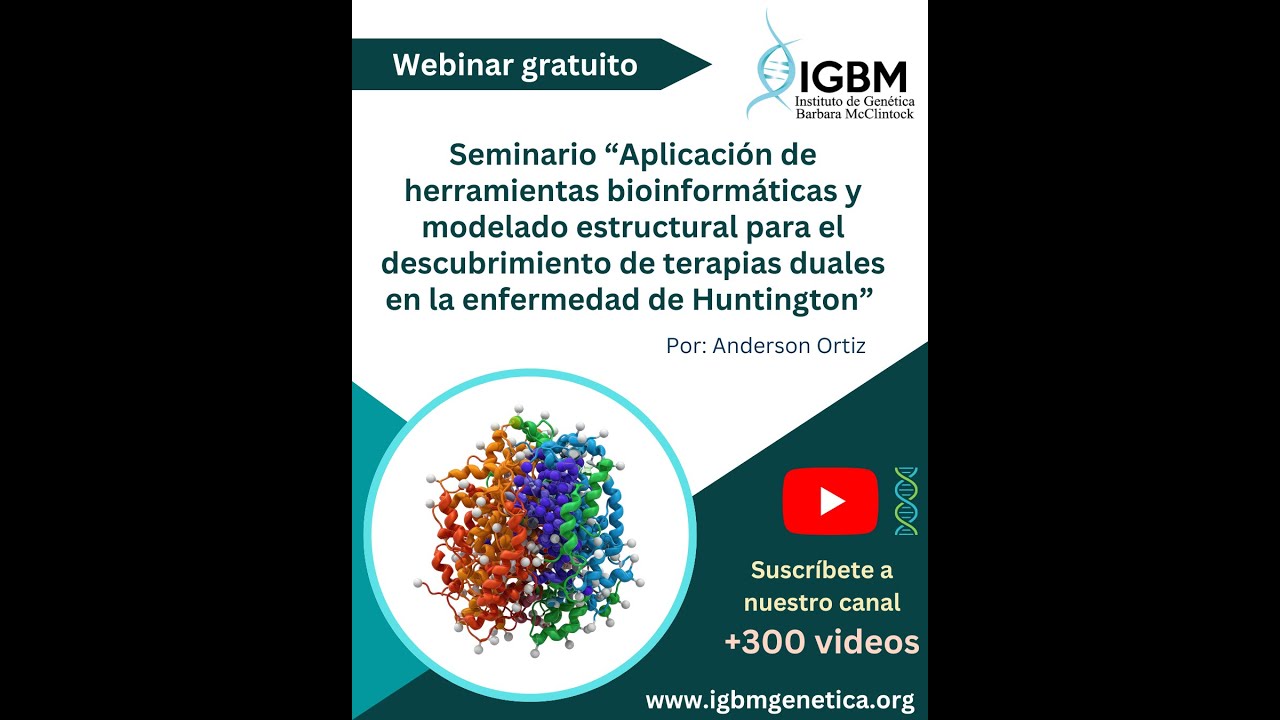
Aplicación bioinformáticas y modelado estructural para el descubrimiento de terapias en Huntington
Keywords
Summary
131 words
Critical Evaluation
Value of the Information & Strength of the Argument
The video provides a clear overview of a computational approach to drug discovery for Huntington’s disease. The argumentation is logical, starting from the disease mechanism to the proposed dual therapeutic strategy. The value lies in the integration of bioinformatics and structural biology to address a rare disease, which is a promising area. However, the presentation is a proposal without experimental validation, and the speaker acknowledges uncertainties about computational costs and the need for further research. The argumentation is solid but lacks depth in some areas, such as the specific details of the docking protocols and the selection of compounds.
Scientific Rigor, Source Quality, Title Accuracy
The speaker cites several papers from 2020 onwards, but specific references are not clearly provided in the video. The description includes a WhatsApp channel link, which is not a scientific source. The title accurately reflects the content. The scientific rigor is moderate: the speaker references GWAS studies and molecular dynamics methods, but does not provide detailed citations or data. The presentation is more of a research proposal than a rigorous scientific review.
186 words
Title / Content Match
The title accurately reflects the content, which focuses on bioinformatics and structural modeling for Huntington's disease therapies.
Quality & Reliability
6/10
The presentation is a personal research proposal by a student, based on a literature review and computational methods. It is informative but lacks peer-reviewed validation and detailed methodological specifics.
Key Moments
Markers derived by PSI from the transcript: the creator did not define chapters.
- Introduction to the seminar and speaker
- Overview of Huntington's disease: definition, rarity, and genetic cause
- Explanation of the dual therapeutic strategy: inhibiting MSH3 and blocking mHTT aggregation
- Research objectives and motivation
- Molecular biology of Huntington's disease: CAG repeats and protein aggregation
- Role of MSH3 and MMR in disease progression
- Bioinformatics tools: molecular docking, molecular dynamics, and free energy calculations
- Methodology: three modules - initial analysis, virtual screening, and validation
- Details on sequence alignment, genomic analysis, and structural modeling
- Expected results and conclusion
Cited Sources
- WhatsApp Channel of IGBM — Link provided in the video description for joining the institute's channel for free talks.
Concurring Sources
- GWAS studies on Huntington's disease — The speaker mentions large-scale genetic studies identifying MSH3 as a modifier, but no specific URL is provided.
Contribution & Novelties
The presentation proposes a novel dual therapeutic strategy for Huntington’s disease by combining inhibition of MSH3 and blocking mHTT aggregation using computational methods. This approach is innovative as it targets two key pathological mechanisms simultaneously. The speaker integrates genomic, transcriptomic, and structural data to identify potential drug candidates, which is a comprehensive approach. However, the work is preliminary and lacks experimental validation.
Pour aller plus loin :
- Huntington’s disease - Wikipedia — Overview of the disease.
- MSH3 - Gene — Information on the MSH3 gene.
- Molecular dynamics - Wikipedia — Background on MD simulations.
- AlphaFold - DeepMind — AI-based protein structure prediction.
102 words
Radar Profile
The radar profile shows moderate scores across all dimensions, indicating a balanced but not exceptional presentation. The technical level is relatively high, but the quantity and quality of information are moderate, and the overall reliability is limited due to the lack of peer-reviewed sources.