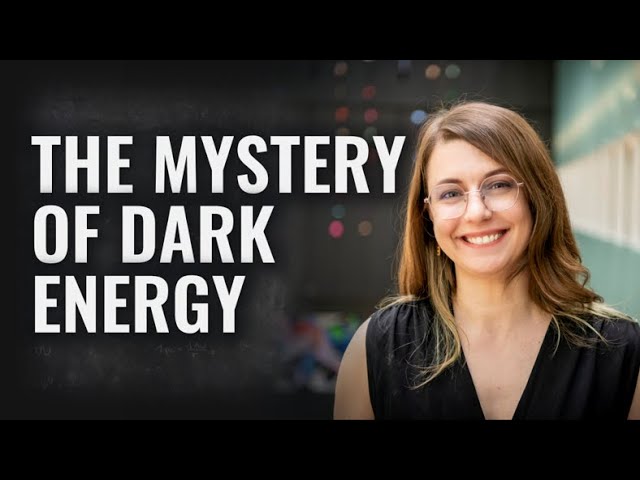
Jessie Muir on the mystery of dark energy | Conversations at the Perimeter
Keywords
Summary
214 words
Critical Evaluation
Value of the Information & Strength of the Argument
The video provides valuable insights into the current state of dark energy research, explained by an active researcher. Muir’s explanations are clear and accessible, using analogies like a lawn of grass to illustrate statistical uniformity. She effectively argues for the importance of statistical methods in cosmology, distinguishing between predictions of individual galaxy positions and statistical properties. The discussion on the Dark Energy Survey offers a concrete example of how large collaborations operate and the challenges of data analysis. The argumentation is solid, with Muir carefully separating established facts from hypotheses and acknowledging uncertainties in modeling.
Scientific Rigor, Source Quality, Title Accuracy
The scientific rigor is high, as the guest is a practicing cosmologist involved in a major survey. She accurately describes the standard model of cosmology and the evidence for dark energy. However, the conversational format means that specific sources or publications are not cited, and the depth of methodological detail is limited. The title accurately reflects the content, focusing on dark energy and the guest’s expertise. The video is a science communication piece, not a formal lecture, so it prioritizes accessibility over technical depth.
194 words
Title / Content Match
The title accurately reflects the content, focusing on dark energy research and the guest's expertise.
Quality & Reliability
8/10
The discussion is led by a postdoctoral researcher actively involved in the Dark Energy Survey, providing expert insights grounded in current research. The content is presented with appropriate scientific caution, distinguishing established facts from hypotheses. However, the conversational format limits the depth of methodological detail, and no specific publications are cited within the video.
Key Moments
Markers derived by PSI from the transcript: the creator did not define chapters.
- Introduction to dark matter vs dark energy
- Discovery of cosmic acceleration and cosmological constant
- Role of statistics in cosmology
- Description of the Dark Energy Survey and its camera
- Galaxy clustering and weak lensing as probes
- Challenges in modeling and data analysis
- Science communication and cartoons
Cited Sources
- Conversations at the Perimeter Podcast — Podcast homepage for the series
- Episode: Jessie Muir on the mystery of dark energy — Audio version of this episode
- Perimeter Institute LinkedIn — Institution's LinkedIn page
Concurring Sources
- Dark Energy Survey — Official collaboration website, consistent with the described survey.
- Cosmological constant — General reference on the concept discussed.
Contribution & Novelties
The video offers an accessible yet expert overview of dark energy research, emphasizing the statistical nature of cosmological measurements. It provides a behind-the-scenes look at the Dark Energy Survey, illustrating how large collaborations work. The discussion on the interplay between theory and observation is valuable for understanding current research challenges.
Pour aller plus loin :
- Dark Energy Survey — Official website of the collaboration, providing details on the survey and its results.
- Cosmological constant — Wikipedia article explaining the concept and its role in general relativity.
- Weak gravitational lensing — Wikipedia article on the technique used to map dark matter distribution.
101 words
Radar Profile
The radar profile shows high scores across all dimensions, indicating a well-balanced and informative content. The strength lies in the quality and reliability of information, with slightly lower scores for technical depth due to the conversational format.
💬 Très positif. Sur les 29 commentaires analysés, la majorité exprime une grande appréciation pour la clarté des explications et l'accessibilité du sujet, avec quelques remarques critiques mineures sur le manque de formalisme statistique.