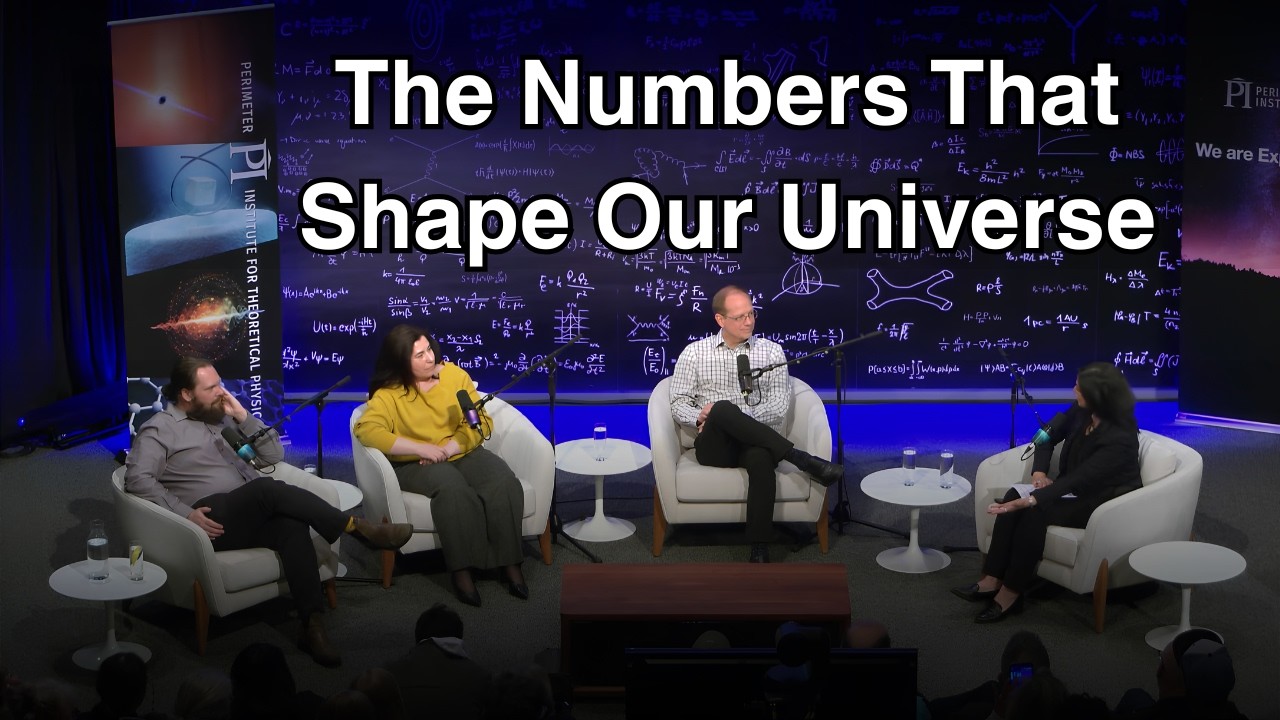
CBC IDEAS at Perimeter - The Numbers That Shape Our Universe
Keywords
Summary
164 words
Critical Evaluation
The video provides a high-quality, engaging discussion of fundamental physics concepts, featuring three experts from Perimeter Institute. The panelists demonstrate deep knowledge and communicate complex ideas in an accessible manner, using analogies and personal anecdotes. The discussion is well-structured, moving from personal introductions to specific numbers and constants, and then to broader implications. The scientific content is accurate and up-to-date, with no obvious errors or misleading statements. The panelists are careful to distinguish between established facts and speculative ideas, such as the multiverse, which they present as a hypothesis. The format as a panel discussion allows for diverse perspectives, particularly between the mathematician (Ben Webster) and the physicists (Matthew Johnson and Mina Arvanitaki), enriching the conversation. However, the video lacks explicit citations or references to specific research papers, which may limit its utility for those seeking to verify claims. The adéquation between title and content is strong, as the title accurately reflects the focus on numbers that shape our universe. The production quality is high, with clear audio and visuals. Overall, this is a valuable resource for anyone interested in fundamental physics, offering both educational content and intellectual stimulation. The only minor weakness is the absence of formal references, but the expertise of the speakers mitigates this concern.
208 words
Title / Content Match
The title accurately reflects the content, which explores fundamental numbers and constants that shape our understanding of the universe.
Quality & Reliability
8/10
The video features three established researchers from Perimeter Institute, a leading theoretical physics center. The discussion is grounded in established physics and mathematics, with accurate explanations of concepts like the cosmological constant and the speed of light. No sources are cited in the video, but the institutional affiliation and expertise of the speakers lend credibility. The content is presented as expert opinion and discussion rather than peer-reviewed research.
Key Moments
Markers derived by PSI from the transcript: the creator did not define chapters.
- Introduction by host Nahlah Ayed, introducing the panelists and the topic.
- Matthew Johnson shares his story of discovering calculus and physics.
- Mina Arvanitaki discusses the speed of light and its implications for our perception of time.
- Ben Webster explains the role of mathematics in giving precise meaning to physical concepts.
- Ben Webster shares the anecdote about the 'Grothendieck prime' 57.
- Mina Arvanitaki explains the coincidence of the moon and sun angular sizes leading to eclipses.
- Matthew Johnson introduces the cosmological constant and its significance.
- Discussion on the history of the cosmological constant and Einstein's 'biggest blunder'.
- Panelists discuss the fine-tuning of the universe and the multiverse hypothesis.
- Audience Q&A session begins, with questions about the nature of numbers and reality.
Contribution & Novelties
The video offers a unique panel discussion format that brings together a mathematician and two physicists to explore the role of fundamental numbers in physics. It provides personal insights into how these scientists think about numbers and their significance, which is not typically found in textbooks or lectures. The discussion of the cosmological constant and its implications for the universe’s expansion is particularly insightful, as it connects abstract concepts to observable phenomena.
Pour aller plus loin :
- Cosmological constant - Wikipedia — Provides a comprehensive overview of the cosmological constant, its history, and its role in modern cosmology.
- Speed of light - Wikipedia — Detailed information on the speed of light, its measurement, and its significance in physics.
- Fine-structure constant - Wikipedia — Explains the fine-structure constant, a fundamental dimensionless constant that characterizes the strength of electromagnetic interaction.
138 words
Radar Profile
The radar profile shows strong scores in quality of information and reliability, reflecting the expertise of the panelists and the accuracy of the content. The quantity of information and technical level are moderate, as the discussion is accessible but covers advanced topics. The overall balance indicates a high-quality educational resource.