Keywords
Summary
188 words
Critical Evaluation
Value of the Information & Strength of the Argument
The lecture’s value lies in its effective use of analogy to make complex cosmological and quantum concepts accessible. Alexander’s argumentation is solid: he builds a historical narrative from Pythagoras to Kepler to modern cosmology, demonstrating a continuous thread of musical thinking in physics. He clearly states that he is using analogies, not claiming literal equivalence, which maintains scientific integrity. The live musical demonstrations with Dennis Ronda powerfully illustrate the concepts of harmonics, timbre, and spectral decomposition, making abstract ideas tangible. The argument that the universe’s CMB spectrum can be understood like an instrument’s spectrum is well-supported by the data and the work of Jim Peebles. The transition to quantum mechanics is more suggestive than rigorous, but it serves as a thought-provoking conclusion rather than a definitive claim.
Scientific Rigor, Source Quality, Title Accuracy
The scientific rigor is high, consistent with a Perimeter Institute public lecture. Alexander correctly attributes the prediction of the CMB peaks to Jim Peebles and references the work of Vera Rubin and Fritz Zwicky on dark matter. He is careful to distinguish between analogy and fact. The title accurately reflects the content. The lecture is well-structured, moving from historical context to modern physics. The sources cited are primarily the historical figures (Pythagoras, Kepler) and the scientific results (CMB, dark matter), which are well-established. The lecture does not rely on external citations but rather on established scientific knowledge, which is appropriate for a public lecture.
246 words
Title / Content Match
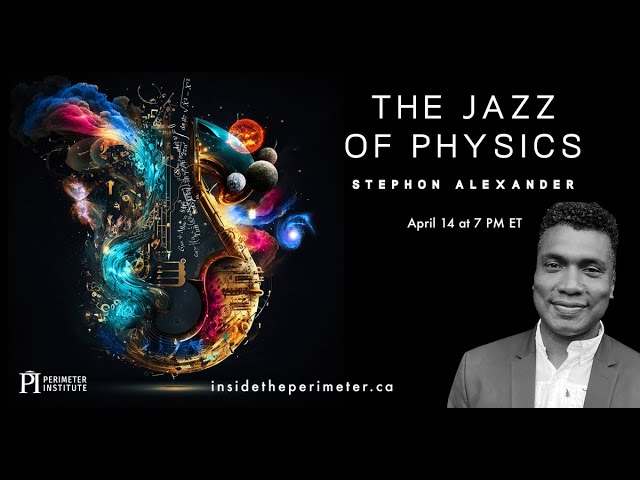
The title accurately reflects the content: a public lecture exploring parallels between jazz and physics, delivered by Stephon Alexander.
Quality & Reliability
8/10
The lecture is given by a recognized physicist (Stephon Alexander, professor at Brown University) and hosted by Perimeter Institute, a leading theoretical physics center. The content is scientifically accurate, well-structured, and appropriately caveated as analogical. The presentation is engaging and accessible without compromising rigor.
Key Moments
Markers derived by PSI from the transcript: the creator did not define chapters.
- Introduction by Katie Mack and Lauren Hayward, welcoming Stephon Alexander.
- Alexander begins his talk, sharing his background and the conflict between music and science.
- Discussion of Pythagoras and the discovery of musical ratios, with live demonstration on monochord.
- Explanation of Kepler's laws and his use of musical ratios to derive planetary motion.
- Introduction to Fourier transform and its application to sound waves.
- Application of Fourier analysis to the cosmic microwave background, revealing peaks that indicate universe's composition.
- Transition to quantum mechanics, drawing parallels between quantum probability and jazz improvisation.
- Conclusion and final thoughts on the unity of music and physics.
Cited Sources
- Perimeter Institute newsletter — Mentioned in the video description for updates on future webcasts and events.
- Perimeter Institute donation page — Mentioned in the video description as a way to support Perimeter Institute.
- Perimeter Institute public engagement page — Mentioned in the video description as a way to support Perimeter Institute's public events.
Concurring Sources
- Perimeter Institute — Host institution, known for high-quality theoretical physics outreach.
- Stephon Alexander's faculty page at Brown University — Confirms the speaker's credentials as a professor of physics.
Contribution & Novelties
The lecture’s original contribution is its compelling and accessible narrative that connects jazz improvisation to fundamental physics, from Pythagoras to modern cosmology. It offers a fresh perspective on the role of analogy in scientific discovery, emphasizing the creative and exploratory nature of both jazz and physics. The live musical demonstrations make abstract concepts like Fourier analysis and spectral decomposition tangible and intuitive.
Pour aller plus loin :
- Music of the spheres — Historical concept linking music and astronomy, central to the lecture’s theme.
- Cosmic microwave background — The radiation whose spectrum is analyzed in the lecture to reveal the universe’s composition.
- Fourier transform — Mathematical tool used to decompose waves, key to the lecture’s analogy between instruments and the universe.
- Dark matter — Mysterious matter inferred from the CMB peaks and galaxy formation, discussed in the lecture.
- Quantum mechanics — The probabilistic framework of physics, compared to jazz improvisation in the lecture.
152 words
Radar Profile
The radar profile shows high scores in information quantity, quality, and reliability, with a slightly lower technical level, reflecting the lecture's accessible yet rigorous nature. The strong performance across all dimensions indicates a well-balanced and effective science communication piece.