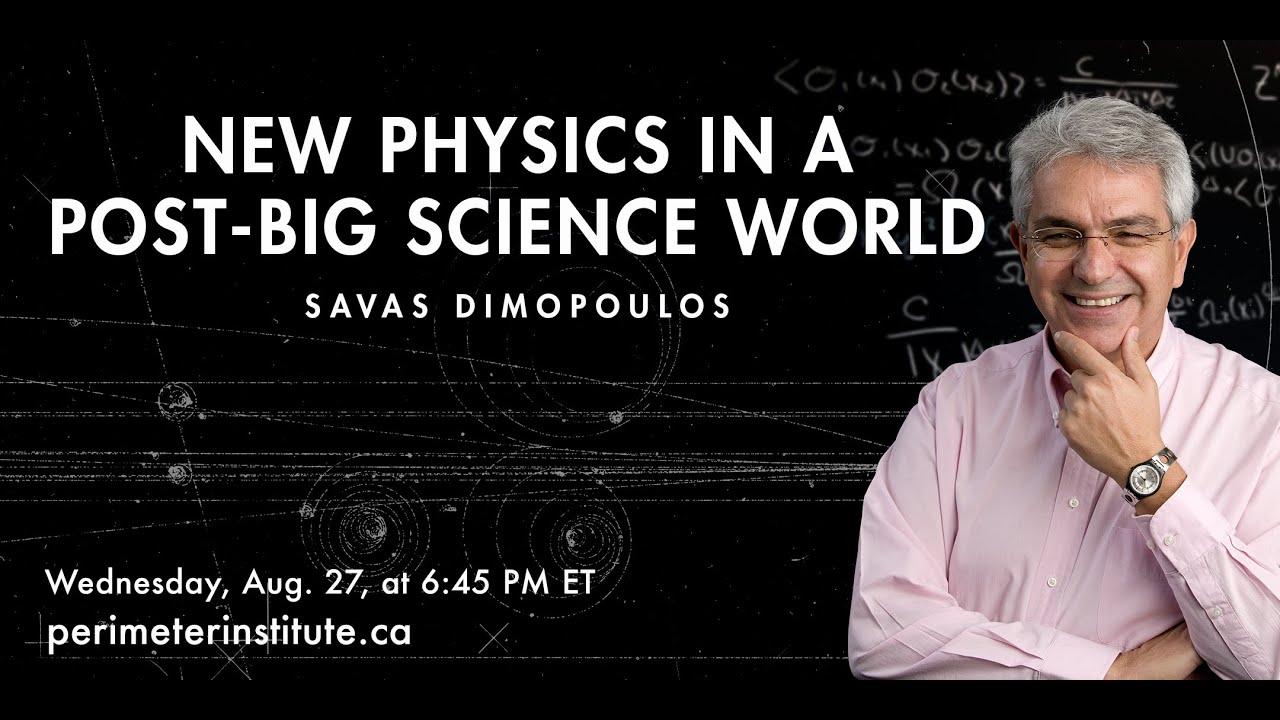
Public Lecture: New Physics in a Post-Big Science World - Savas Dimopoulos
Keywords
Summary
139 words
Critical Evaluation
The lecture provides a compelling overview of the current state of particle physics and the potential shift towards small-scale experiments. Dimopoulos, a leading theorist, presents the material with authority and clarity. The historical context, from Archimedes to the LHC, is well-structured and engaging. The argument for small-scale science is persuasive, though it remains speculative. The lecture lacks detailed citations, but the speaker’s expertise lends credibility. The title accurately reflects the content. The Q&A session adds value, addressing audience questions. Overall, the lecture is informative and thought-provoking, suitable for a general audience with some physics background. The main weakness is the absence of concrete examples of ongoing small-scale experiments, which would strengthen the argument. Additionally, the speculative nature of extra dimensions and supersymmetry is acknowledged but not critically examined. Nevertheless, the lecture succeeds in conveying the excitement of fundamental physics research.
140 words
Title / Content Match
The title accurately reflects the content: a lecture on new physics beyond big science, focusing on small-scale experiments.
Quality & Reliability
8/10
Lecture by a renowned theoretical physicist, presenting established physics concepts and speculative ideas clearly. No citations provided, but speaker's expertise is high. Content is accurate but not peer-reviewed.
Key Moments
Markers derived by PSI from the transcript: the creator did not define chapters.
- Introduction by Emily Petro, acknowledging traditional territory and introducing Savas Dimopoulos.
- Dimopoulos begins lecture, discussing the role of mathematics and experiment in physics.
- Historical examples: Archimedes' Eureka moment and Eratosthenes' measurement of Earth's circumference.
- Transition to big science era, starting with Manhattan Project and growth of accelerators.
- Completion of Standard Model with Higgs boson discovery at LHC.
- Discussion of unresolved mysteries: dark matter, weakness of gravity, extra dimensions.
- Argument for small-scale experiments as future of fundamental physics.
- Q&A session begins, addressing audience questions.
Cited Sources
- Perimeter Institute Newsletter — Mentioned in description for staying updated.
- Perimeter Institute Donation Page — Mentioned in description for supporting science.
- Perimeter Institute LinkedIn — Mentioned in description for following Perimeter Institute.
Concurring Sources
- Perimeter Institute — Institution hosting the lecture, known for theoretical physics research.
Contribution & Novelties
The lecture offers a unique perspective on the future of particle physics, advocating for a shift from large-scale collaborations to smaller, more agile experiments. Dimopoulos draws on his own research in supersymmetry and extra dimensions to illustrate potential breakthroughs. The historical narrative provides context for this transition.
Pour aller plus loin :
- The Standard Model — Overview of the theory that describes fundamental particles and forces.
- Dark Matter — Evidence and theories about the mysterious substance.
- Large Extra Dimensions — Concept proposed by Dimopoulos and others.
- Supersymmetry — Theoretical framework extending the Standard Model.
94 words
Radar Profile
The radar profile shows high scores in information quantity, quality, and technical level, with a slightly lower but still strong reliability score. This indicates a well-balanced lecture that is both informative and credible.