QTML 2025: Decoded Quantum Interferometry
Keywords
Summary
111 words
Critical Evaluation
Value of the Information & Strength of the Argument
The talk provides a high-value presentation of a novel quantum algorithm with potential exponential speedup for optimization problems. The argumentation is solid, based on rigorous theoretical results and numerical evidence. The speaker clearly explains the reduction and the conditions for advantage. He also addresses limitations and open problems, such as the difficulty of achieving speedups in the sparse regime. The presentation is well-structured and convincing, though some details are omitted due to time constraints.
Scientific Rigor, Source Quality, Title Accuracy
The talk is scientifically rigorous, presenting a peer-reviewed algorithm published in Nature. The speaker cites the original paper and mentions recent developments. The title accurately reflects the content. The talk is a conference presentation, so sources are not explicitly listed, but the context implies the work is from Google Quantum AI and collaborators. The adequacy between title and content is excellent.
150 words
Title / Content Match
The title accurately reflects the content: the talk is about the Decoded Quantum Interferometry algorithm, presented at QTML 2025.
Quality & Reliability
8/10
The talk presents a peer-reviewed algorithm (published in Nature) with clear theoretical results and explicit proofs. The speaker is an expert from Google Quantum AI. The presentation is technical and rigorous, with no obvious overclaims. However, the video is a conference talk, so details are condensed and some claims are not fully substantiated in the talk itself.
Key Moments
Markers derived by PSI from the transcript: the creator did not define chapters.
- Introduction and overview of DQI
- Explanation of the reduction from optimization to decoding
- Example: linear equations over F2
- Performance guarantees and semicircle law
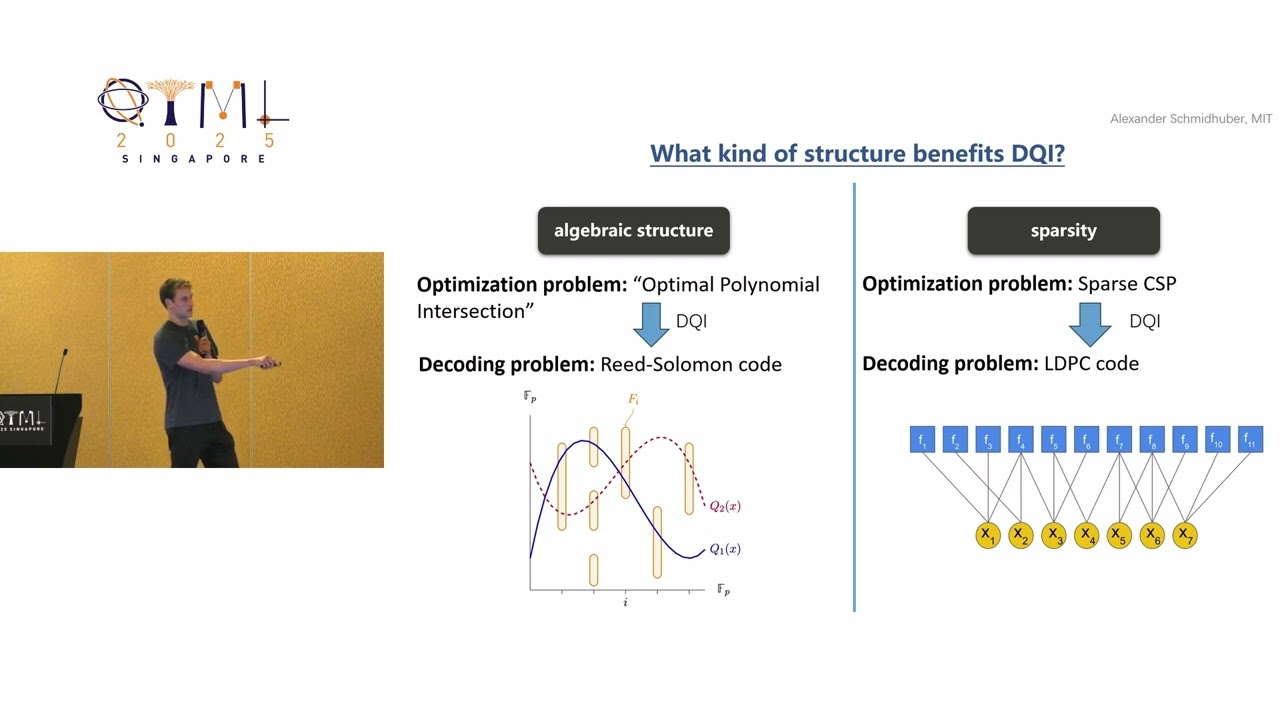
- Applications: optimal polynomial intersection and sparse problems
- Extension to Hamiltonian DQI
- Reduction to decoding for Hamiltonians
- Theorems for performance prediction and conclusion
Cited Sources
- Decoded Quantum Interferometry (Nature paper) — The speaker mentions the paper was published in Nature.
Concurring Sources
- Quantum speedup for combinatorial optimization (related work) — Related work on quantum algorithms for optimization.
Dissenting Sources
- Recent paper arguing against exponential speedup for DQI in sparse regime — The speaker mentions recent papers that argue against exponential speedup in the sparse regime, but he disputes their conclusions.
Contribution & Novelties
The talk presents a novel quantum algorithm (DQI) that reduces optimization problems to decoding, potentially achieving exponential speedups. It also introduces Hamiltonian DQI, extending the approach to quantum Hamiltonians. The main novelty is the combination of quantum Fourier transforms with classical decoding, and the instance-by-instance reduction. The talk also provides a theorem to predict performance based on classical decoding, which is a practical tool.
Pour aller plus loin :
- Quantum Fourier transform — Core component of DQI.
- Reed-Solomon codes — Used in the algebraic case.
- LDPC codes — Relevant for sparse problems.
- Belief propagation — Classical decoding heuristic for LDPC codes.
101 words
Radar Profile
The radar profile shows high scores in information quantity, quality, and technical level, with slightly lower but still high reliability. This indicates a dense, technical, and reliable presentation, suitable for experts.
💬 No comments were provided for analysis.