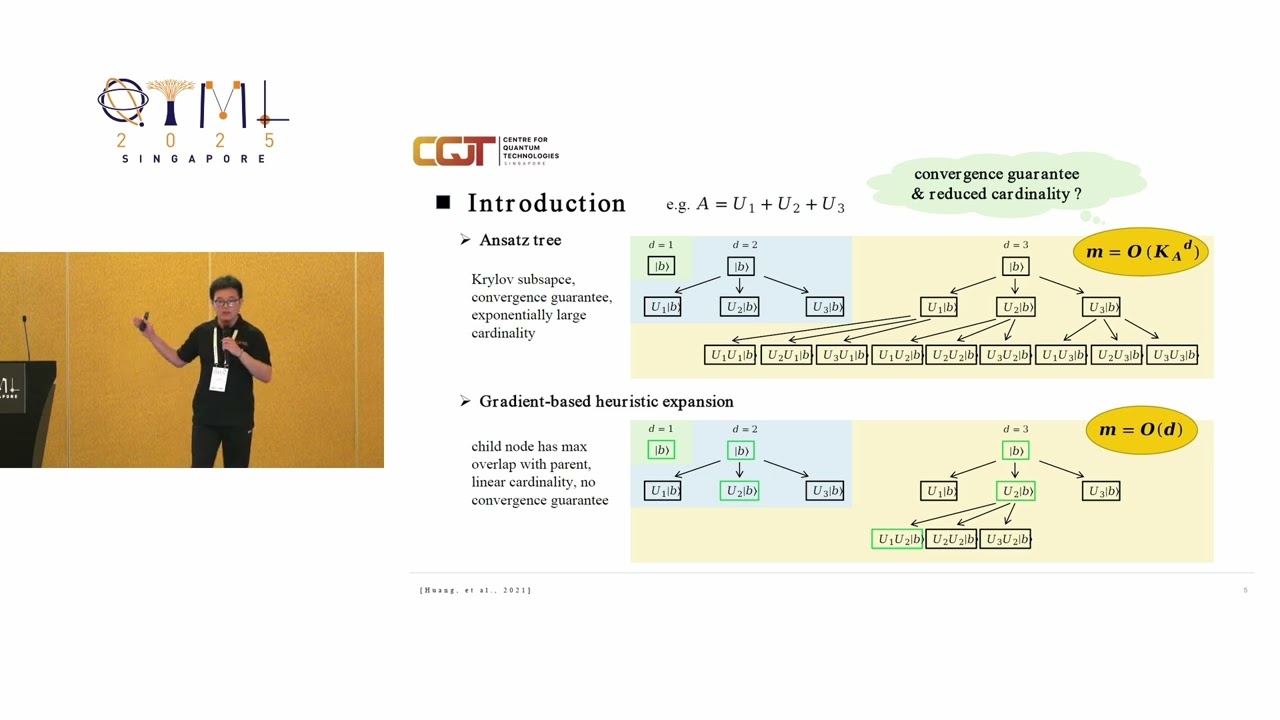
QTML 2025: StoCQS: Stochastic Strategy For Ansatz Tree Construction In Krylov-Based Linear Solver
Keywords
Summary
130 words
Critical Evaluation
Value of the Information & Strength of the Argument
The talk provides a novel algorithmic contribution that addresses a significant limitation of existing quantum linear solvers. The argumentation is logically structured, starting with the problem, introducing the CQS method, and then presenting the stochastic strategy. The theoretical convergence guarantees are a strong point, as they provide a rigorous basis for the algorithm’s effectiveness. The speaker also discusses potential extensions and open questions, which adds depth to the presentation. However, the lack of numerical experiments or empirical validation weakens the overall argument, as the practical performance remains unverified.
Scientific Rigor, Source Quality, Title Accuracy
The talk is based on the work of Rebentrost et al. (CQS) and builds upon established quantum algorithms like HHL. The speaker references the original CQS paper and mentions the work of Robert Hang (likely a mispronunciation of Rebentrost). The title accurately reflects the content. The presentation is a conference talk, so it does not include a formal list of sources, but the abstract and description provide context. The lack of citations in the talk itself is a minor weakness, but the theoretical nature of the work is clear.
192 words
Title / Content Match
The title accurately reflects the content, which focuses on a stochastic strategy for ansatz tree construction in a Krylov-based linear solver.
Quality & Reliability
7/10
The talk presents original research with a clear theoretical framework, including convergence guarantees and algorithmic details. However, it lacks peer-reviewed publication and experimental validation, and the presentation is a conference talk with limited audience interaction.
Key Moments
Markers derived by PSI from the transcript: the creator did not define chapters.
- Introduction and overview of the talk
- Background on linear system solvers and HHL algorithm
- Introduction to CQS algorithm and ansatz tree
- Problem statement: need for reduced state count with convergence guarantee
- Stochastic gradient descent formulation and sampling strategy
- Pseudo-code and diagram of StoCQS algorithm
- Convergence guarantees and theoretical bounds
- Summary, contributions, and future outlook
Cited Sources
- Classical Combination of Quantum States (CQS) paper — The talk builds upon the CQS algorithm proposed by Rebentrost et al. in 2022, which is the foundation for the StoCQS approach.
Concurring Sources
- HHL algorithm — The HHL algorithm is a foundational quantum linear solver that the talk references as a starting point.
Contribution & Novelties
The talk introduces StoCQS, a stochastic strategy for constructing ansatz trees in quantum linear solvers, which reduces the number of quantum states required while maintaining convergence guarantees. This is a significant improvement over the original CQS method, which requires exponentially many states. The use of stochastic gradient descent and importance sampling is novel in this context. The theoretical convergence bounds are a key contribution, providing a rigorous foundation for the algorithm’s efficiency.
Pour aller plus loin :
- Quantum linear systems algorithms — Overview of quantum algorithms for linear systems, including HHL and variational approaches.
- Stochastic gradient descent — Background on SGD, which is central to the StoCQS algorithm.
- Krylov subspace methods — Mathematical foundation for the Krylov subspace used in the algorithm.
122 words
Radar Profile
The radar profile shows high scores in technical level and information quality, indicating a technically rigorous presentation. The quantity of information is moderate, and the reliability is good but not perfect due to the lack of empirical validation.
💬 No comments were provided for analysis.