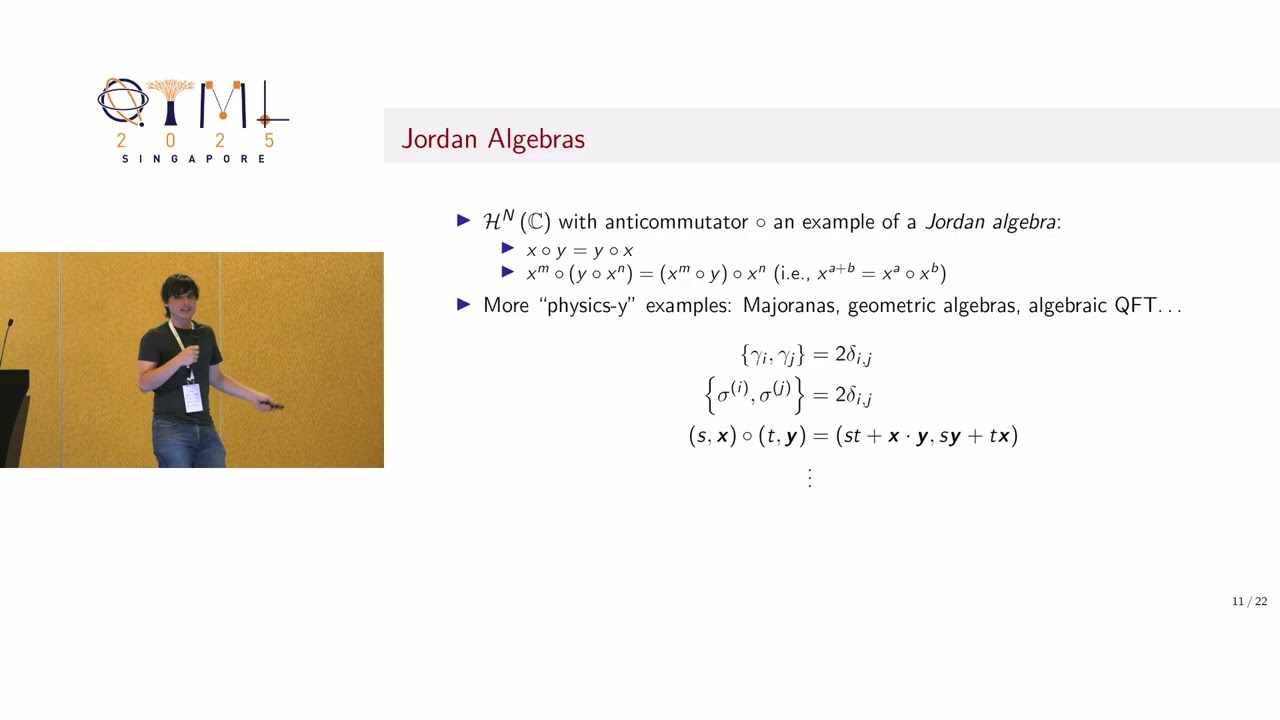
QTML 2025: A Unified Theory of Quantum Neural Network Loss Landscape
Keywords
Summary
157 words
Critical Evaluation
Value of the Information & Strength of the Argument
The talk provides significant value by introducing a novel, unified mathematical framework for QNN loss landscapes, which is a major step forward in the field. The argumentation is rigorous, building on established concepts like Jordan algebras and Wishart matrices, and the speaker clearly explains the logical progression from classical results to the new quantum results. The claims are supported by mathematical proofs, and the implications are well-delineated. The presentation is dense but coherent, and the speaker effectively communicates the importance of the work.
Scientific Rigor, Source Quality, Title Accuracy
The talk demonstrates high scientific rigor, with a clear theoretical foundation and explicit references to prior work (e.g., classical neural network Gaussian process limits, barren plateau results). The sources cited are appropriate and relevant. The title accurately reflects the content, and the presentation is well-structured. The speaker does not overstate claims and acknowledges limitations, such as the assumption of uniform random initialization.
160 words
Title / Content Match
The title accurately reflects the content: a unified theory for quantum neural network loss landscapes.
Quality & Reliability
8/10
The talk presents original mathematical proofs and rigorous results, with a clear theoretical framework based on Jordan algebras and Wishart processes. The content is highly technical and appears scientifically sound, though the presentation is concise and assumes advanced background.
Key Moments
Markers derived by PSI from the transcript: the creator did not define chapters.
- Introduction and motivation: classical neural networks as Gaussian processes
- Classical neural network loss landscape and optimization
- Introduction to quantum neural networks and loss functions
- Jordan algebras and their role in QNN loss functions
- Main result: QNNs as Wishart processes
- Implications: barren plateaus, Gaussian process limits, local minima
- Future directions and conclusion
Cited Sources
- QTML 2025 conference — The talk was presented at this conference.
Concurring Sources
- Barren plateaus in quantum neural network training landscapes — The talk's results generalize the barren plateau phenomenon described in this paper.
Contribution & Novelties
The talk introduces a novel unified framework for understanding QNN loss landscapes via Wishart processes, which is a significant advancement over previous piecemeal results. It provides necessary and sufficient conditions for Gaussian process limits, generalizes barren plateau results, and offers a new quantity (degrees of freedom) to characterize trainability.
Pour aller plus loin :
- Wishart distribution — The distribution underlying the Wishart process description.
- Jordan algebra — The algebraic structure used to classify QNN architectures.
- Barren plateaus — The phenomenon of vanishing gradients in QNNs, which the framework generalizes.
89 words
Radar Profile
The radar profile shows high scores in quality and technical level, with slightly lower scores in quantity and reliability, reflecting the dense but focused nature of the talk.