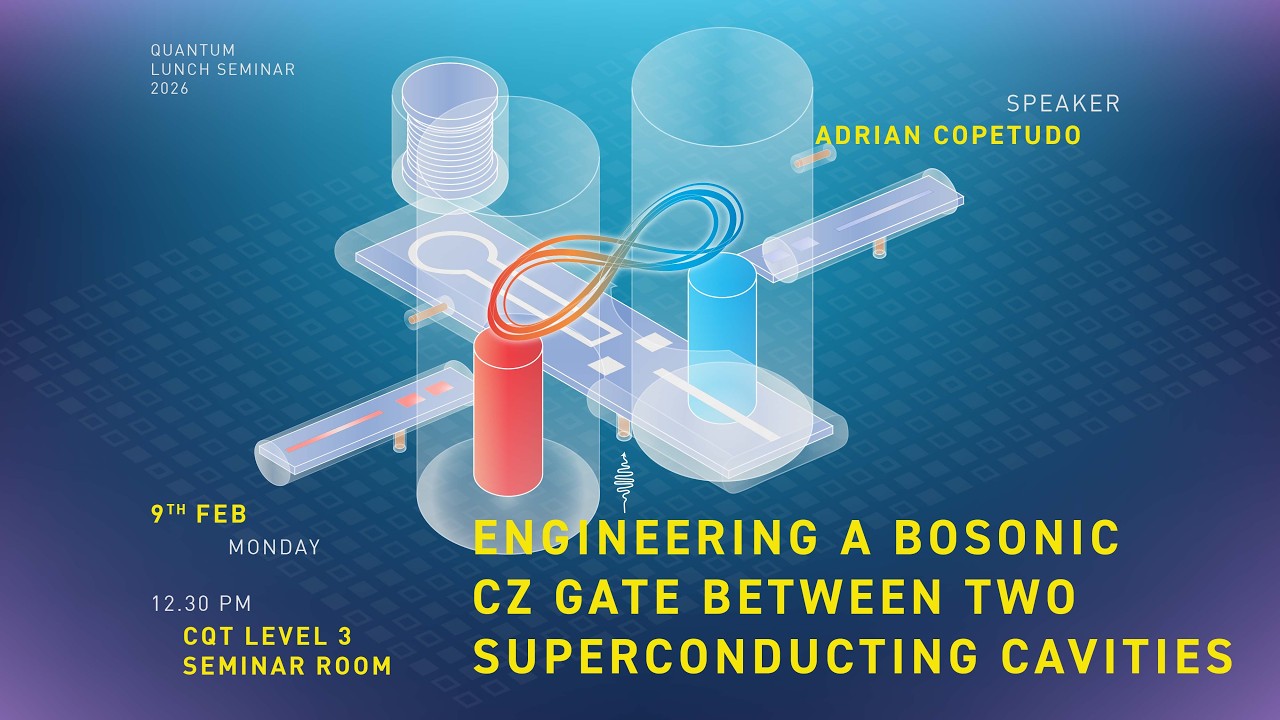
Engineering a bosonic CZ gate between two superconducting cavities
Keywords
Summary
119 words
Critical Evaluation
Value of the Information & Strength of the Argument
The talk provides significant value by presenting a novel gate implementation that addresses a key limitation in bosonic cQED: the need to excite the ancilla qubit, which limits gate fidelity. The argumentation is solid, with a clear logical progression from the problem statement to the theoretical solution and experimental validation. The speaker supports claims with data, including Wigner function measurements and fidelity calculations. The discussion of trade-offs, such as drive-induced decoherence, adds depth. However, the talk is a seminar presentation, so some details are simplified, and the results are not yet peer-reviewed.
Scientific Rigor, Source Quality, Title Accuracy
The scientific rigor is high, with a thorough theoretical derivation and careful experimental methodology. The speaker references known concepts like the James-Cummings model and dispersive regime, but does not cite specific papers. The title accurately reflects the content. No comments were provided for analysis.
151 words
Title / Content Match
The title accurately reflects the content, which focuses on engineering a bosonic CZ gate between two superconducting cavities.
Quality & Reliability
8/10
The talk presents original experimental results with detailed theoretical background, including derivations and data. The methodology is rigorous, with clear explanations of the physics and experimental procedures. The speaker is a researcher at a reputable institution (CQT, NUS). However, the video is a seminar recording with limited production quality and no external references or peer-reviewed citations provided.
Key Moments
Markers derived by PSI from the transcript: the creator did not define chapters.
- Introduction to entanglement and quantum computation
- Challenges with artificial atoms and harmonic oscillators
- Paradigm shift to encoding in harmonic oscillators
- Optical intuition: Kerr effect and three-wave mixing
- Current implementations and their limitations
- Device design and Hamiltonian
- Engineering cross-Kerr via Raman transition
- Experimental results in Raman regime
- Demonstration of CZ gate and entanglement
- Fidelity analysis and drive-induced decoherence
- Two-photon encoding and parity checks
Contribution & Novelties
The talk presents a novel method for implementing a CZ gate between two superconducting cavities without exciting the intermediate qubit, using a Raman transition to engineer a cross-Kerr interaction. This approach avoids the decoherence associated with qubit excitation, potentially improving gate fidelities. The gate is continuous and can be used for various rotationally-symmetric codes. The experimental demonstration shows promising fidelities, especially with two-photon encoding and parity checks.
Pour aller plus loin :
- Bosonic codes — Overview of bosonic error-correcting codes.
- Circuit QED — Background on superconducting circuits coupled to cavities.
- Cross-Kerr effect — Explanation of the nonlinear optical effect used.
100 words
Radar Profile
The radar profile shows high scores in technical level and information quality, reflecting the advanced and detailed nature of the talk. The moderate score in information quantity suggests a focused presentation, while the high reliability score indicates a trustworthy source.