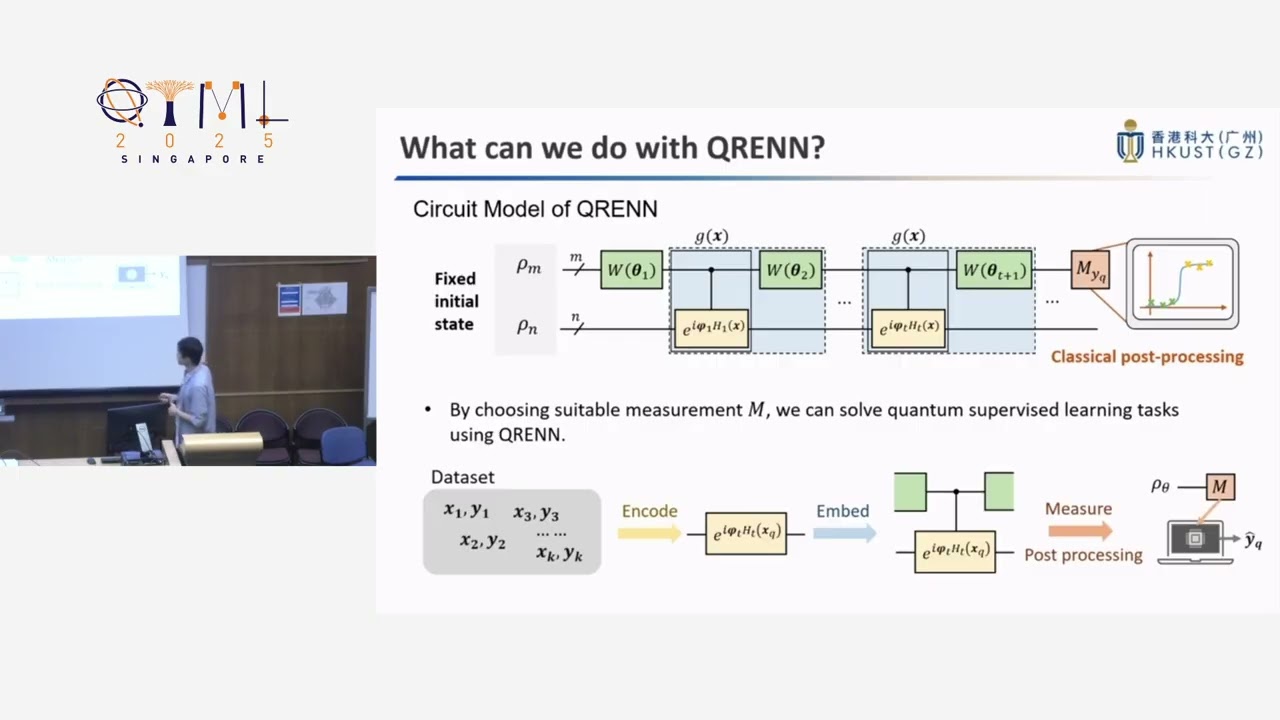
QTML 2025: Quantum Recurrent Embedding Neural Network
Keywords
Summary
154 words
Critical Evaluation
Value of the Information & Strength of the Argument
The value of the information is high, as it addresses a critical issue in quantum machine learning (barren plateaus) with a novel architecture and rigorous theoretical analysis. The argumentation is solid, grounded in dynamical Lie algebra theory, and supported by numerical experiments. The speaker clearly explains the theoretical framework and provides evidence for the trainability of QRENN. The applications to Hamiltonian classification and SPT phase detection demonstrate practical utility. The presentation is well-structured, moving from background to theory to experiments, and the claims are appropriately qualified.
Scientific Rigor, Source Quality, Title Accuracy
The scientific rigor is high, with references to established works in the field (e.g., Nature Communications papers on Lie algebra theory). The sources cited in the talk are credible, though specific citations are not explicitly listed in the description. The title accurately reflects the content, focusing on the QRENN architecture. The talk is a conference presentation, so it may not have undergone full peer review, but the methodology appears sound. The adequacy between title and content is good, as the talk directly addresses the QRENN model and its properties.
190 words
Title / Content Match
The title accurately reflects the content, which introduces the Quantum Recurrent Embedding Neural Network (QRENN) and its applications.
Quality & Reliability
8/10
Presentation of original research with rigorous theoretical proofs based on dynamical Lie algebra, supported by numerical experiments. The methodology is sound, but the lack of peer-reviewed publication details and limited experimental scope slightly reduce the score.
Key Moments
Markers derived by PSI from the transcript: the creator did not define chapters.
- Introduction and presentation outline
- Preliminaries on quantum neural networks and data re-uploading
- Challenges in QNNs: barren plateaus and other issues
- Introduction to dynamical Lie algebra and its role in trainability
- Trade-off between expressivity and trainability
- Presentation of QRENN circuit architecture
- Main theoretical result: trainability and avoidance of barren plateaus
- Numerical experiments: Hamiltonian classification and gradient sampling
- Application to SPT phase detection and conclusion
Cited Sources
- Quantum machine learning review (2022) — Mentioned as a comprehensive review of QNN applications
- Nature Communications papers on Lie algebra theory — Referenced for exact variance formulas and barren plateau analysis
Concurring Sources
- Barren plateaus in quantum neural network training landscapes — Supports the existence and impact of barren plateaus.
- Lie algebra theory for quantum machine learning — Provides theoretical framework used in the talk.
Dissenting Sources
- Potential classical simulability of structured QNNs — The talk acknowledges that structured QNNs may be classically simulable, which could limit quantum advantage.
Contribution & Novelties
The QRENN architecture introduces a novel approach to designing trainable quantum neural networks by incorporating fast-track information pathways inspired by ResNets and leveraging dynamical Lie algebra to prove trainability. This contributes to the ongoing effort to overcome barren plateaus, a major obstacle in quantum machine learning. The model demonstrates practical applicability in quantum supervised learning tasks, such as Hamiltonian classification and SPT phase detection.
Pour aller plus loin :
- Barren plateaus in quantum neural networks — Key paper on barren plateaus.
- Dynamical Lie algebra for quantum circuits — Relevant theoretical background.
- Quantum convolutional neural networks — Related architecture for comparison.
100 words
Radar Profile
The radar profile shows high scores in technical level and information quality, reflecting the advanced and rigorous nature of the content. The lower score in information quantity suggests the talk is concise and focused. Overall, the profile indicates a technically strong presentation with solid theoretical foundations.
💬 Sur les 0 commentaires analysés, aucune tendance n'est disponible.