QTML 2025: Do You Know What Q-Means?
Keywords
Summary
135 words
Critical Evaluation
Value of the Information & Strength of the Argument
The talk provides significant value by presenting novel algorithms with rigorous complexity analysis. The argumentation is solid, building on prior work and clearly explaining the improvements. The speaker justifies the theoretical contributions with lower bounds and supports the practicality with experimental implementations. The presentation is well-structured, moving from problem definition to algorithmic details and results.
Scientific Rigor, Source Quality, Title Accuracy
The scientific rigor is high, with careful attention to complexity bounds and error propagation. The talk references prior work, including the original q-means paper and quantum multivariate Monte Carlo methods. The title is a playful pun that effectively hints at the paper’s exploration of the asymptotic complexity of q-means and k-means, matching the content well. The presentation is based on original research and does not rely on unverified sources.
139 words
Title / Content Match
The title is a playful pun that effectively hints at the paper's exploration of the asymptotic complexity of q-means and k-means, matching the content well.
Quality & Reliability
8/10
Talk presents original research with rigorous complexity analysis, including lower bounds, and is delivered by an expert in the field. The claims are supported by theoretical derivations and experimental implementations, though the presentation is concise and some details are omitted.
Key Moments
Markers derived by PSI from the transcript: the creator did not define chapters.
- Introduction and motivation for the talk, including job advertisements.
- Recap of the clustering problem and the classical k-means algorithm.
- Analysis of the classical k-means runtime and introduction of the approximate version.
- Review of the 2019 q-means quantum algorithm and its limitations.
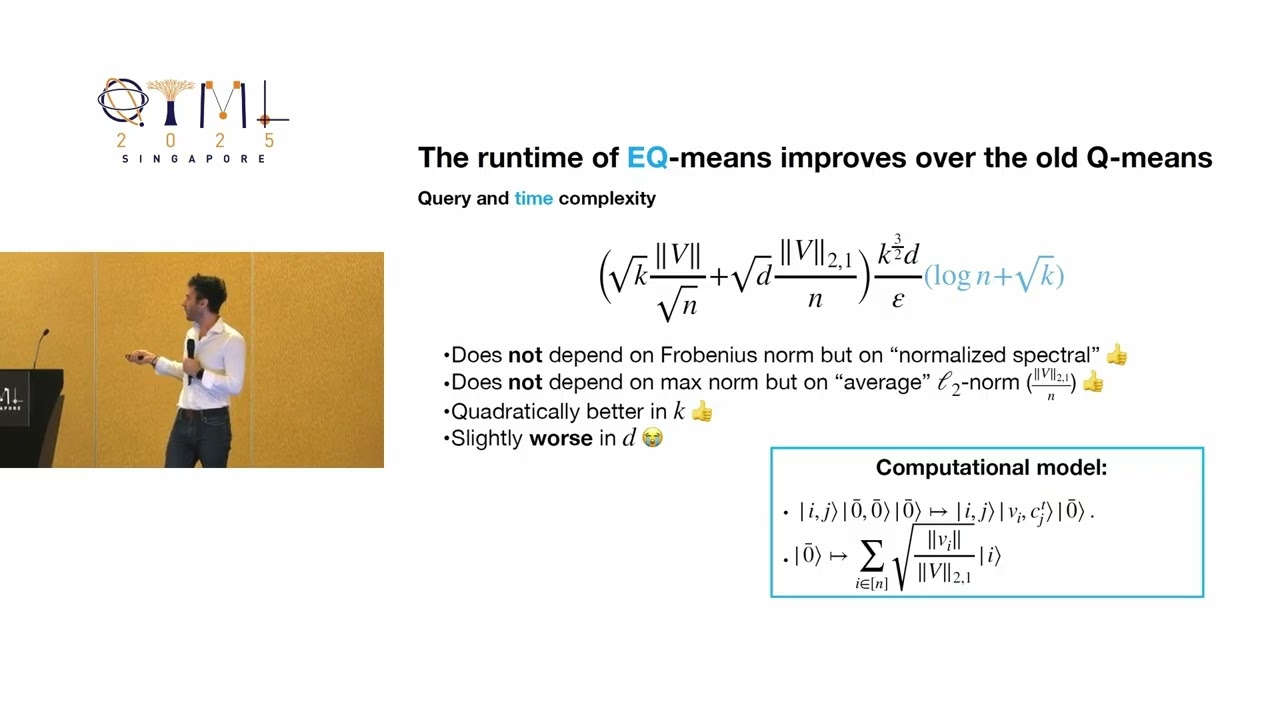
- New quantum algorithm using quantum multivariate Monte Carlo, removing dependence on condition number and Frobenius norm.
- Further improvement using Hadamard test and variable time minimum finding to reduce dependence on dimension.
- Introduction of the classical epsilon-k-means algorithm with sampling techniques.
- Experimental implementation details and runtime results.
- Discussion of lower bounds and optimality of the algorithms.
- Conclusion and future directions.
Cited Sources
- q-means: A quantum algorithm for unsupervised learning — Original q-means algorithm by Kerenidis et al., referenced as the basis for the quantum algorithm.
- Quantum multivariate Monte Carlo — Tool used for quantum amplitude estimation in the new algorithm.
Concurring Sources
- q-means: A quantum algorithm for unsupervised learning — The original q-means algorithm is the foundation for the improved quantum algorithm.
Contribution & Novelties
The talk presents a classical algorithm that matches the runtime of the quantum q-means algorithm, marking a significant dequantization result. It also improves the quantum algorithm to achieve better runtime and provides lower bounds for k-means iterations. The novelty lies in the use of sampling techniques and quantum amplitude estimation, avoiding quantum linear algebra primitives.
Pour aller plus loin :
- k-means clustering — Overview of the classical algorithm.
- Quantum machine learning — Context for quantum algorithms in ML.
- QRAM — Concept used in the quantum algorithm.
86 words
Radar Profile
The radar profile shows high scores in information quality and technical level, with slightly lower scores in quantity and reliability, reflecting the concise presentation and the theoretical nature of the content.