QTML 2025: Scalable quantum machine learning models in Fourier space
Keywords
Summary
206 words
Critical Evaluation
Value of the Information & Strength of the Argument
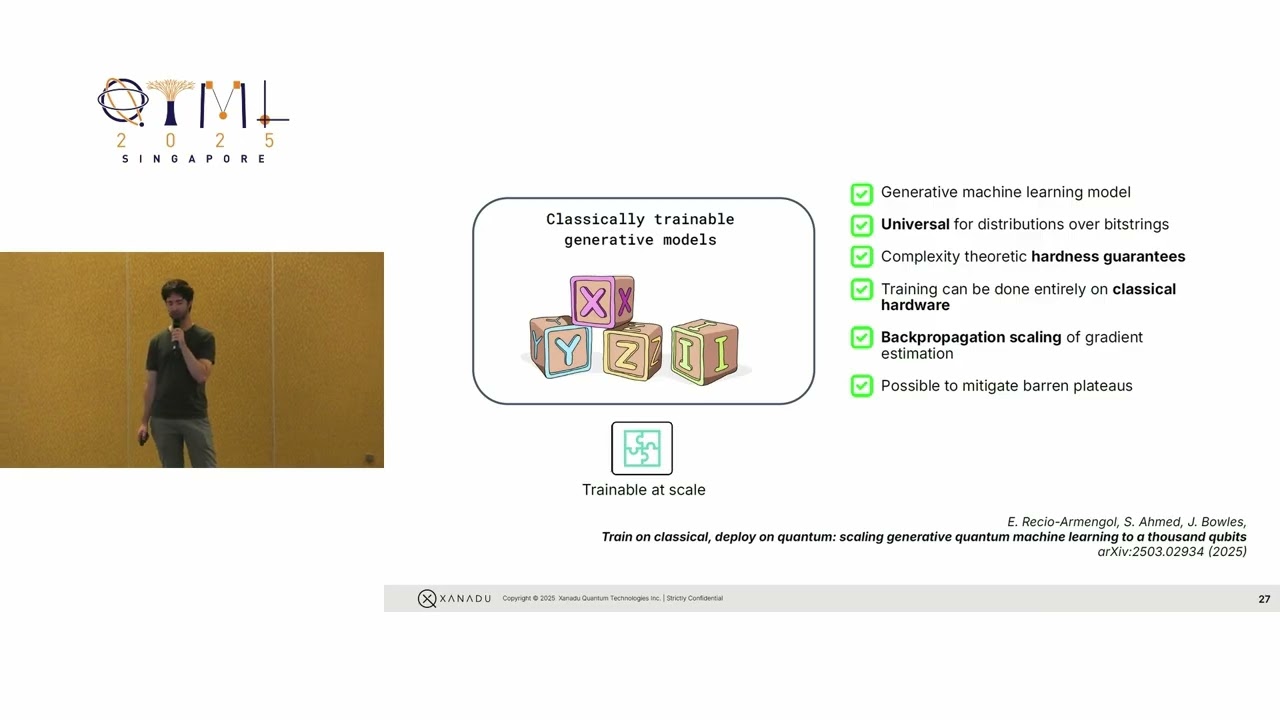
The talk provides significant value by addressing a major challenge in quantum machine learning: scalability. The proposed method allows training of large quantum models on classical hardware, which is a substantial advancement. The argumentation is solid, grounded in theoretical results (e.g., universality, hardness guarantees) and empirical demonstrations on real-world data. The speaker clearly explains the mathematical foundations, such as the Fourier transform on the Boolean hypercube and the connection to IQP circuits. The use of MMD as a loss function is well-justified, and the classical estimation of the loss is a key contribution. The presentation is coherent and persuasive, with a clear logical flow from motivation to method to results.
Scientific Rigor, Source Quality, Title Accuracy
The talk demonstrates scientific rigor by referencing published work (the paper published earlier this year) and known results in the field. The speaker cites specific sources, such as the paper on creating artificial human genomes using generative neural networks, and mentions the work of others (e.g., Kirkin et al. on universality). The title accurately reflects the content, focusing on scalable quantum machine learning models in Fourier space. The presentation is technical and precise, with no obvious overclaims. The speaker acknowledges limitations, such as the need for further research on barren plateaus. Overall, the sources are credible and the title-content alignment is strong.
227 words
Title / Content Match
The title accurately reflects the content: the talk focuses on scalable quantum machine learning models built in Fourier space, as presented at QTML 2025.
Quality & Reliability
8/10
Talk by a researcher at Xanadu presenting peer-reviewed work (published earlier this year) and new unpublished results. Claims are supported by theoretical arguments and empirical demonstrations on real-world genomic data. The presentation is technical and precise, with references to known results (e.g., IQP hardness, MMD theory).
Key Moments
Markers derived by PSI from the transcript: the creator did not define chapters.
- Introduction and motivation: challenges in variational QML, barren plateaus, and scalability.
- Fourier analysis in machine learning: smoothness, spectral bias, and connection to kernels.
- Fourier transform on Boolean hypercube: definition and interpretation of Fourier coefficients.
- Quantum Fourier transform and its efficiency; connection between state and distribution Fourier coefficients via autocorrelation.
- Introduction of Fourier phase generative models: structure and universality.
- Classical trainability: MMD loss and estimation of Fourier coefficients classically.
- Implementation details: IQPopt package, scaling to 1000 qubits and 500k parameters.
- Application to genomic data: training on 805 qubits and comparison with classical models.
- Introduction of generative bandlimiting: exploiting correlation decay bias in data.
- Discussion of barren plateaus and empirical evidence of trainability.
Cited Sources
- Paper on Fourier phase generative models (published earlier this year) — The speaker mentions a paper published earlier this year, but no specific URL is given in the description.
- Creating artificial human genomes using generative neural networks — Referenced as the source of the genomic dataset used in the talk.
Concurring Sources
- Quantum machine learning literature on Fourier analysis — The talk aligns with recent research on quantum models in Fourier space, though no specific sources are cited.
Dissenting Sources
- Potential skepticism about quantum advantage in generative modeling — Some researchers argue that classical models may achieve similar performance, as seen in the comparison with classical generative models on genomic data.
Contribution & Novelties
The talk presents a novel approach to quantum generative modeling that is classically trainable, addressing scalability issues. The key contribution is the use of Fourier analysis to construct models that can be trained on classical hardware, enabling scaling to thousands of qubits. The introduction of generative bandlimiting is a new algorithm that exploits biases in data to improve training. This work opens new directions for practical quantum machine learning.
Pour aller plus loin :
- Quantum Fourier transform — Foundational concept used in the talk.
- IQP circuits — The class of circuits related to the proposed models.
- Maximum mean discrepancy — The loss function used for training.
106 words
Radar Profile
The radar profile shows high scores in information quantity, quality, technical level, and reliability, indicating a technically dense and credible presentation. The balanced profile suggests a well-rounded talk with strong scientific content.
💬 No comments were provided for analysis.