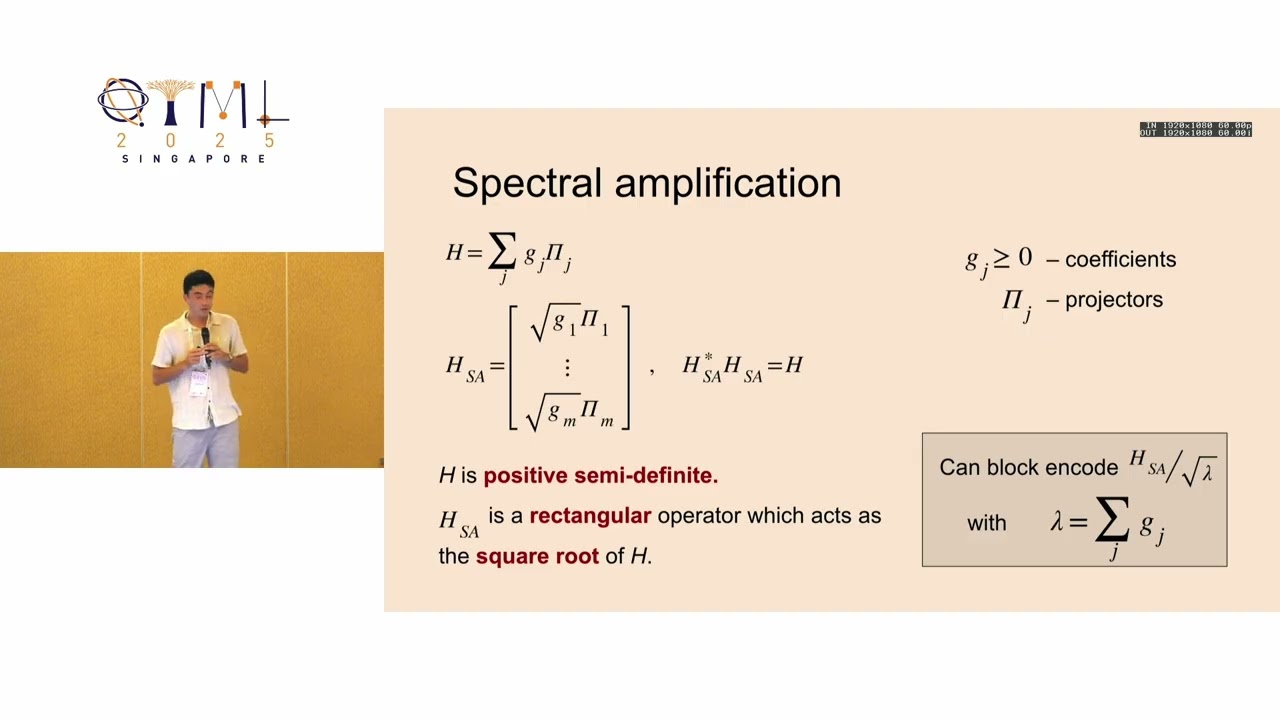
QTML 2025: Quantum Simulation By Sum Of Squares Spectral Amplification
Keywords
Summary
141 words
Critical Evaluation
Value of the Information & Strength of the Argument
The talk provides a high-value contribution to the field of quantum simulation by introducing a novel algorithmic framework that improves the efficiency of phase estimation for low-energy states. The argumentation is solid, grounded in theoretical analysis and numerical experiments. The speaker clearly explains the motivation and the technical details, making a compelling case for the advantages of SOSSA. The improvement is demonstrated both asymptotically on the SYK model and concretely on chemistry molecules, strengthening the credibility of the approach.
Scientific Rigor, Source Quality, Title Accuracy
The talk demonstrates scientific rigor by presenting original research with clear methodology and results. The sources cited include the two papers on which the talk is based, as well as a reference to prior work by Low et al. The title accurately reflects the content. The presentation is technical and assumes familiarity with quantum computing concepts, but the reasoning is clear and well-structured.
157 words
Title / Content Match
The title accurately reflects the content, focusing on the SOSSA technique for quantum simulation.
Quality & Reliability
8/10
The talk presents original research from a team of established researchers in quantum computing, with results supported by theoretical analysis and numerical experiments. The presentation is clear and technical, but lacks detailed derivations and peer-reviewed publication details.
Key Moments
Markers derived by PSI from the transcript: the creator did not define chapters.
- Introduction and overview of quantum simulation for quantum chemistry
- Explanation of the two-step process: state preparation and readout
- Progress in compiling phase estimation, showing exponential improvement over years
- Introduction of spectral amplification and its benefits for low-energy states
- Sum of squares representation and its role in enabling spectral amplification
- Application to SYK model showing asymptotic speedup
- Application to real-world chemistry molecules with factor 10 improvement
- Conclusion and future directions, highlighting readout as the new bottleneck
Cited Sources
- arXiv:2502.15882 (2025) — Referenced as prior work using SOSSA for phase estimation of quantum chemistry systems.
Concurring Sources
- arXiv:2502.15882 (2025) — Prior work by Low et al. using SOSSA for phase estimation, consistent with the presented results.
Contribution & Novelties
The talk introduces SOSSA, a novel framework that combines sum-of-squares representations with spectral amplification to improve quantum simulation of low-energy states. The key innovation is exploiting the low-energy nature of the target state to achieve a square-root improvement in the scaling of phase estimation algorithms. This is demonstrated both theoretically on the SYK model and numerically on real-world chemistry molecules, showing significant reductions in gate counts.
Pour aller plus loin :
- Quantum simulation — Overview of quantum simulation and its applications.
- Phase estimation algorithm — Background on phase estimation, a key component of the proposed method.
- Sachdev-Ye-Kitaev model — The toy model used to demonstrate asymptotic speedup.
107 words
Radar Profile
The radar profile shows high scores in technical level and information quality, with slightly lower scores in information quantity and global reliability. This indicates a technically dense presentation with strong content, but limited in breadth and requiring further validation.