QTML 2025: Testing and Verification for Quantum Learning
Keywords
Summary
132 words
Critical Evaluation
Value of the Information & Strength of the Argument
The talk provides a valuable overview of how testing and verification techniques can be integrated into quantum learning. Caro clearly motivates the need for these methods by identifying potential failure points in the learning workflow. He presents property testing with a clear abstract definition and illustrates it with examples. The argumentation is solid, building from basic concepts to more advanced ideas. He also acknowledges the limitations of simple approaches and points to more sophisticated methods. The interactive format with quizzes and questions enhances understanding.
Scientific Rigor, Source Quality, Title Accuracy
The talk is scientifically rigorous, referencing specific works (e.g., by Haah, O’Donnell, Wright; Montanaro) and presenting established results. The sources are appropriate for the level of the talk. The title accurately reflects the content. The speaker is an expert in the field, and the presentation is well-structured. No discrepancies between title and content were noted.
154 words
Title / Content Match
The title accurately reflects the content: the talk focuses on testing and verification techniques applied to quantum learning.
Quality & Reliability
8/10
The talk is a tutorial by an academic expert (assistant professor) at a recognized conference (QTML 2025). It presents established results and frameworks (property testing, interactive proofs, identity testing) with references to specific works. The content is technical and rigorous, with clear definitions and examples. No obvious errors or unsupported claims were detected.
Key Moments
Markers derived by PSI from the transcript: the creator did not define chapters.
- Introduction and overview of the talk's structure.
- Explanation of the quantum learning workflow and potential breaking points.
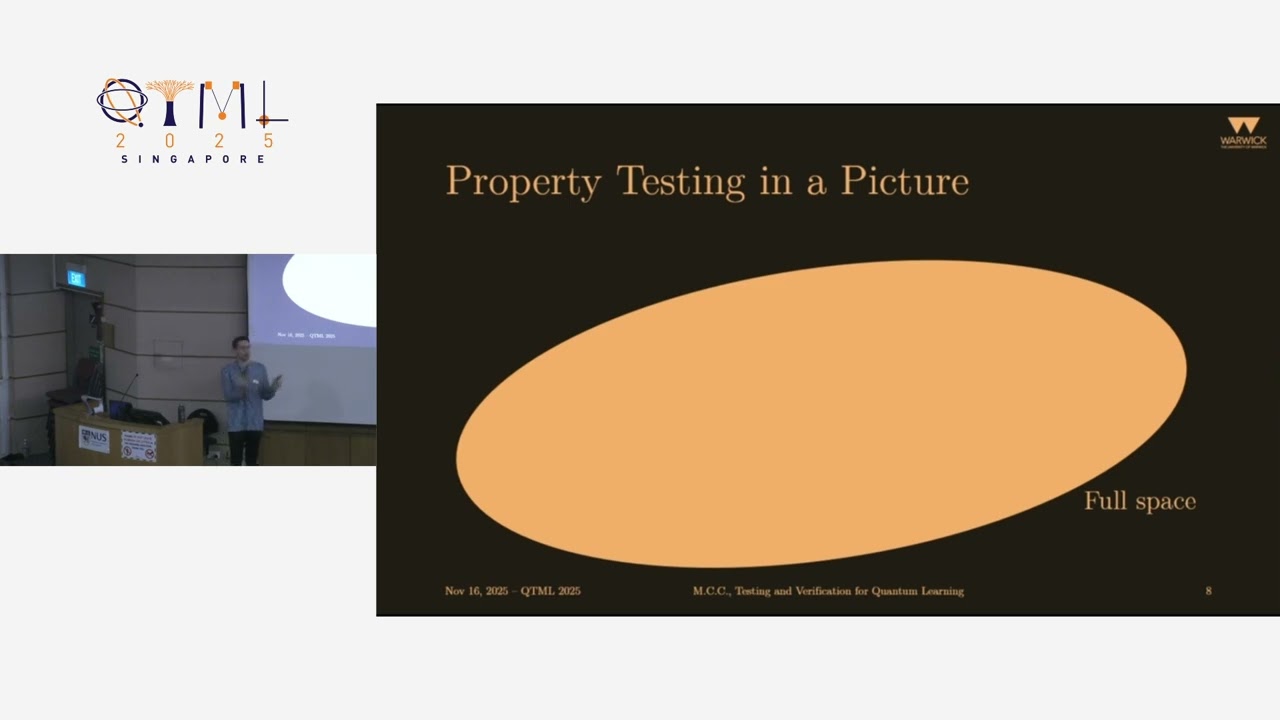
- Introduction to property testing with the 'egg yolk' picture.
- Discussion of tolerant testing and its relation to distance estimation.
- Quiz on property testing for unstructured properties, leading to a trivial algorithm.
- Transition to interactive proofs for verifying quantum learning execution.
- Introduction to identity testing for certifying hypotheses.
- Discussion of open questions and future directions.
Cited Sources
- Haah, O'Donnell, Wright - Quantum tomography — Mentioned as work on the exponential complexity of full tomography for arbitrary mixed states.
- Montanaro - Learning stabilizer states — Cited for the result that stabilizer state tomography can be done in linear complexity.
Concurring Sources
- Quantum property testing literature — The talk aligns with recent research on quantum property testing, such as work by Montanaro and others.
Contribution & Novelties
The talk provides a comprehensive overview of how testing and verification techniques can be applied to quantum learning, synthesizing recent research. It highlights the importance of certifying assumptions and verifying the learning process, which are often overlooked. The tutorial format with interactive quizzes helps clarify concepts.
Pour aller plus loin :
- Property testing — Overview of property testing in computer science.
- Quantum tomography — Background on quantum state tomography.
- Interactive proof system — Concept of interactive proofs in complexity theory.
80 words
Radar Profile
The radar profile shows high scores in technical level and information quality, indicating a dense, expert-level tutorial. The lower score in quantity of information reflects the focused scope, while the overall reliability is strong due to the speaker's expertise and cited works.
💬 No comments were provided for analysis.