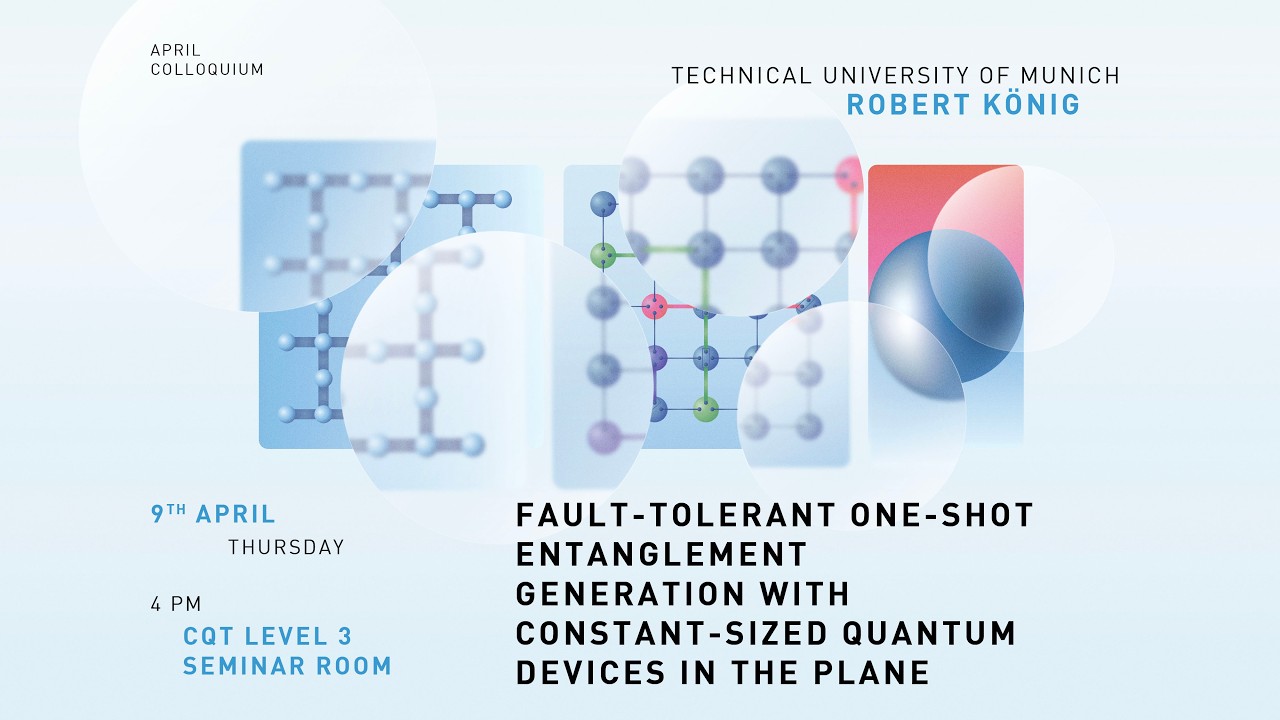
Fault-Tolerant One-Shot Entanglement Generation with Constant-Sized Quantum Devices in the Plane
Keywords
Summary
171 words
Critical Evaluation
Value of the Information & Strength of the Argument
The talk provides a clear and rigorous argument for the possibility of fault-tolerant entanglement generation in 2D. The speaker carefully defines the noise model and the notion of single-shot entanglement generation, and then presents a constructive protocol with explicit resource scaling. The argumentation is solid, building on established concepts such as local stochastic noise, fault tolerance thresholds, and percolation. The speaker also discusses the limitations of 1D settings and compares with previous work, providing a balanced view. The presentation is technical but well-structured, making the main ideas accessible while maintaining mathematical precision.
Scientific Rigor, Source Quality, Title Accuracy
The talk is scientifically rigorous, with clear definitions and references to prior work, including the 3D cluster state protocol by Raussendorf and Harrington, and the concept of local stochastic noise introduced by Gottesman. The speaker also mentions a review paper on quantum repeaters and a recent work on fault-tolerant quantum input/output. The title accurately reflects the content, and the presentation is consistent with the abstract. The talk does not include any commercial or promotional content.
182 words
Title / Content Match
The title accurately reflects the content: the talk presents a protocol for fault-tolerant one-shot entanglement generation using constant-sized quantum devices in a 2D plane.
Quality & Reliability
8/10
Presentation of a peer-reviewed research result with rigorous mathematical proofs, clear definitions, and explicit noise models. The speaker is a recognized expert, and the work is joint with Dylan Harley. The talk is technical and precise, though it does not provide full details of the proofs.
Key Moments
Markers derived by PSI from the transcript: the creator did not define chapters.
- Introduction to locality constraints and the problem of generating entanglement between distant qubits.
- Definition of local stochastic Pauli noise and its properties.
- Classical repeaters and the need for better connections in 1D.
- Quantum repeaters and entanglement swapping; limitations in 1D.
- Introduction to long-range localizable entanglement and the 3D cluster state example.
- Main result: 2D protocol for fault-tolerant one-shot entanglement generation.
- Three steps of the construction: fault-tolerant simulation, geometry change, and space-time transformation.
- Details on fault-tolerant simulation with quantum inputs/outputs.
- Resource comparison and conclusion.
Cited Sources
- 3D cluster state and fault tolerance — Mentioned as the remarkable example by Raussendorf and Harrington.
- Local stochastic noise model — Introduced by Gottesman, used as the noise model.
- Fault-tolerant quantum input and output — Recent work mentioned as related to the problem.
- Review paper on quantum repeaters — Recommended by the speaker for further reading.
Concurring Sources
- Raussendorf, R., & Harrington, J. (2007). Fault-tolerant quantum computation with high threshold in two dimensions. — The 3D cluster state protocol that the talk builds upon.
- Gottesman, D. (2005). Fault-tolerant quantum computation with local gates. — Introduces local stochastic noise model.
Contribution & Novelties
The talk presents a novel protocol for fault-tolerant one-shot entanglement generation in 2D, which is the first of its kind. It extends the 3D cluster state approach to 2D, achieving constant-sized devices and constant time operation. The construction combines fault-tolerant simulation with a space-time transformation, providing a rigorous analysis against local stochastic noise. This work opens new possibilities for quantum communication networks with planar geometries.
Pour aller plus loin :
- Quantum error correction — Foundational concepts for fault tolerance.
- Cluster state — The 3D cluster state is a key example.
- Percolation theory — Underlies the intuition for 2D connectivity.
- Quantum repeater — Context for entanglement generation over long distances.
109 words
Radar Profile
The radar profile shows high scores in quality of information, technical level, and reliability, with a slightly lower score in quantity of information due to the focused scope of the talk. The overall profile indicates a highly technical and reliable presentation.