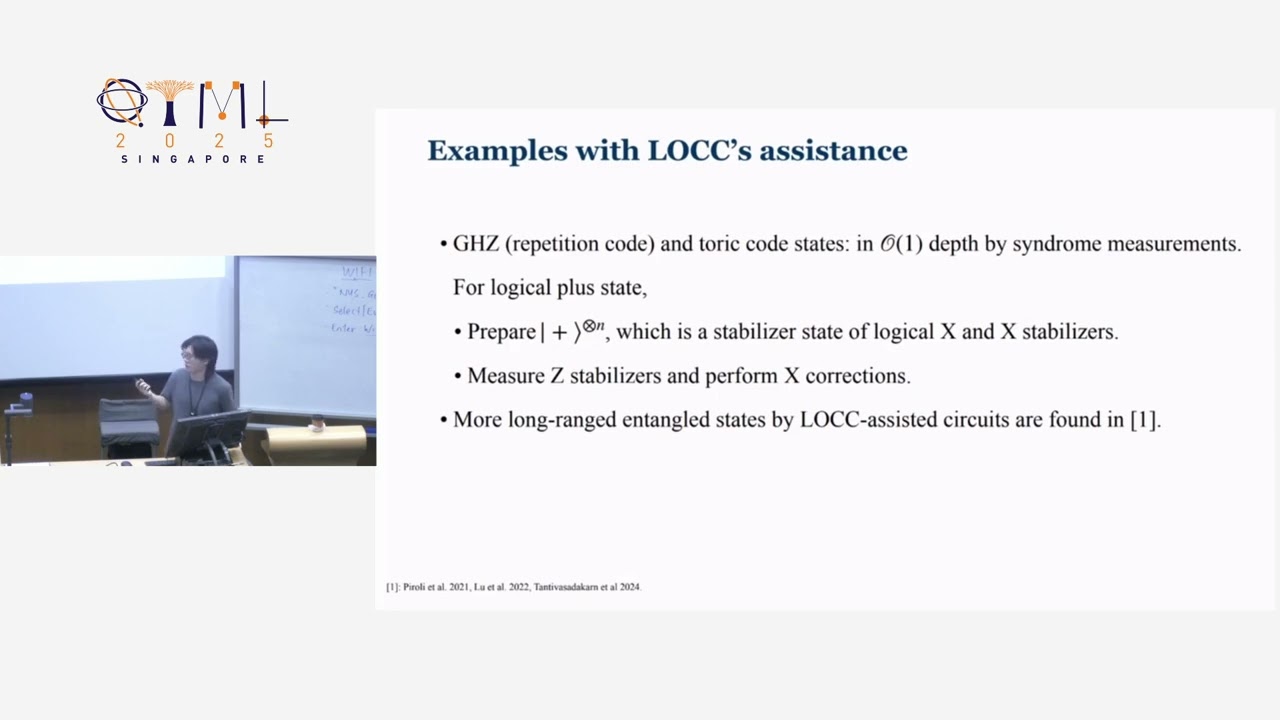
QTML 2025: LOCC-Assisted Quantum Circuits for Long-Range Entangled States
Keywords
Summary
92 words
Critical Evaluation
Value of the Information & Strength of the Argument
The talk provides a clear motivation for the need for shallow circuits in preparing long-range entangled states, highlighting the experimental challenges. The proposed algorithm is well-structured, with a clear explanation of the gradient estimation and the avoidance of post-selection. The argumentation is supported by theoretical results on barren plateaus and numerical examples showing advantages over unitary VQE. The presentation is concise but technically sound.
Scientific Rigor, Source Quality, Title Accuracy
The talk is based on a peer-reviewed publication in Physical Review Letters, indicating high scientific rigor. The presentation includes references to the paper and mentions the conference. The title accurately reflects the content. No external sources are cited in the talk, but the description provides the paper reference.
127 words
Title / Content Match
The title accurately reflects the content, focusing on LOCC-assisted quantum circuits for long-range entangled states.
Quality & Reliability
8/10
The talk presents original research published in Physical Review Letters, with clear theoretical and numerical results. The presentation is concise and technical, but lacks detailed derivations and references to prior work.
Key Moments
Markers derived by PSI from the transcript: the creator did not define chapters.
- Introduction and overview of the talk
- Background on long-range entanglement and its importance
- Examples of long-range entangled states: GHZ and surface code
- Introduction to LOCC-assisted circuits and their advantages
- Proposed algorithm: LOCC-VQE and gradient estimation
- Analysis of trainability and barren plateaus
- Numerical results for GHZ and surface code models
- Conclusion and summary
Cited Sources
- Physical Review Letters publication — The paper presenting the work discussed in the talk.
Concurring Sources
- Physical Review Letters publication — The peer-reviewed paper supporting the claims.
Contribution & Novelties
The talk introduces a novel algorithm that integrates LOCC into variational quantum eigensolvers, enabling the preparation of long-range entangled states with shallow circuits. The key contributions include an efficient gradient estimation method that avoids post-selection and theoretical guarantees on trainability. This work advances the field of quantum simulation by providing a practical method for preparing states that are otherwise challenging.
Pour aller plus loin :
- Variational quantum eigensolver — Foundational concept for the algorithm.
- Barren plateaus — Key issue addressed in the talk.
- Quantum error correction — Application area for long-range entangled states.
93 words
Radar Profile
The radar profile shows high scores in technical level and information quality, with moderate scores in quantity and reliability. This indicates a technically deep presentation with solid content, but with limited breadth and some reliance on the published paper for full details.