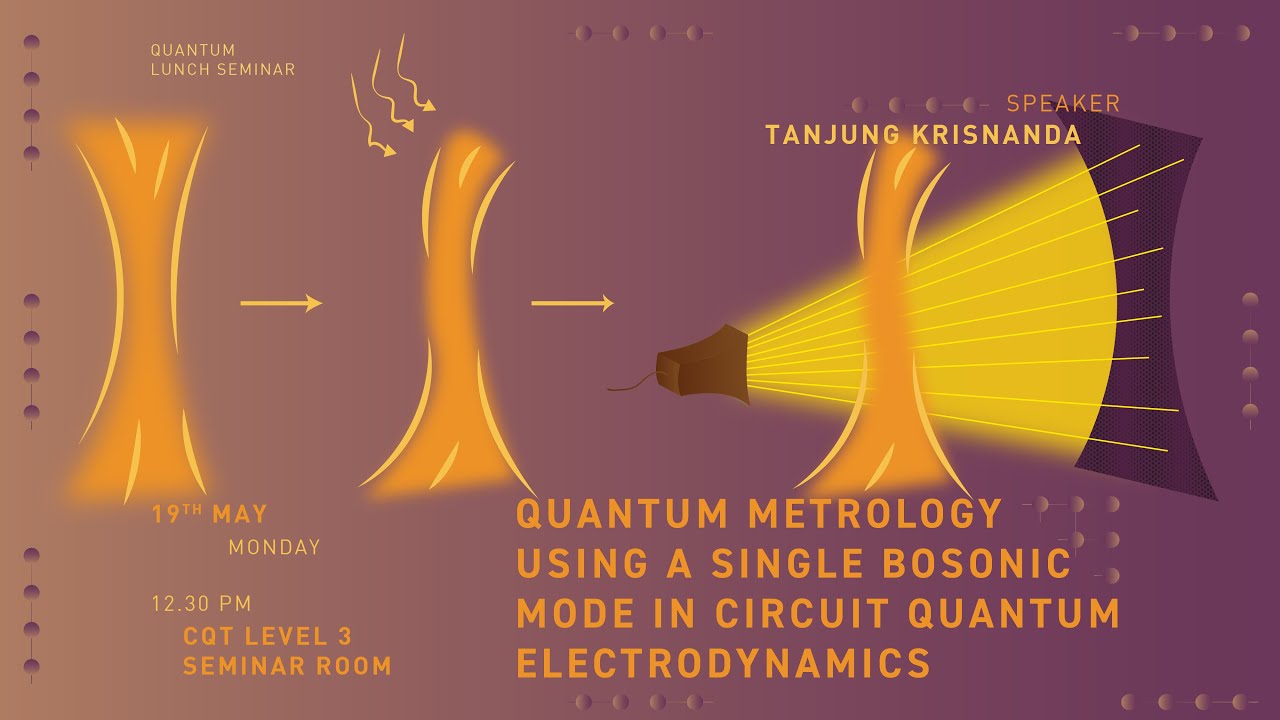
Quantum metrology using a single bosonic mode in circuit quantum electrodynamics
Keywords
Summary
132 words
Critical Evaluation
Value of the Information & Strength of the Argument
The talk provides significant value by presenting a novel, deterministic scheme for quantum metrology that achieves Heisenberg-like scaling without requiring complex multipartite entanglement. The argumentation is solid: the speaker systematically compares different resource states (Fock states, coherent states, squeezed vacuum) and justifies the choice of superposition of coherent states based on experimental performance. The experimental data are shown to agree with theoretical models, and the metrological gains are benchmarked against state-of-the-art results. The presentation is clear and well-structured, with a logical flow from theory to implementation to results.
Scientific Rigor, Source Quality, Title Accuracy
The scientific rigor is high: the work is published in PRX Quantum, a reputable journal, and the presentation includes detailed methodology and error analysis. The sources cited are primarily the speaker’s own work and relevant literature on quantum metrology. The title accurately reflects the content. No comments were provided, so no analysis of public reception is possible.
160 words
Title / Content Match
The title accurately reflects the content: the talk focuses on quantum metrology using a single bosonic mode in circuit QED, matching the abstract and presentation.
Quality & Reliability
8/10
The talk presents original experimental results from a peer-reviewed study (published in PRX Quantum), with detailed methodology, clear data, and comparison to theoretical limits. The speaker is a researcher at CQT, a reputable institution. The presentation is technical and rigorous, though some details are simplified for a seminar audience.
Key Moments
Markers derived by PSI from the transcript: the creator did not define chapters.
- Introduction and acknowledgments
- Outline of the talk
- Introduction to quantum metrology and limits
- Challenges and goals for the protocol
- General scheme for quantum metrology
- Hardware description: 3D cavity and transmon
- State preparation and measurement techniques
- Comparison of resource states and choice of superposition of coherent states
- Phase estimation results and Heisenberg scaling
- Amplitude estimation results and gain
- Further optimization by tailoring superposition weights
- Summary and outlook
Cited Sources
- PRX Quantum publication (mentioned in talk) — The speaker mentions the results are published in PRX Quantum, but no specific URL is provided in the video description.
Concurring Sources
- PRX Quantum publication (mentioned in talk) — The speaker mentions the results are published in PRX Quantum, but no specific URL is provided in the video description.
Contribution & Novelties
The talk presents a novel deterministic protocol for quantum-enhanced metrology using a single bosonic mode, achieving Heisenberg-like scaling without complex entangled states. The experimental demonstration on a cQED platform shows significant metrological gains, and the scheme’s versatility allows optimization of resource states for further enhancement.
Pour aller plus loin :
- Quantum metrology — Overview of quantum metrology and its limits.
- Heisenberg limit — Explanation of the Heisenberg limit.
- Circuit quantum electrodynamics — Background on cQED platforms.
- Coherent states — Mathematical description of coherent states.
- Quantum Fisher information — Concept of quantum Fisher information.
93 words
Radar Profile
The radar profile shows high scores in information quantity, quality, and technical level, with slightly lower but still strong reliability. This indicates a technically dense and reliable presentation, suitable for an expert audience.