QTML 2025: Variational quantum algorithms with exact geodesic transport
Keywords
Summary
169 words
Critical Evaluation
Value of the Information & Strength of the Argument
The talk presents a significant contribution to the field of variational quantum algorithms by addressing the training bottleneck. The key value lies in the analytical derivation of the metric for a specific ansatz, which makes Riemannian optimization practical without overhead. The argumentation is solid: the authors clearly explain the theoretical foundations, provide numerical evidence of speedup, and include preliminary hardware results. They also compare against established methods like Adam and quantum natural gradient, showing clear advantages. The presentation is well-structured, building from the motivation to the method and results.
Scientific Rigor, Source Quality, Title Accuracy
The talk is based on original research, with references to prior work such as Stokes’ quantum natural gradient and the amplitude encoding ansatz. The authors mention an arXiv paper and a Qiskit implementation, but no specific URLs are provided in the description. The title accurately reflects the content. The scientific rigor appears high: the method is mathematically grounded, and the numerical simulations are detailed. However, the hardware results are preliminary and not yet peer-reviewed, which slightly reduces the overall reliability.
184 words
Title / Content Match
The title accurately reflects the content, focusing on variational quantum algorithms and the novel exact geodesic transport method.
Quality & Reliability
8/10
The talk presents original research with a clear methodology, numerical simulations, and preliminary hardware results. The approach is based on established differential geometry and quantum information concepts. However, the work is not yet peer-reviewed (preprint) and the hardware results are preliminary, limiting the score.
Key Moments
Markers derived by PSI from the transcript: the creator did not define chapters.
- Introduction and motivation: accelerating VQA convergence
- Sneak peek at results: training curves for H5 molecule
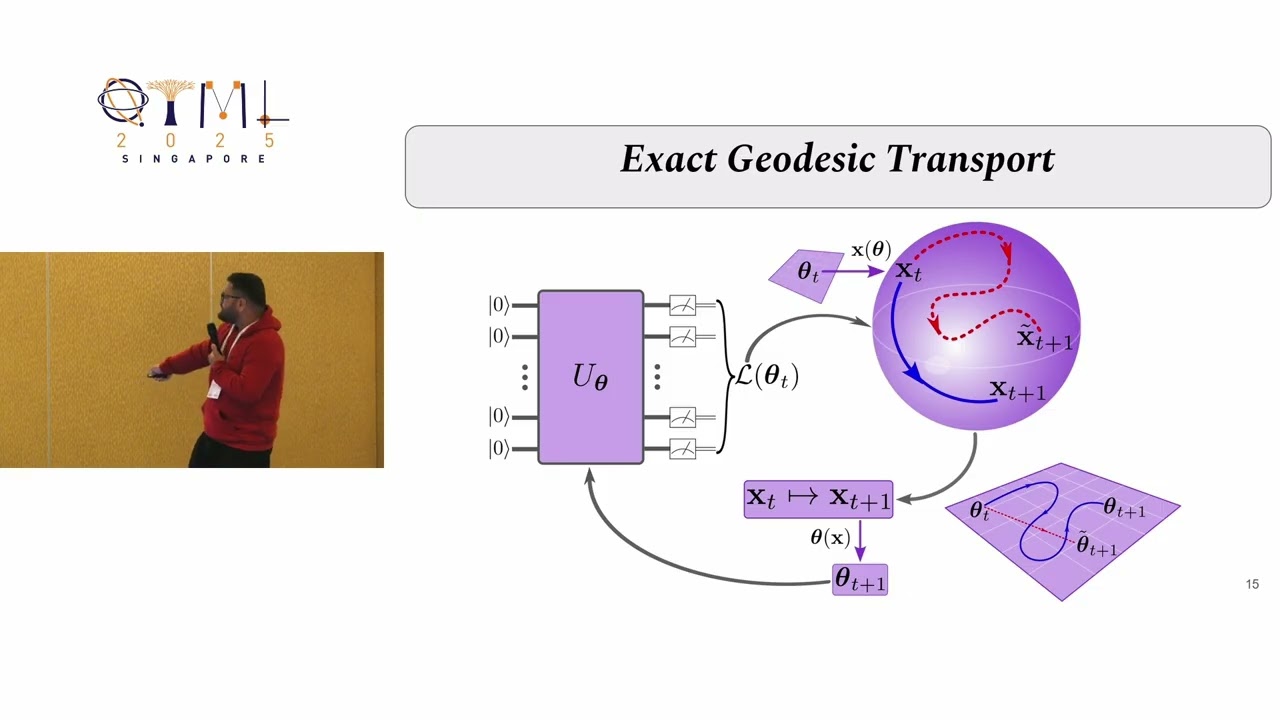
- Main idea: geometry-aware optimization and geodesics on the hypersphere
- Quantum natural gradient as first-order approximation of exponential map
- Analytical metric from amplitude encoding ansatz
- Exact geodesic transport (EGT) update rule and implementation
- Incorporating conjugate gradients (EGT-CG) and numerical results
- Hardware experiments on H2 and conclusions
Cited Sources
- arXiv paper (mentioned) — The authors mention an arXiv paper with a QR code, but no URL is provided in the description.
- Qiskit implementation (mentioned) — The authors mention a public implementation in Qiskit, but no URL is provided.
Concurring Sources
- Quantum natural gradient (Stokes et al., 2020) — The quantum natural gradient method is the first-order approximation of the exponential map, which this work extends.
- Amplitude encoding ansatz (presented at QTML 2024) — The ansatz used in this work was introduced in a previous presentation, but no URL is provided.
Contribution & Novelties
The main novelty is the introduction of exact geodesic transport for VQAs, enabled by an ansatz that yields an analytical metric. This allows for exact Riemannian optimization without the overhead of estimating the metric, leading to significant speedups in convergence. The method also incorporates conjugate gradients for further acceleration. The work bridges quantum machine learning, differential geometry, and optimal control theory.
Pour aller plus loin :
- Quantum natural gradient — The first-order approximation method that this work supersedes.
- Fubini-Study metric — The metric used on the quantum state manifold.
- Exponential map (Riemannian geometry) — The mathematical tool for walking along geodesics.
101 words
Radar Profile
The radar profile shows high scores in technical level and information quality, reflecting the advanced mathematical and quantum computing content. The reliability score is slightly lower due to the preliminary nature of the hardware results and lack of peer review. Overall, the profile indicates a technically rigorous presentation with strong potential impact.